
It's a strange time to be a campaign FPS sicko. What once felt like the dominant mode of big-budget game has felt somewhat neglected by the mainstream for a good while now, long overtaken by third-person spectacle and open world checklists. Call of Duty still gets annualised, but old mainstays like Bungie and Respawn have long-since rooted their shooter pedigree in the live service mines.
(That new Doom might be good, but so long as Xbox remains a BDS target, I'll never know.)
And yet, if you dig a little deeper, you'll find that the humble shooter is thriving. With games like Dusk asking basic questions like "what if we never stopped making Quake", we now have an entire divergent evolutionary tree of shooters like Ultrakill, Selaco, Cultic, End of Starchild - games for whom the dream of running down gnarly monsters in labyrinthine corridors with subwoofer-justifying shotguns never died.
As this new wave of more independently-driven shooters grew, however, they also calcified—and it's a calcification that's seeped into the indie development ecosystem itself. In dabbling with a friend on a little Godot project last year, I was met with countless documentation, videos and tutorials on what a good FPS should be. No moveset complete without a wallrun or a slide, implemented without care as to why you'd have those things or how you'd built a momentum system around them. The assumption is that an indie FPS should be around 75% Quake, 20% Titanfall 2, and lightly sprinkled with a dose of Half-Life. A recipe listing how to meet the markers of a good shooter, without understanding the heart inside a great one.
For me, the first Spawl was exactly that type of game. Developer Maeth's 2023 debut painted a wonderfully bleak cyberpunk wrapper around a totally serviceable shooter—a game that checked all the boxes of what a good throwback shooter should be, but never exceeded it. You could wallrun, you could slow down time, you could run down crowds of foes with SMGs akimbo, but never in ways that cohered into a satisfying mechanical whole. Sprawl wasn't exactly maligned on launch - reviews were broadly pretty up on it - but in an ocean of shooters that were starting to reach away from their Quake-like roots, it was a game without a strong sense of self. There was something there, something waiting to be unearthed, but I never got the feeling that this was a game that knew what it was.
Sprawl Zero, though? That's a game that knows exactly what it is.
Sprawl Zero is a gun pointed directly at the head of people who haven't shut up about Half-Life 2 in over 20 years. It is a game less concerned with meeting some nostalgic memory of Quake or Doom than it is in capturing a thoroughly 2000s moment where the big shooters were finding novelty outside of the labyrinth. It's the era of the gravity gun, of Red Faction GeoMod and Halo: Combat Evolved's chaotic physics sandbox. Titanfall might have irreparably poisoned the well of all shooters that came after, but Zero is less interested in wallrunning than it is the more esoteric novelty of the vortex shield and deeply expressive movement fundamentals.
The gut response Sprawl Zero leaves you with is that you can simply rule of cool your way through a game's design. But on paper, so did its predecessor, with its grab bag of slow-mo and finishers and movement tools taken from the Good Shooter Handbook. So why does Zero feel different?
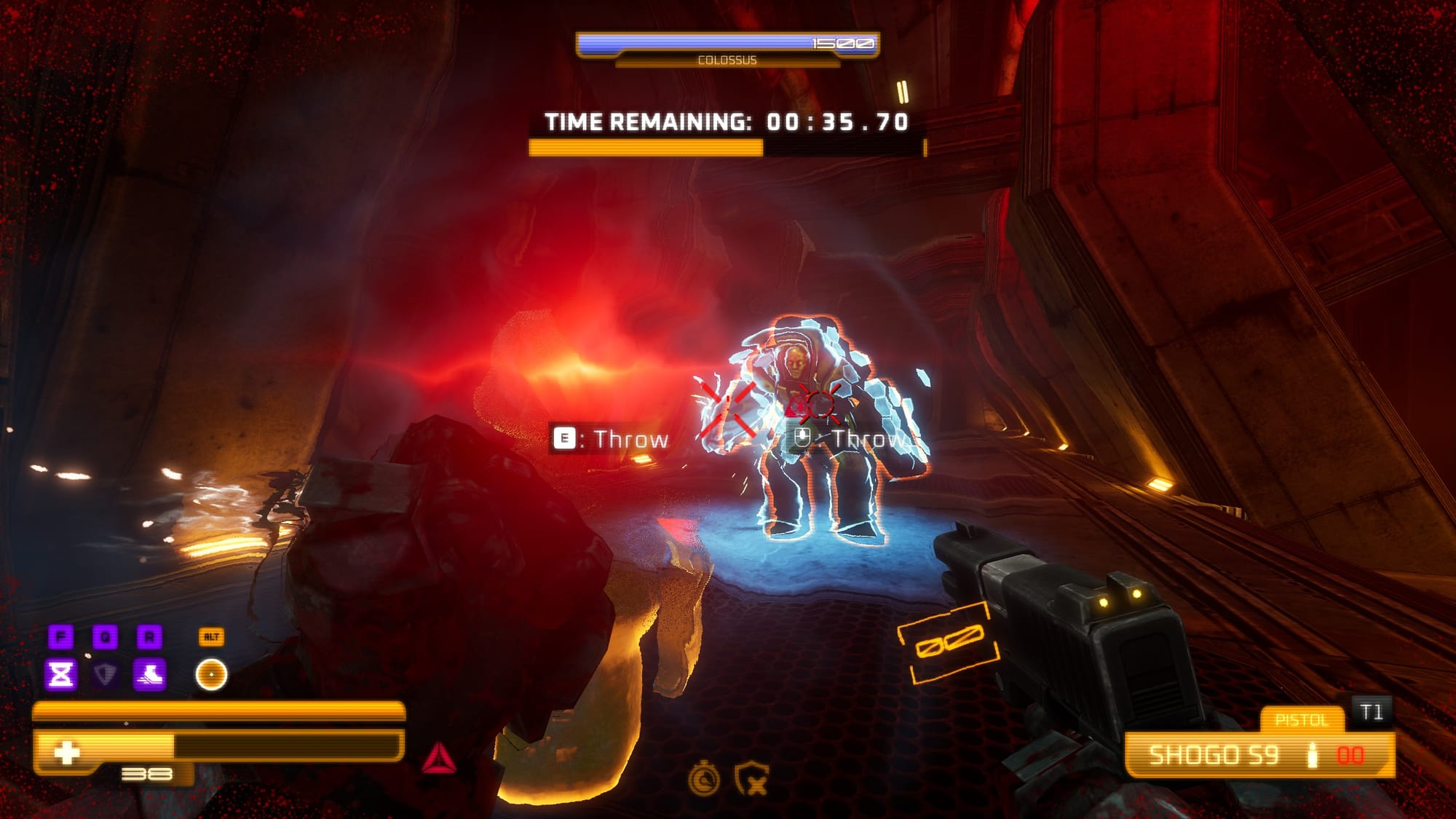
In Zero you play as Five—and above anything else, Five is a tank. Five is a Space Marine without the Games Workshop branding, an apt feeling given that a fair bit of 40K DNA has seeped into this universe's own-brand Neotokyo this time around. Every mechanic in Zero is a buttress reinforcing how much bigger and badder you are than everything else on the field. Your basic unarmed punch is an explosion that evaporates the poor sucker on the other end and stuns everyone around them. Your primary means of navigation involves tearing open concrete walls and shunting train cars with gravity fists. Every verb you gain over the course of play only enhances your immensity, from grabbing bullets from the air to a charge that pulps anyone you run into.
At the center of this lies the gun toss. Five's power doesn't come from his arsenal, but from himself. Every weapon is yoinked from a cultist's corpse with a flick of your gravity fingers and, importantly, discarded as soon as the clip is empty - ideally thrown at some schmuck's head. In practice, you're juggling entire battlefields in your hands every skirmish, never holding onto a gun for more than a few seconds before it gets traded out in a gore-soaked refund program.
It's a genius way of handling the age-old FPS problem of getting players to use the entire weapon sandbox. To give you the desperation of having to solve a long-ranged problem with a short-ranged gun or force you into David and Goliath confrontations multiple times a fight. The squishiest guys will usually have the flimsiest arms, but that means a plentiful source of ammo to spend grinding down the minigun-wielding colossus charging up the flank.
A fight is a constant process of surveying the arms on the field and figuring out who you can take a shot at, what you'll gain by doing so, and where to cash in those chance few shots if you do luck into a rocket launcher. And because everyone you face on the field has to also be a walking gun rack, Zero's arsenal can be gratuitous and overpowered without ever feeling unfair. There is no feeling greater than using a rusted pistol to clutch out against a 10ft woman rushing you with an electrified katana, then turning the table on her friends in a hazy decapitation spree.
Signing up is free!
By signing up—again, it costs nothing!—you can read the rest of "Smash, Move, Shoot: Sprawl Zero's Perfect Simplicity," and receive free newsletters and emailed articles from Remap!
Sign up now Already have an account? Sign in