Wadjet Eye Games is best known for making and publishing point-and-click adventure games, like the excellent Excavation of Hob’s Barrow (2022). Nighthawks is an interesting swing for them in that it’s not really an adventure game at all but rather an entry in an emerging genre I tend to call “literary RPGs”: Games like Roadwarden, Lovely Lady RPG, Citizen Sleeper, and Thousand Hells; games which combine the purely story-driven PC role-playing game (in the vein of Disco Elysium) with a more abstracted presentation closer to a visual novel.
Failbetter Games’ Fallen London, and Sunless Skies are also touchstones here; Nighthawks designer and writer Richard Cobbett is of course a veteran of those games, and both this game’s design and presentation are very Sunless Skies-esque.
It’s a very good format for a game about playing as a vampire, specifically. Vampires often figure in video games as fantasy monsters, but rarely do we see a game that really tries to explore the central themes of modern vampire fiction, in which the vampire is a protagonist and a social predator heavily laden with metaphor.
Vampire: the Masquerade, one of the most successful tabletop RPGs of all time, codified a lot of these ideas. That game is generally best played with a table of 4-5 viziers missing an emperor, in which play is directed by ambition and scheming rather than by missions from on high or mere incident. Vampirism, in the V:tM mold, is a sort of undead pyramid scheme: Vampires turn new vampires to help them further their centuries-long agendas; those vampires eventually develop their own agendas, thus continuing the cycle.
The modern vampire is a very self-directed creature. They treat the city as a hunting ground and a chessboard. It’s often a poor fit for most video game genres, which tend to require constrained action, clearly delineated goals, and a limited social milieu. Vampire: the Masquerade: Bloodlines tried to capture that through the lens of an immersive sim with an open world, and that game is beloved for its ambitions, even if it is also seriously flawed.
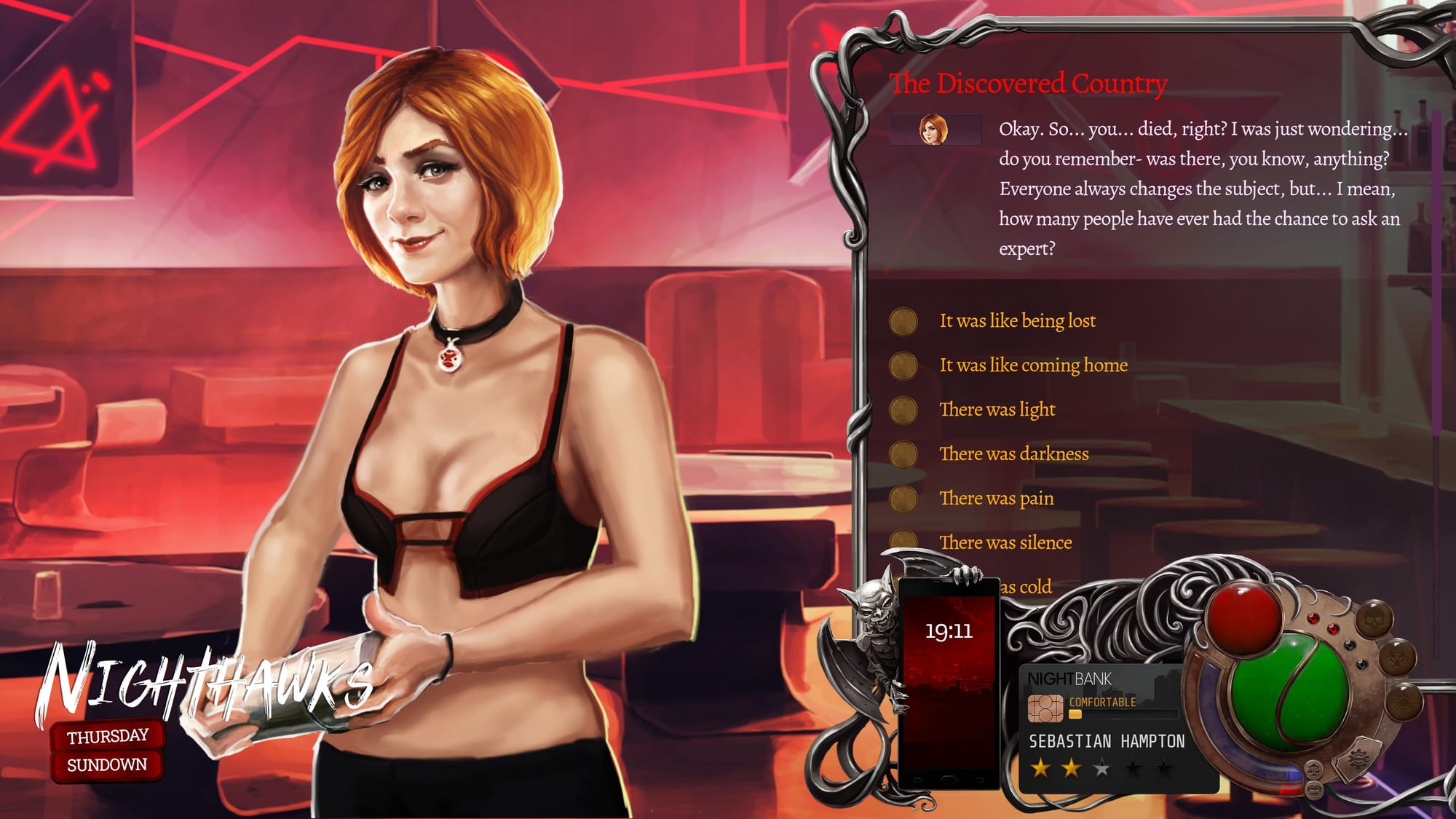
Nighthawks is told entirely through voice acting, written text, and illustration; it has the same liberty that a visual novel would have to depict a wide range of situations and present a very expansive world. It uses this flexibility to set the player loose on a nocturnal city full of places to visit and characters to get to know, with a handful of loose agendas to pursue and a slowly ticking clock.
This is a structure that can risk feeling saggy, and at times it does. Nighthawks' pacing sometimes made me wish there was more material there, more things to do or see, more of a sense of time pressure to do everything I wanted to do. It’s a big game, with a large number of stories that feel substantial, but the game’s calendar can feel a little sparse and hard to interpret for cues about what I needed to do or accomplish. I sometimes found myself just wandering the city, not really able to advance the storyline I was pursuing, only to find that going back home and sleeping until the next day would cause it to move forward. However, the material itself is often excellent.
Vampires can be revolting or alluring; they can be monstrous or tragic; vampirism can be read as a metaphor for disease, for sex, for capitalism, for queerness, for family, for abuse. Nighthawks, like much of the best vampire fiction, doesn’t pick one lane here but rather is willing to do all of them. This is a game that will remind you that a character wears perfume to mask the scent of decay, moments before a sex scene illustrated with a depiction of her wearing nothing but a pair of playing cards. It enacts its metaphors without being caged by them.
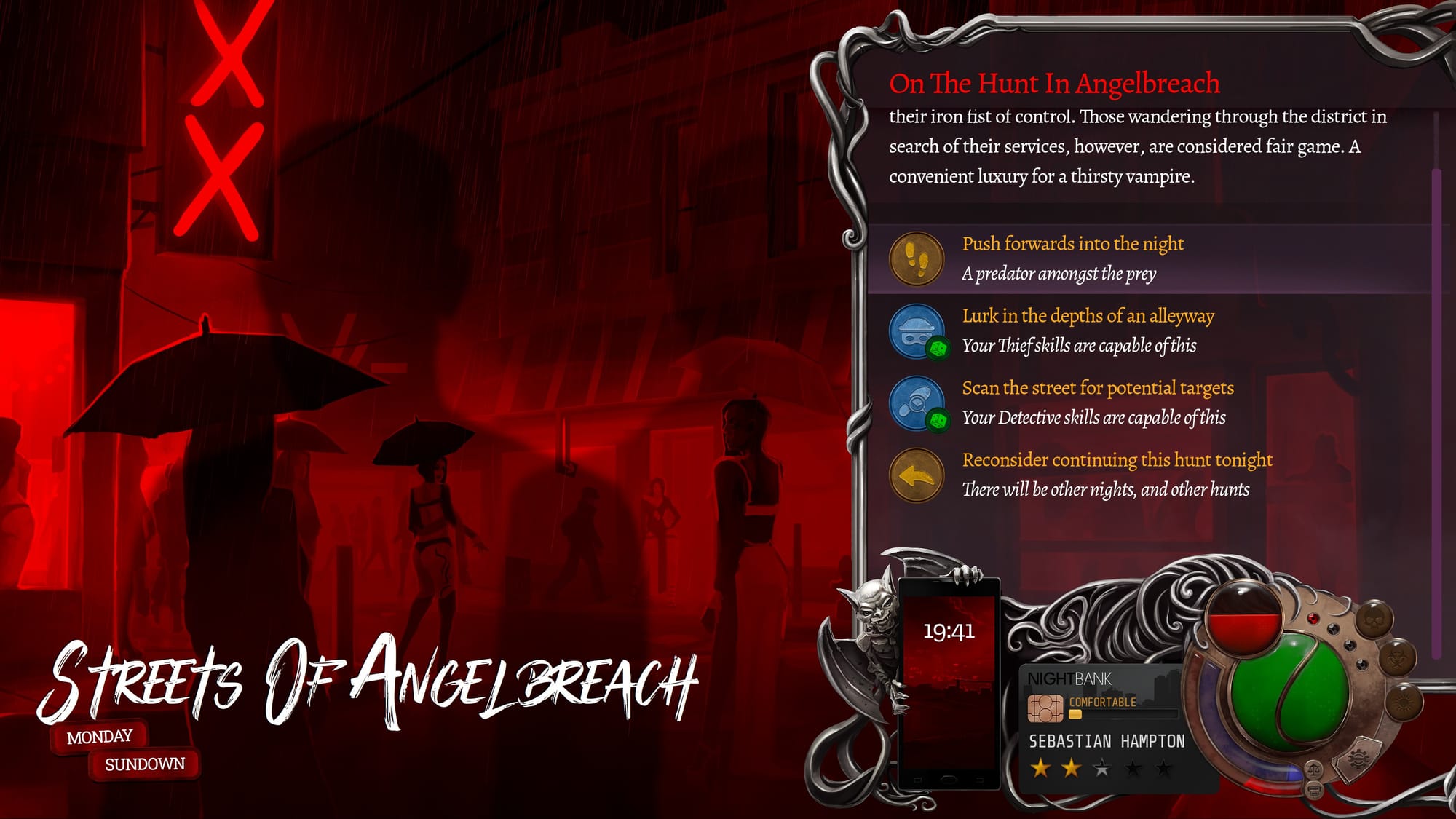
The nocturnal world of Nighthawks is a dark blend of Gothic, noir, and cyberpunk aesthetics. It’s a world where cigar-chomping mob bosses and trenchcoat-clad detectives rub shoulders with characters dressed for a bondage party or a board meeting at the Tyrell corporation. The V:tM influence is once again very clear here.
But what really peels this off from V:tM and makes it a distinct setting is the central idea that this world’s version of the Masquerade—the veil of secrecy keeping humanity ignorant of the vampires among them—fell about ten years ago. The existence of vampires is now public knowledge, but it sits somewhere outside public acceptance.
Mobs of “human supremacists” in white masks roam the streets, explicitly calling humans who help vampires “race traitors.” The old ancients entombed in their castles and skyscrapers have wealth and power to protect them from the fear and hatred of mortals; your average down-on-their-luck neonate is more screwed than ever, no longer kept safe by the notion that vampires are just a myth.
Again, we have those metaphors running around. I can’t not think of what the last few years have been like: Living through a time of historically unprecedented queer visibility but also a rising tide of anti-queer violence; violence which is being stoked as part of a broader reactionary project financed by right-wing tech billionaires like Peter Thiel—himself a gay man.
And yet, those metaphors are fraught and slippery, which is what makes them more interesting than rote allegories. Vampires, after all, really are monsters with a thirst for human blood. And though it is possible for them to deny the parasitic and exploitative component of their nature, most… don’t. The game tracks whether you played through it without ever consuming someone’s blood non-consensually, a state that you can and probably will break within minutes of starting the story. Predation is both a game system and a recurring theme.
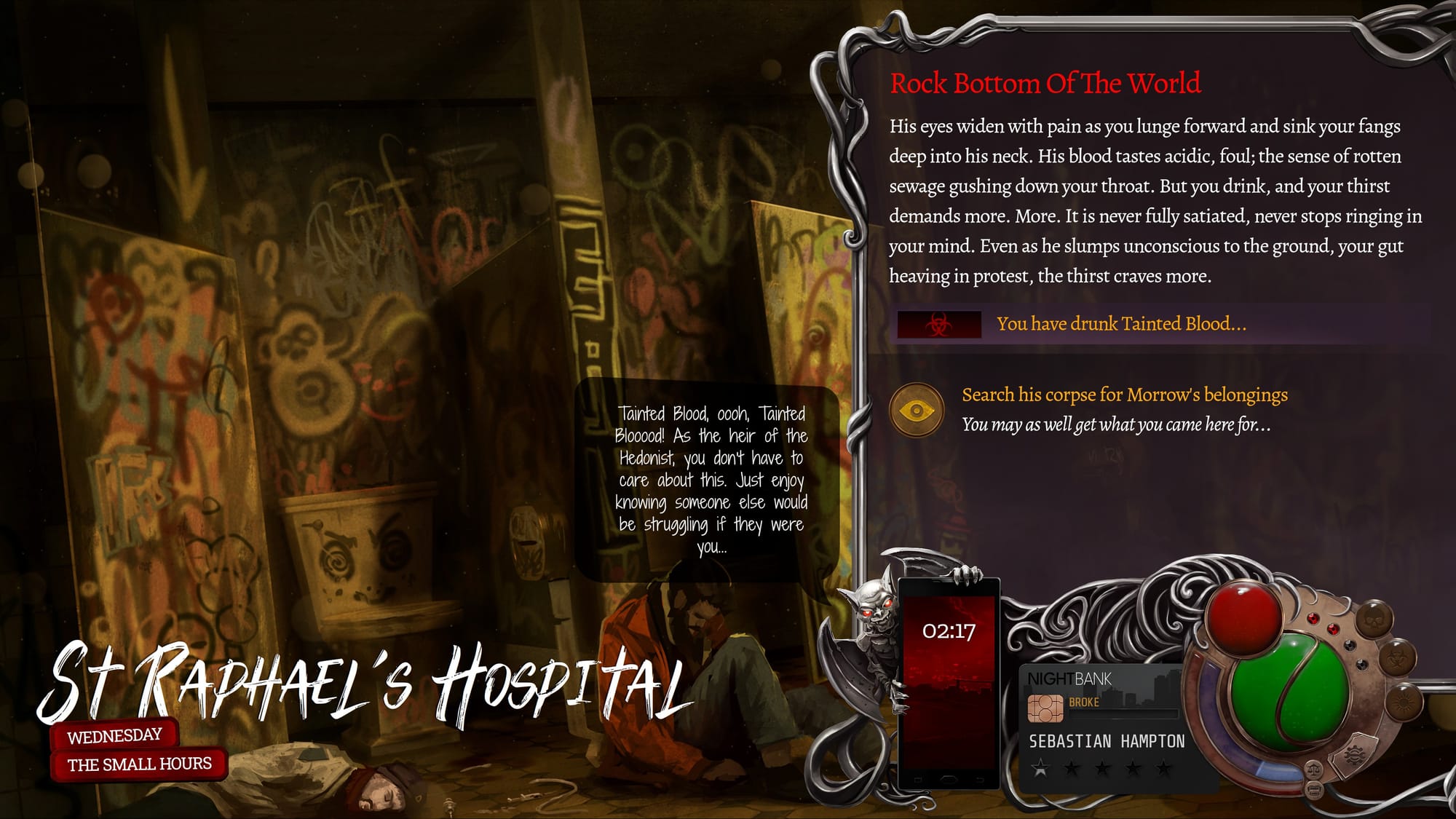
You can feed opportunistically, or you can deliberately prowl the streets for victims, or you can try to stick to the unsatisfying bottled blood poured for you by a bartender—but you have to feed; even if you’re not sinking your teeth into someone in a dark alley, there’s no guarantee that whoever’s blood is in that bottle wasn’t desperate, or coerced, or dead. More metaphors: Can there be ethical consumption under vampire capitalism?
This game features a system where drinking “tainted” blood can do… something. I have no idea what; as one of my starting vampire powers, I picked immunity to it—appropriately granted by choosing that your character’s sire was the archetypal Hedonist. This being the case, the game will not even tutorialize the mechanic; the tooltip for it just explicitly tells you that you can ignore it.
The end result, of course, is that many situations of apparent desperation—where the game presents a chance to feed that’s obviously dodgy, and likely to poison you—are just an entirely free meal, assuming you don’t mind draining some poor unfortunate just because it was convenient. This is both incredibly funny and incredibly thematic, and it speaks to Nighthawks’ willingness to give its vampires a wide array of perspectives on their condition. Every character is reacting to their curse, and to this brave new world of vampires being out in the open, in their own way. Immortality makes them catastrophically bored, or catastrophically reckless, or catastrophically weird.
Layered, charming, interesting characters really carry a lot of this game; and though many of them are playing with well-worn vampire tropes, they never feel trapped by them. Take for example Agatha, who’s here playing the archetype of the immortal monster in a child’s body. Nighthawks’ version of this idea is a vicious, thieving, rude Victorian urchin straight out of a Fallen London story, complete with an army of mesmerized rats; less a take on Anne Rice’s Claudia and more like a deathless Cunoesse.
Agatha is often tremendously funny. As one of several companion NPCs who can tag along on your adventures, you have the opportunity to bring her with you to entirely inappropriate places and watch how this night-time world of strip clubs and leather bars reacts to a jacknife-flicking twelve-year-old. How much the companions factor into the game’s stories feels relatively uneven; the story will sometimes contrive to have them stay behind, sometimes involve them heavily in a sequence. But I was never not happy to have them, and they all deliver something unique.
Being an RPG, Nighthawks is more like an anthology of short stories than a completely unified narrative, and those stories have an impressive tonal range. Some of the material here is very dark; some of it is very funny. Most of it has interestingly thorny choices or thoughtful reactivity about the player character. All of it is well written, though I sometimes felt a little structural wobble in the narrative design—slight bugs like beats arriving out of order, or an individual moment overstaying its welcome, or a point of confusion about what a choice would do.
It’s hard to fault a game that is so expansive and where the story is so high-quality for these occasional moments, though, and I can’t say they really hurt my enjoyment; take these as sharpened professional observations more so than a real impression of what this game is like to play. Because for me the experience of it is an incredibly moreish narrative game. In what we might call method game reviewing, I did end up playing this through the night until the sun came up; there’s a sense of gentle momentum here that had me going “one more night” in roughly the same cadence as saying “one more turn” four hours into a Civilization bender.
This is not a game with a dozen plots layering over each other or an intricate living world, but it is a game where every night feels laden with little surprises couched in a routine. You walk into the bar at the titular Nighthawks, a night club where vampires congregate. Different characters might be lounging there; you might invite one of them to tag along with you, pick their brains about your current goals, catch two of them in a conversation with each other. The bartender will have a different rumor to share as she pours you a glass of blood.
At its best, Nighthawks captures exactly that sense of scheming, planning, and autonomy that I associate with vampire role-playing in tabletop games. A vampire’s existence is constant hustling; places to go, things to do, people to drink.
This routine is broken up by chance encounters as you wander the streets, and by substantial story sequences that are often the culmination of a quest. This is also where we can separate this game and others like it from something like Disco Elysium; the simpler presentation creates a liberty for extended shifts in format. Some of the quests here feel like horror short stories, with the player character sometimes cast as a would-be victim, sometimes as an investigator puzzling events together after the fact—sometimes, perhaps, as the monster. One memorable quest has the player reliving the sad, horrific history of a family under a vampire’s influence—presented with an illustration of a dollhouse reproduction of their suburban home, the individual rooms lighting up as the story advances.
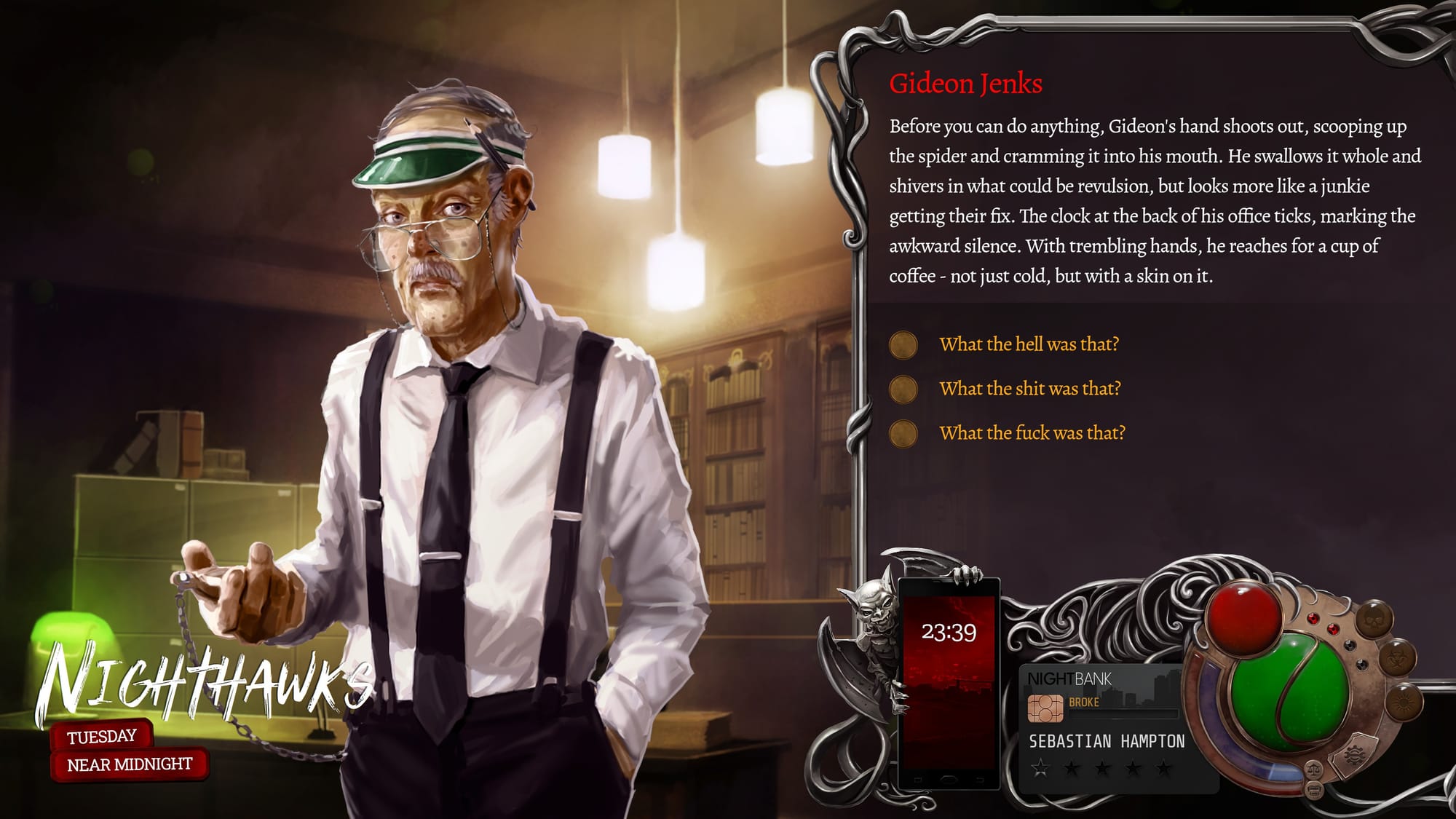
More than a single piece of vampire fiction, Nighthawks is large enough to feel like a collection of studies or lenses through which to look at vampire fiction. It is, above all, the product of someone thinking really rather a lot about vampires. And it is easy to love if you love vampires, themselves, for the metaphors that they serve as and the characters that they can be. This is a role-playing game in the very true sense of asking you to play a character, of inviting the player to explore a sense of a person (well, not a person) that they are inhabiting for the evening.
I think of watching a fellow vampire walking in with a bag of maggots for his Renfield, a demeaning gift not wholly devoid of affection. Of being taught that a vampire’s arm is no stronger in death than it was in life—but you can punch harder if you’re willing to break your wrist every time. Of the executive-class vampire offering me a drink from a dazed blood boy with scars on his neck, prompting me to think primarily about the optics of partaking or not. Of the moment when I found the line that my amoral, blood-sucking monster wasn’t quite willing to cross.
Vampire fiction is about allure and revulsion being friends and neighbors; corpse-stench and perfume. It’s a fruitful genre because it gives rise to characters who can’t help but be conflicted. It almost (almost) takes the choice to write a boring character away; the irony of a genre about monsters is how it facilitates writing characters that are profoundly human. Nighthawks’ vampires are, like people, both fascinating and disgusting. Like people, they are monstrous both in their natures and in their choices; and like people, they invite affection all the same.