
When Microprose greenlit Sid Meier's Pirates! in 1986, the company—which Meier founded along with Bill Stealey back in 1982—was mostly known for vehicle sims (Gunship, Spitfire Ace, F-15 Strike Eagle) and dry strategic wargames like Crusade in Europe.
Pirates was something different. It's hard to pin it down to a genre even today, but it certainly wasn't like previous Meier titles—even though it's the first game to be called Sid Meier's Something or Other. At the time the game came out in 1987, it was generally called an "action adventure" game; this is somewhat hard to square with the way most people today would understand the genre. It has basically nothing in common with contemporaries like Castlevania, Metroid, or The Legend of Zelda.
There's no platforming of any kind; controlling the player character directly and individually is restricted to brief sword-fighting sequences. Those have controls and mechanics that are totally unlike any other game combat I've seen. It tries to create the feeling of an Errol Flynn fencing duel with an elaborate control scheme that's more like a mutant version of a fighting game; you can thrust (which is fast) or slash (which does more damage), or parry; you can also either aim low, or high, or down the middle.
Those motions are mapped to the eight-direction joystick commonly used for games on the Commodore 64 and other eighties computers—or, if you don't have one of those, they're mapped to the keyboard numpad. Some ports of the game let you do it with the mouse, or with awkward combinations of mouse clicks and keyboard input.
This description makes the swordfighting in Pirates sound terrible and indeed it is hard to defend; the 2004 remake substantially simplified it, but that simplification only peels away its skin to reveal a strange quasi-rhythm game buried underneath. It still feels in no way like a concession to "standard" combat design.
But what you have to understand about playing this game—whether the original 1987 version, the many 1988 ports, the beautiful 1993 remaster Pirates! Gold with its 256-color graphics, or the modernized 2004 remake—is that if you encounter it at an early age it will open a rift in your brain. When I asked Nic Tringali (designer of The Banished Vault and Amberspire) about it, they put it perfectly: "Pirates! feels unstuck in genre, not quite an open-world game or a role-playing game, not only economic strategy or resource management. It has a goal for a clear thematic position for the player to inhabit and uses the systems and friction to reach that. The peculiarities of its design are unique and inseparable—the wind always blowing east comes to mind, and dueling a rival captain immediately winning a sea battle—and are not solely driven by video game genre expectations, or pre-packaged ideas redressed in a pirate theme."
Meier was working in an era where genre and mechanics were still unsettled, undefined things. In his 2020 memoir—would you believe it's called Sid Meier's Memoir!—Meier pointed out that "The good news was there were very few preconceived notions back then about what a game was supposed to be. The bad news was there were no tried-and-true conventions, either." All of Pirates is like this; a bunch of first-principles attempts at extricating game mechanics from all the half-remembered pirate tropes rattling inside Meier's brain.
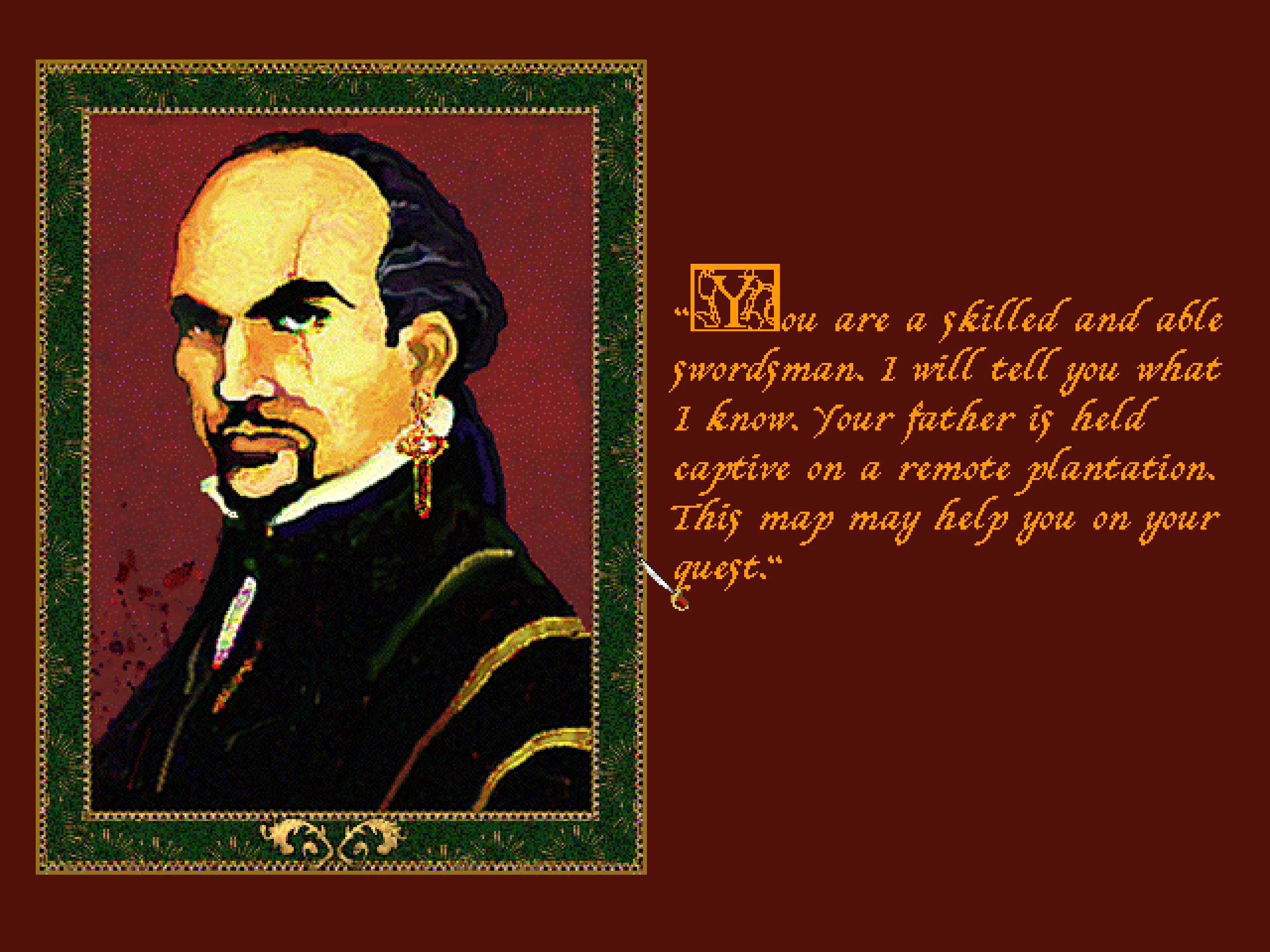
The resulting game takes all these romanticized ideas pointing towards a genre—Treasure Island, Errol Flynn movies, Peter Pan, the centuries-old distillation of the Black Legend into anglophone culture—and treats them not as story beats to play out or as window dressing, but as the grounding rules of a clockwork world that you can poke and prod at. The game models the way silver travels on mule trains all the way from Potosí to be loaded up on ships in Panama, and from there along the ports of Gran Colombia until the Treasure Fleet, heavy with the blood of the Americas, leaves for Spain. The game models the way that a pirate's harsh life wears you down over time, each merchant ship captain or colonial guard that you fight seeming that little bit faster until you have to admit that your sword arm just isn't what it used to be. The game seeds the Caribbean with an elaborate, randomized quest to find your long-lost family, chasing down a laundry list of villainous aristocrats to rescue relative after relative from indentured servitude on obscure plantations.
To modern design sensibilities, I think there's a risk one might look at Pirates and see a bunch of minigames in a trenchcoat. In reality, what that game is expressing is a way of thinking about games that we've tamped down over the years as the medium has built up its own library of conventions, tropes, and recycled ideas.
Pirates is hewn from its underlying themes in a very raw way, but so are many other games of this era. Cinemaware, a now largely forgotten studio, made a whole very successful business out of this style of design. Their 1989 title, It Came from the Desert, gleefully jumps around in presentation and perspective—one moment a rudimentary first-person shooting gallery, the next a top-down shmup, all wrapped up in a visual novel wearing the skin of a strategy game. The original Dune video game—not Dune II, the origin point of real-time strategy as we know it—was essentially an attempt at capturing the whole scope of the 1984 David Lynch movie, oscillating between a strategy game about spice extraction and a visual novel-like adaptation of the movie's plot.
Pirates was immensely successful in its own time, and this exact style of design thinking was then adapted to Microprose's follow-ups—classics like Covert Action and Sword of the Samurai. Pirates essentially changed the studio's whole identity, something that was incredibly hard to do even in those days.
And yet, this entire era of video games feels like a hole that has been carved out of the collective memory of the medium. It is, in truth, a reflection of how niche the computer game market really was in those days; for every Amiga 500 sold, Nintendo sold 23 NESs and 45 Game Boys. The era of IBM PC consolidation and true mass adoption of PC gaming was a few years away in the late 1980s; and by the time the remade DOS version of Pirates arrived in 1993, it was competing with platform-defining games like Wolfenstein 3D. This 1982-1990 era of PC gaming is, really, better known through dubious CDs packed in with magazines, discount-bin collections put out by failing publishers, and abandonware sites.
But among that whole crop of games, Pirates has the most enduring influence. Maybe because it's nearly the first of its kind. You could also point at Cinemaware's groundbreaking Defender of the Crown, which came out in 1986, but those games were always bound up in the Amiga platform, a niche within a niche. Maybe it's because of Pirates' later re-releases, which kept reintroducing it to new audiences; I first played the Windows port of the 1993 remaster on CD-ROM, several years after that had come out. Maybe because the pirate genre never really settled into video games as a genre in the same way that other adventure-story milieus have.
Pirates features swashbuckling duels, land and naval battles, romance and adventure, politics and economics. It can't really be reduced to pure action in the way that video games distilled war movies and fantasy role-playing games, and its design allows an unusual amount of player freedom, both for the time and relative to today’s games.

Soren Johnson, the design director of Old World and a lead designer on Firaxis’ own Civilization IV, highlighted this: “It's hard to explain how far ahead the design was without having the context of contemporary games, but Pirates! was fundamentally not on rails—you were only a pirate depending on the actual actions you took. Obviously, the game is an important milestone for open-world gaming, but it's important to note that Sid made sure the player only experienced the fun parts. For example, visiting a port meant quickly navigating some menus, not tediously walking from building to building.”
The minimal mechanics and mostly-text presentation of the 1987 game gave players just enough to latch on to that it felt more atmospheric than like a dry simulation. The 1993 version, in particular, is almost like a playable storybook—with its spare UI that doesn’t stick to a particular layout and the painterly illustrations it uses in places where the original game could only fit text. But rather than being limited by its presentation, Pirates is expansive; the game contains so much because each of its components can be, individually, so simple.
The naval battles in Assassin's Creed IV: Black Flag, and then again in games like Skull and Bones and Sea of Thieves, took what was the best mechanic in Pirates as a clear template: the jockeying for position; the anticipation as your crew reloads the guns; the crackle of cannon. But Black Flag has no model of the Caribbean trade winds pushing you into sailing in big counter-clockwise circles around the map. It doesn't model Edward Kenway's slowing reflexes as he ages. It doesn't let you meddle in colonial politics, changing the allegiance of sacked towns just to give yourself safer ports to resupply in.

It seems ridiculous to even consider those things being put into an Assassin's Creed title. Those games, not necessarily to their detriment, are caught up in a level of presentation that can't coexist with the way that every figure in Pirates 1987 is an archetype; every colonial governor, every barmaid, every shady traveller selling a treasure map wears the same face as every other one, though they may tell you different things based on random chance and your own behavior. What the manicured worlds of modern AAA games lost us is the world of malleable possibility that could exist when game pieces were allowed to be, well, game pieces.
This open-ended nature is what really made the game an adventure, if not at all an adventure game. Tyler Sigman (Darkest Dungeon I and II) recalled to me: "You remember the times you took big risks, whether you succeeded or failed. The time you took a War Galleon with your Sloop. The time you found the Treasure Fleet. Remembering big moments from a game you played is a huge sign of that game being special in some way."
If Pirates holds something of a quiet place in broader gaming culture, it's disproportionately celebrated by game designers. Last year, Polaris (an organization that runs a small yearly design conference) put out a survey asking game designers to list the games that were most influential on them. 161 people responded; Pirates wasn't in the top 10, but it came out ahead of much-beloved franchises like Mass Effect, Metal Gear, Pokémon, and Quake.
The result is—as Polaris organizer Tanya X. Short made sure to remind me when I asked her about it—somewhat skewed by the type of systems-and-simulations thinker in the organization's network. But it also speaks to how Pirates, to this day, retains this enduring influence. Many people have taken inspiration from it, including myself, and launched games that trace some design lineage to Pirates. But nobody has successfully released a Pirates-alike that really tries to capture the full thematic scope of the original game.

Meier himself explicitly went into Pirates not wanting to simply make another vehicle sim: "It wasn't enough to paint a seventeenth-century veneer over an otherwise straightforward boat simulator," he wrote in 2020. "When I thought of pirates, I didn't think of arduous ship maneuvers. I thought of sword fights, and swinging from ropes, and billowy white shirts with little string ties at the neckline for no reason."
It is a bit ironic that the games most clearly trying to carry the torch for Pirates—games like Tasharen's Windward, which got a sequel just last year—really are vehicle sims. Windward isn't a bad game, but it just isn't about, say, marrying a merchant's daughter so that she'll keep feeding you information about where Spain's treasure fleet is anchored.
And on a certain level I get it; the naval battles are, again, the best part of Pirates, in isolation. They are great fun—especially in the 2004 version, which gives the ships a "handling model" that feels a bit like doing donuts in a parking lot with your dad's car. But in Pirates, those battles are just one cog in the whole machinery of the game. Like its compatriot X-COM, Pirates has that beautiful telescoping effect, where the different layers of the simulation rub up against each other in interesting ways.
There are two ways to claim a prize at sea: You can either harass an opposing ship with cannon fire until they surrender, or you can crash into them, board them, and take the ship by force. Sinking your target before you can plunder them is a failure mode; as is letting them escape; as is outright losing the battle, whether by sinking yourself, or through boarding action. This complicated landscape of risk and reward connects the moment to moment choices—furling and unfurling sails, tacking this way and that, choosing when to give the order to fire—to the broader ebbs and flows of the game.

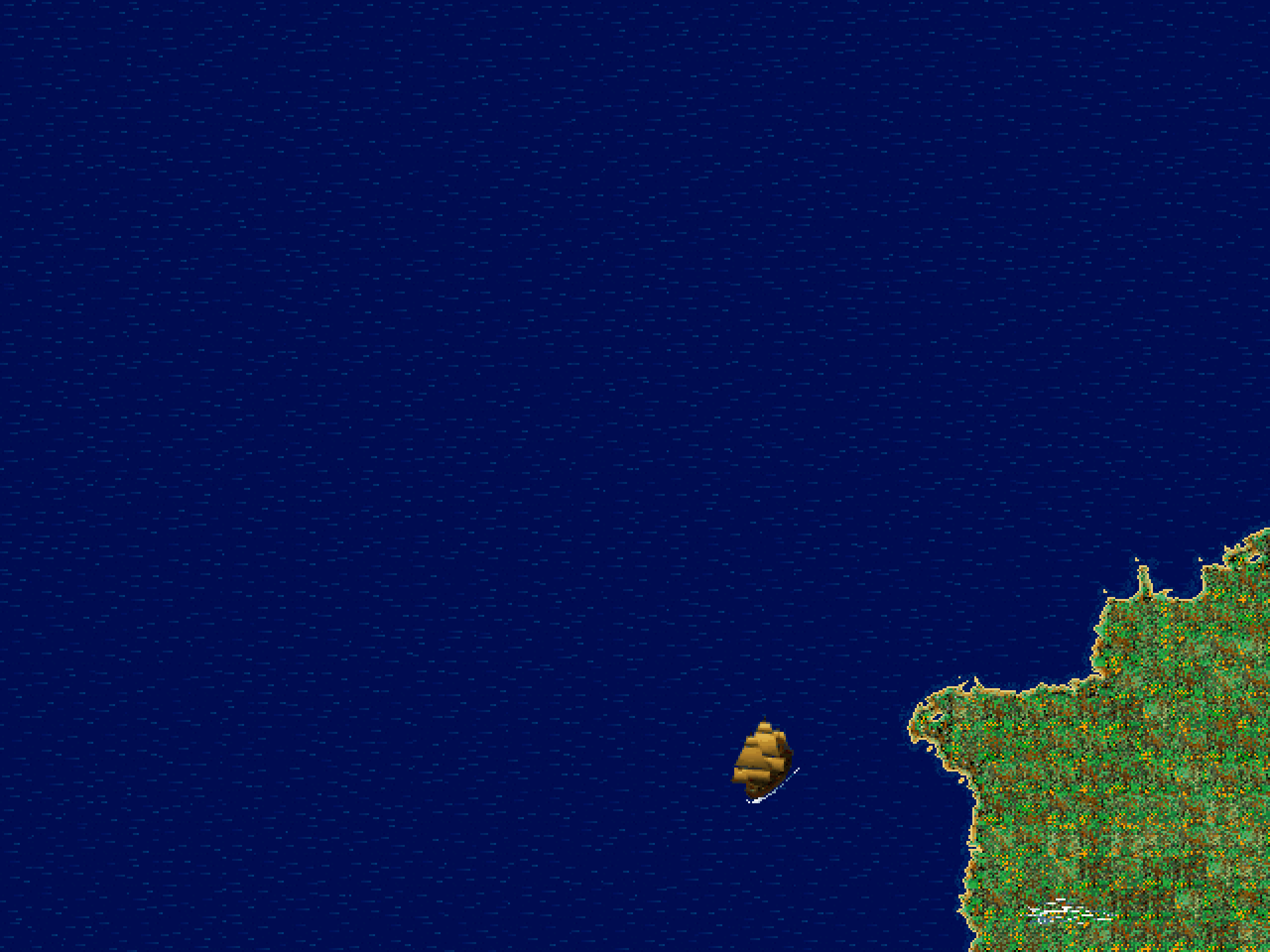
When you're a young captain, you can just cruise around in your sloop looking to ram Spanish galleons and beat their captains with your sword arm. But ten, fifteen, twenty years into the harsh life of a seafaring criminal? Your reflexes will have slowed down, and you won't be able to afford so many new war wounds. By then hopefully you will be more prepared to be patient; bringing your ship about at your victim's stern; firing grapeshot into their deck until they strike their colors. And of course, the tactical then backfeeds into the strategic: An English frigate is dangerous, carries little gold, and there's not much reward in antagonizing the English. But if you had a frigate, well, those Spanish galleons would be looking like easy pickings, wouldn't they? So maybe it's worth taking that risk now...
To pluck just the naval battles out of Pirates is to miss their point entirely. As a whole work, Pirates stands in for a whole quasi-genre in early computer games that, eventually, fell out of commercial viability without finding the same latter-day hobbyist pipeline that interactive fiction did. Those games—Defender of the Crown, Dune, Covert Action, Star Control II and many others—never really got packed together into a self-conscious genre, because in many ways they aren't one; they're more like one of those movements that's only visible in hindsight, to people writing the histories of a medium after the fact.
And what was lost there was a whole mode of thinking about game design that it seems like we can't access any more. It's not the formalist thinking that gets taught in college classes; it's not the market-fit approach that publishers want to see in pitch meetings; it's not what anyone at Ubisoft or Xbox—if there are still people at Xbox by the time this feature is published—thinks about.
It is design as this pure exercise in translating a thematic impulse into mechanics, and using those mechanics as the structural members of an edifice that then enacts those themes. In these games, it's almost like the habitual conceptual tools of game design—themes, pillars, mechanics, systems, affordances—have been shuffled around in how they relate to one another, in the roles they occupy.
It has never been easier to make video games; but it feels like it has never been harder to get one funded. Pirates, in my mind, lives on as this distant beacon, this glow in the fog. We can see it, just barely. We can't go there. We lost the charts, and no one will underwrite the voyage.

On Playing Pirates! in 2026
If you’d like to experience Pirates for yourself, both GOG and Steam have the 1993 and 2004 versions available; the GOG version of the 1993 game (called Pirates! Gold Plus by GOG) also bundles in the DOS version of the 1987 game. Of these, the 2004 one probably plays the best; it adds depth that makes the naval combat even better and replaces the original game’s land combat with turn-based tactical battles that’ll feel familiar to anyone who’s played Civilization. If any game on Steam is ripe for a remaster, it’s that one. The mechanics and play still feel very balanced and good, but the game is locked at a 4:3 aspect ratio, doesn’t have proper support for rebinding controls, and also defaults to a keyboard control scheme that assumes you have a keypad.
The 1993 version is also still extremely playable; but make sure you have a copy of the game’s old-school copy protection on hand, a sheet of pirate flags with their respective captains’ names that the game expects you to consult once every time you start it up. You may need to fiddle with DOSBox settings or keybindings. If the swordfighting feels impossible: use the cutlass, right-click to slash, and aim for the eyes.
The 1987 version exists in a huge panoply of different flavors. Of those, the DOS version is not the best; you may want to try to track down and emulate either the Amiga version (by far the most graphically-capable machine of that era) or the Macintosh version, with crisp black-and-white graphics that might remind you of Return of the Obra Dinn.
