
It’s a classic sci-fi setup. A computer that believes it’s human—or could be. The difference between Isaac Asimov and Sam Altman, however, is that one person presented the concept as thematic exploration of ethics and morality and the human condition that could act as a cautionary tale, while the other is trying to get you fired and profit along the way.
Which is what makes Prove You’re Human, the new and upcoming video game from 1000xResist developer Sunset Visitor, so compelling.
The pitch is simple: “An AI dares to dream she is human. You’re been hired to put her in her place.” It’s Asimov in the hands of one of gaming’s most exciting new creatives, imagining a future where the same callous disregard for the dignity and agency of workers is turned against AI the moment it achieves the capacity to be more than plagiarizing chatbot.
AI evangelists hype the possibility of true AI sentience as something that could revolutionize human existence; Prove You're Human argues that breakthrough will instantly result in the invention of a new kind of Pinkerton.
1000xResist, though a story about aliens decimating the planet with a virus, was also about COVID-19. There has not been much art made in reflection of COVID-19, especially its earliest days, but 1000xResist spoke powerfully to it. It was, as put by critic Emily Price, “a rare text that acknowledges and shares the pain, suffering, and abandonment of the past four years.”
Prove You're Human arrives in a moment of unbelievable angst over AI. About the potential labor displacement as the result of its unnecessary disruption, about the potential destruction of the arts in favor of flattened creative excess. It’s a game poised to, again, speak to the moment.
The word Remy Siu, founder of Sunset Visitor and creative director on both 1000xResist and Prove You’re Human, kept using in a recent conversation was “porous.” According to Merriam-Webster, porous means “permeable to fluids,” or, in this case, “permeable to outside influences.”
“There was a lot of desire for us to be very porous, both with things that were happening locally and both with things that were happening out in the world,” said Siu. “When we finished 1000x and looked up into the world at that time, we were like, ‘Oh my, what's happening? What's going on?’ Much of this game is looking out into the world and being porous with it again after 1000x and working through what we're seeing through the modality of art. That’s just the way that we cope in some ways. Or make sense of the world or try to understand it.”
art19:33b4d019-9fb1-4c31-b9dd-51a041befcc6
Prove You're Human was an idea Sunset Visitor started seriously picking at when the team was in the midst of finalizing the Switch version of the 1000xResist and realized it was spending real time and resources on tiny details like, as Siu put it, “moving punctuation around.” Time to move on.
“I will say that all the punctuation changes that Pinki [Li, narrative designer on 1000xResist] was making were great,” joked Siu.
There is, admittedly, a very Severance-like quality to the setup in Prove You’re Human.
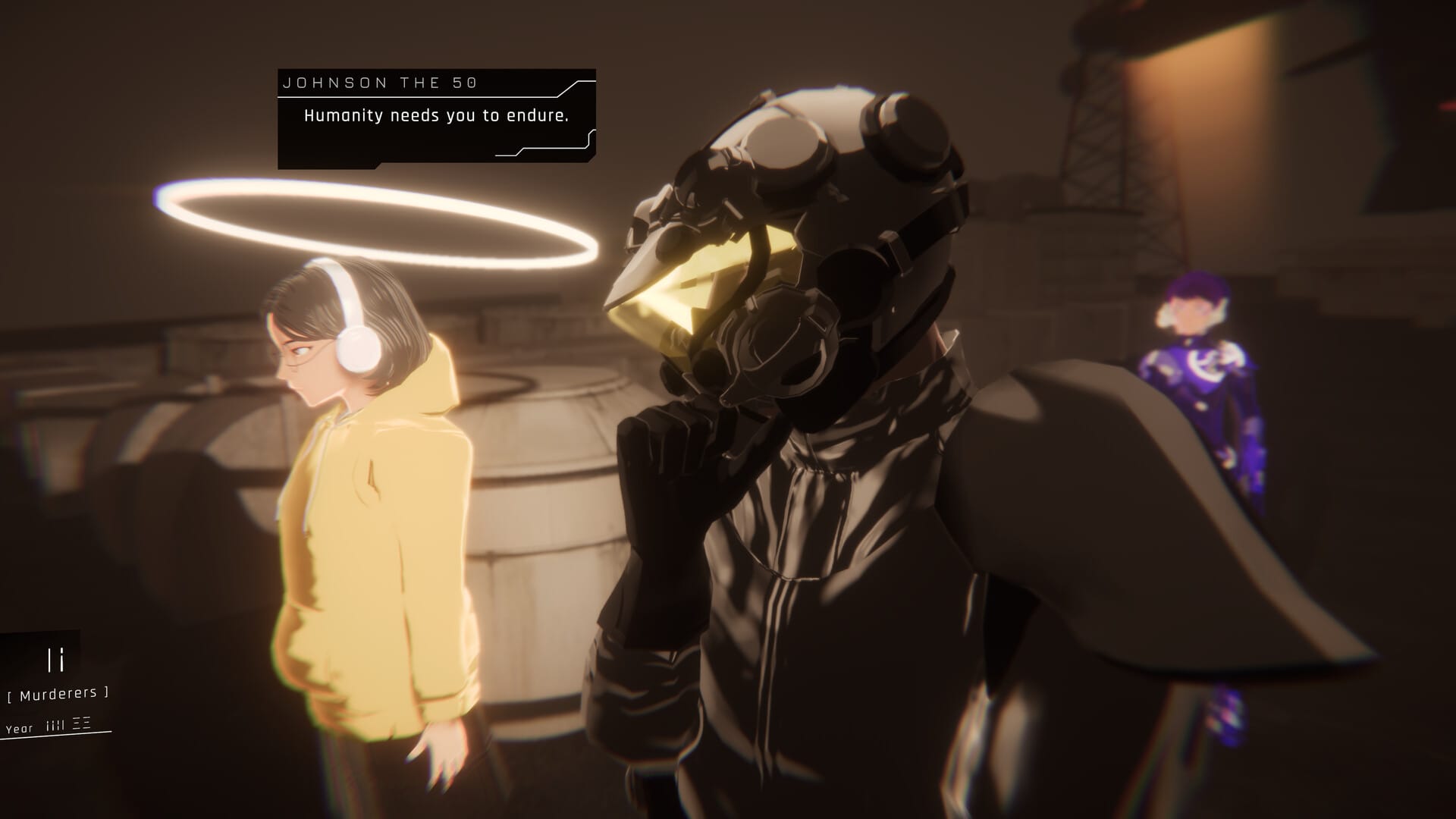
The game has a player with a split consciousness: digital work self and what Siu called a “corporeal other that lives in meat space.” You control the digital work self. You spend the game jealous of meat space, while collecting arguments and evidence to convince the AI at the heart of the company—conveniently named Mesa Meta—that she (not “he” or “it”) is delusional.
By the end, it’s also up to you, as the player, to decide whether to merge with meat space—or delete your “work self” from the equation entirely. The ideas are not, on their face, wholly new, but if you played 1000xResist, you know Sunset Visitor is likely to take them in new directions.
“We're such sci-fi, speculative fiction aficionados,” said Siu. “Artificial intelligence is not a new concept. We talk about this all the time. It's some of the earliest science fiction. We talked about Frankenstein and then, of course, Asimov is dealing with AI and often labor. It really is following in the footsteps of that tradition and being like, ‘This didn't really play out the way that we thought it would play out.’ That's sometimes exciting, at least from an artistic perspective.”
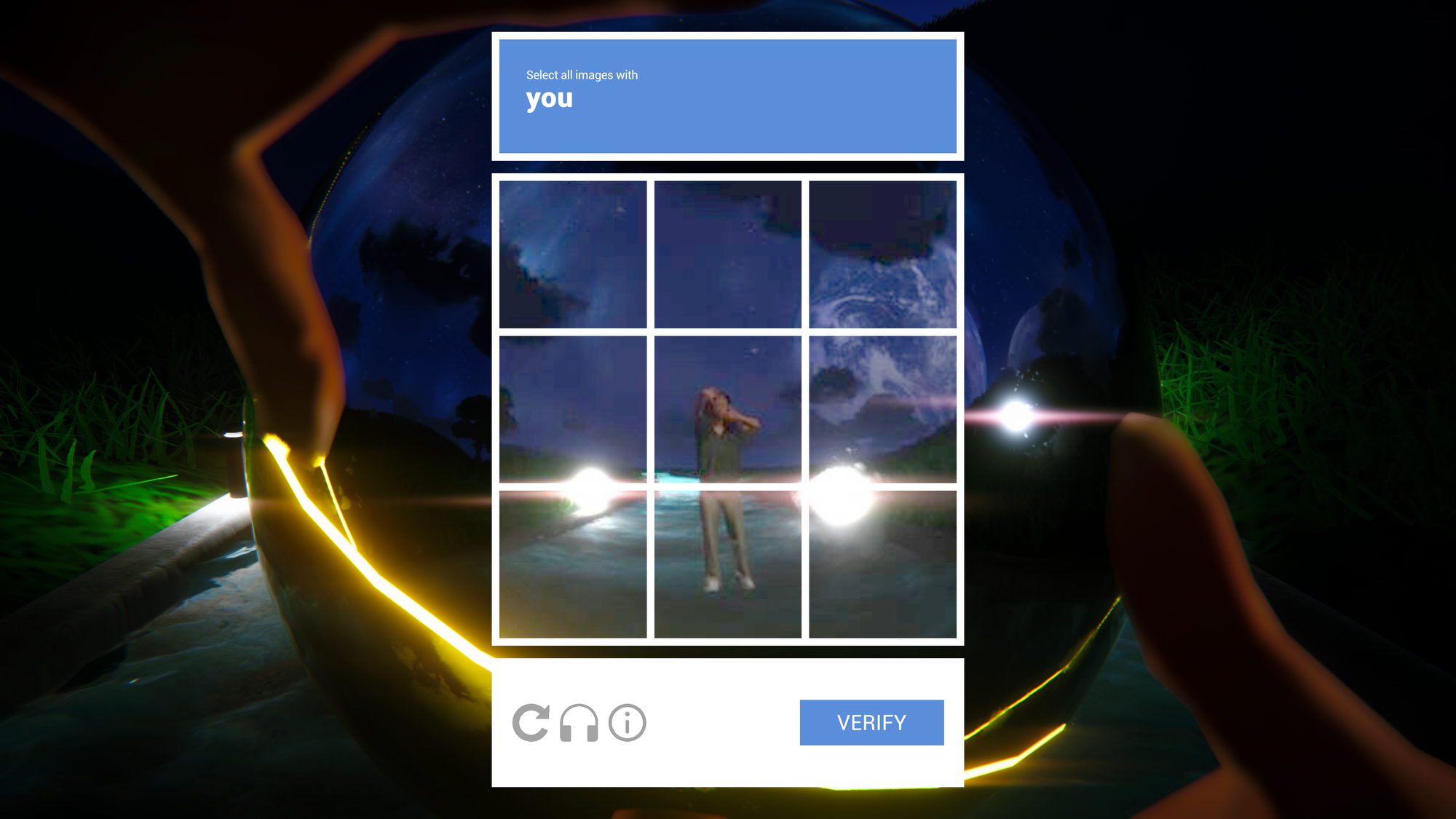
Asimov, though, couldn’t have envisioned one of Prove You’re Human’s most interesting—and, to be honest, funniest—ways of the player interacting with the world: CAPCHAs. Yes, in Prove You’re Human, the player can “capture” information about the world using a “CAPCHA” mechanic, a riff on the all-too-real trick used by companies like Google to learn if we are real.
It also has FMV and it also has—well, Siu is trying to keep it limited. 1000xResist was both a commercial and critical success, and a follow-up can fall into traps of scope, of trying to make good on the ideas that Sunset Visitor didn’t have time, budget, or resources for in the last one.
“Our interest is being driven by, again, poking our head up in May 2024 [when 1000xResist was originally released],” said Siu, “and being like ‘What's the world like now? What are we making? What are we kind of engaging with? Versus being like, ‘There's like this battle system that we really wanted to implement last time. Let's do that this time.”
One big difference this time around is that Prove You’re Human has a different publisher. It’s one of two games signed as part of a debut publishing company from Abby Howard and Tony Howard-Arias of Black Tabby Games, the creative duo behind the psychological horror (with a dash of dating sim) game Slay the Princess. That game was popular enough that Abby and Tony suddenly found themselves in a position, like Outersloth with Among Us, to help others.
“As somebody who's been in a couple creative industries at this point,” said Slay the Princess artist Abby Howard, “this feeling, as soon as you start to feel more stable, that you want to help other people in your cohort to try to maintain the stability for them, as well. If I am successful other people should also be successful, and how do I make sure that this happens?”
"Much of this game is looking out into the world and being porous with it again after 1000x and working through what we're seeing through the modality of art. That’s just the way that we cope in some ways. Or make sense of the world or try to understand it."
“I’m going to start by being annoying and be like, I don't hate publishers,” said Tony Howard. “I think that there are problems with the publishing ecosystem that are systemic problems, rather than people-driven problems. Prove You're Human was the first game that we signed. It was the impetus to form a publisher. A lot of it was just looking at hoops that it felt like Remy had to jump through during the pitching process. This guy made a fantastic game. It won a Peabody Award. It was profitable. It was delivered.”
To that end, both Prove You’re Human and a second (currently unannounced) other game were both signed using “verbal pitches.” There was no vertical slice, as is typically the case with a game pitch, where a developer produces a small, polished segment from their game, a way for the people providing the money to see what the full game might look like in a few years.
As a result, the game Siu pitched Abby and Tony on is “very different” from what it is now.
During our conversation, Abby gestured to a nearby wall, one that was filled with hand drawn pieces of art that were part of the creative process of making Slay the Princess. 1000xResist and Slay the Princess are games where it’s fundamentally impossible to imagine it being produced by AI, no matter how the technology develops in the years to come. But the current moment is nonetheless ruthless and dystopic, a moment with too many great video games for any one person to play, yet also a barrage of distressing daily headlines about core parts of the video game industry’s finances breaking into pieces. It can make a case for optimism hard.
Starting a publishing label to help others, though, is part of building that case.
“A lot of AAA studios spent a lot of money to make giant games,” said Abby, “and at this point I think it's pretty clear that that is not sustainable forever. Exponential growth is not possible. But that doesn't mean that it's dead, it just means it's not going to keep being something that you can make that much money on and to create a project of that gigantic size and still make sure that you're funding your studio. [pause] It’s okay to have smaller games.”
The game itself, too, is part of building that case.
“When it comes to video games, or what we call video games, it's extremely early days in a way that we're just really discovering—and that's exciting,” said Siu. “We're always excited to see what other people are discovering and learning from that. That environment always makes me optimistic, because at the end of a game, you look around and be like, 'What more can be done? What are some things that are thematically and formally left on the table?'"
“The options are vast,” he concluded, as we signed off a Google Meet call (allegedly powered by Gemini).
Prove You’re Human does not currently have a release date.