
The Steam description for Titanium Court, the new and phantasmagorical video game from Consume Me co-creator AP Thomson, is purposefully baffling: “a surreal strategy game for clowns and criminals.” In the playing, it’s a video game that both does—and doesn’t—explain itself. A game full of words, but the shape of those words, what they really mean, isn’t clear.
Is Titanium Court a well-oiled match-3 video game? Yes. Is it a tower defense game? Also yes. Do you spend a significant amount of time exploring a castle like it’s an adventure game? Well, yes. Does the entire game, at times, feel like an elaborate trick being played on you? Absolutely.
It’s funny. It’s goofy. It’s also, all told, more straightforward than it seems. (Mostly.)
Titanium Court is both like and unlike anything else, with the exact mixture being the delight. It’s a game that makes sense as you peel back its layers, but in a world where players are expected to understand so much of a game's content via marketing and explainer videos, much of the joy is realizing what the layers even are.
“The whole picture involves some negative space that you can only see once you've traced the entire outline,” said Thomson in an interview with Remap, “and then you get a sense of the actual shape that it is tracing out. But it's not showing you that shape explicitly, and that is a theme that shows up inside the game, so it is commenting on what it is doing while simultaneously doing it.”
art19:f36bf334-dd19-4d59-b971-ff0235d5d84f
The basic rhythms of Titanium Court, a game where the player has been magically transported to a world of dragons and fairies, revolve around a day and night cycle. By day, players are at war, but war involves match 3’ing resources to assemble a small army. In that phase, you’re also altering the very map you’ll be soon fighting on. Combat is out of your control, at the whims of what you’ve sent up and where—that’s the tower defense part. Survive long enough and you’ll face a boss. (Who you may or may not be able to defeat through violence, paying off, or watching a music video about horny salmon from Thomson himself.)
Win or lose, you move into the night cycle, wherein you explore a trippy castle, filled with a cast of characters whose interest in you is somewhere between disdain and indifference. Curiosity is rewarded, as you poke and prod at what might let you eventually leave—if you even want to.
When it’s time to move onto the next day, the game makes you press a big “okay” button, and it makes me chuckle every single damn time I press it.
“It is trying to blur the lines between a lot of concepts that are happening simultaneously,” he said. “You've got things that are happening on the battlefield that are ostensibly pretty standard medieval fantasy. Oh, a bunch of little soldiers went and conquered a castle! And it'll pop up an image of a guy hitting a golf ball or Jenga tower getting knocked down or something like that.”
Case in point:
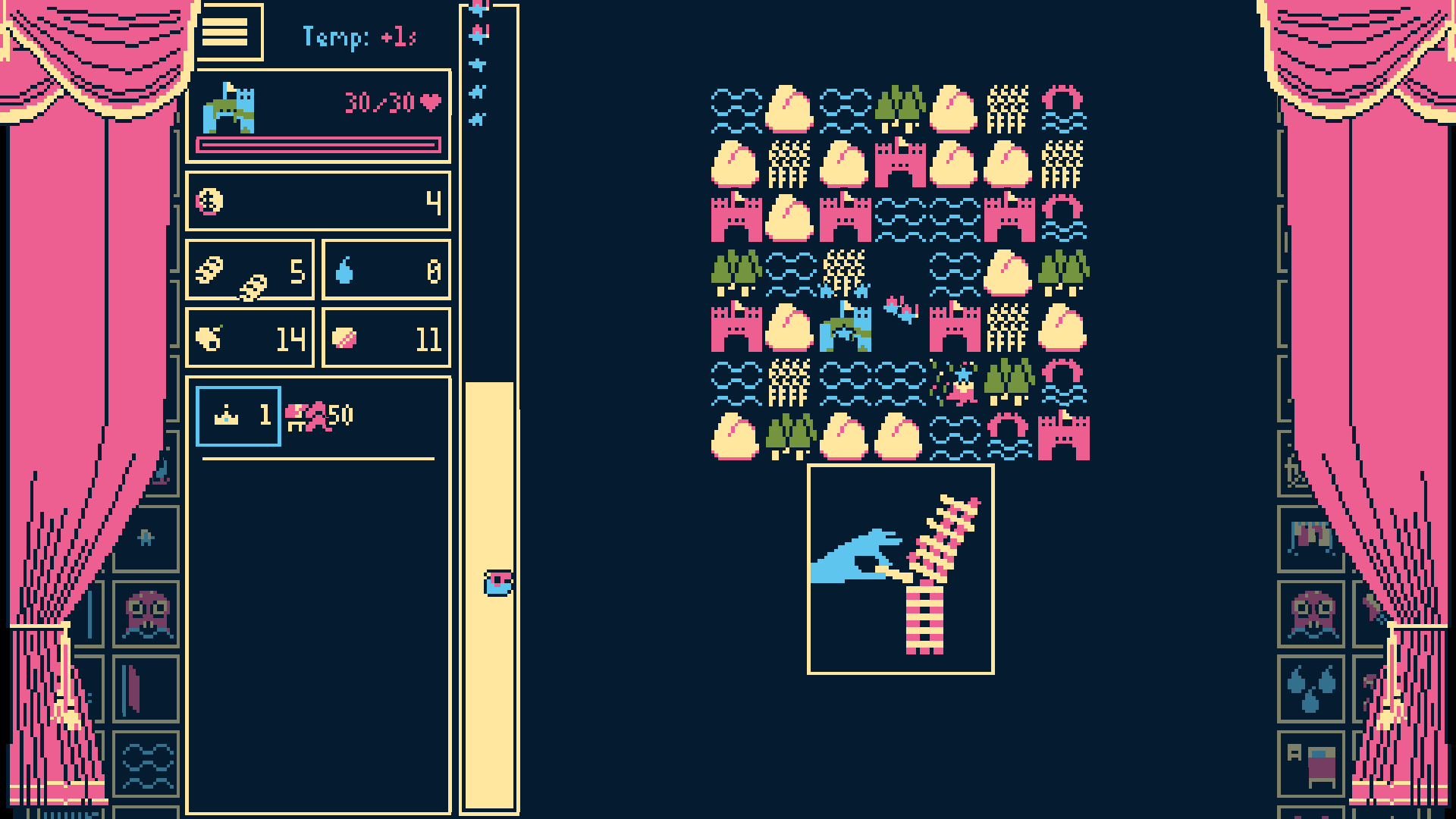
It’s a game with puzzles and a game that often demands you look puzzlingly at it, as well.
Thomson, too, has been noodling with puzzle games for a while, personally and professionally.
“Puzzle game is almost the wrong word for games like Tetris or match 3’s in general,” said Thomson, who credits the 2007 DS game Puzzle Quest: Challenge of the Warlords for truly opening his ideas to the ways puzzle games can be dropped in elsewhere. “I think of them more as pattern matching games. I think of ‘puzzle’ as something closer to a sokoban-style game, where you've got a single solution and trying to solve something. But I've been very interested in them once I saw them less as games by themselves, and more as ingredients."
His online handle, “bad_tetris,” comes from having made many Tetris or Tetris-like games, but more specifically comes from a homebrew project where he programmed an AI to play Tetris by itself on an LED panel. The panel was then placed in a different part of the house he was in.
“I could hear from across the house where we had set this up,” he said. “ [You would hear] groans as people had been watching it spend an hour getting a line ready and then screwing it up. I want to say it was intentional, but I think I just didn't program a very good AI.”
The air of mystery around Titanium Court, in which there’s joy in being coy, was an accident.
When Thomson submitted an early version of Titanium Court to the Independent Games Festival awards, the game didn’t have a publisher. (The IGF has long signaled some of the best and most interesting avant garde games, including Baby Steps, Cart Life, and Paper’s Please.) In that form, you can ask judges to be quiet about what they’ve played or boast loudly about it.
“Normally, my answer to that is, yeah, say whatever you want,” said Thomson. “I don't care. But in this case, I was like, well, I'm maybe about to sign with a publisher, so I don't really know if they want people talking about it publicly, because it technically hasn't been announced yet, so maybe hold off on talking about it until it's actually been announced. Which resulted in a lot of people talking about the game that they were not allowed to talk about, and being very excited about it. And I think there was this element of like, oh, well, we could lean into this.”
Which is how the first email I received about Titanium Court called it “the worst-best-kept secret in gaming,” a game for “strategy game sickos,” and something that’s “impossibly difficult to describe.” It’s cheeky, much like Titanium Court itself. It dares you to unpack it.
The trick did have drawbacks. Titanium Court, however intentionally irreverent, is very much a match 3 game, a tower defense game, and an adventure game. And yet, the game found itself rejected from the seemingly never-ending parade of Steam “fests” that dominate the platform. Thomson wanted the game in Steam’s “Tower Defense Fest” last month—but Steam said no!
“I think we should qualify for that, but I guess not,” laughed Thomson.
The whole picture involves some negative space that you can only see once you've traced the entire outline, and then you get a sense of the actual shape that it is tracing out. But it's not showing you that shape explicitly."
One reason Titanium Court catches your eye is its unique old school-ish aesthetic. It looks vaguely Amiga-coded? Maybe Commodore-adjacent? A handful of pixels end up saying a lot.
Thomson is not an artist by trade. The art in Titanium Court was designed to be a placeholder.
“When I started development, the plan was like, this is my prototyping art style,” said Thomson. “And eventually, I'll be pitching this to other people and potentially I will work with another artist. It just eventually developed enough that, you know, I can get away with this just being the style. That works. That's fine.”
You can see an early draft of this look in Thomson’s 2018 game Fortune-499, where you play a fortune teller who, naturally, is working for a big company and trying to manage magic and office life. Fun fact: the game was originally called Fortune-500, before the game’s publisher asked for a different name. Thomson gave it some thought and settled on, well, Fortune-499.
A core method of arriving at Thomson’s stylization was practical: if you have fewer pixels to work with, if you have fewer colors to work with, you have fewer ways to screw everything up.
Thomson worked with Jenny Jiao Hsia to design the slice of anxious teenage life game Consume Me. Hsai would poke fun at Thomson for “being really bad at picking colors that go together.” The pixels look good in Titanium Court because Thomson ultimately copied a desirable alternate color palette hidden in the options menu of the (also excellent) roguelike shooter Downwell.
Consume Me was in development at the same time as Titanium Court. Consume Me took home the Independent Game Festival’s prestigious grand prize in 2025, while Titanium Court won that same award in 2026. Winning twice? Very hard. Winning back-to-back? Totally unprecedented.

Both games were also released relatively close to one another—Consume Me last September, Titanium Court less than a week ago. Naturally, the two games ended-up influencing one another, up to and including sharing code. Thomson could program a system for one game and immediately drop it into the other. It also gave Thomson a chance to breathe between projects.
“I was working on Consume Me for one to two years prior to really starting Titanium Court,” he said. “By the time I started, Consume Me had reached the part of development that is a lot less fun. It was past the game jam prototyping stage where you're getting tons of stuff done really, really quickly, and to the part of development that a lot of developers refer to as the swamp.”
The “swamp,” according to Thomson, is when “you are working really hard, but you don't seem to be making very much progress.” It’s not an obvious moment, but Consume Me’s “swamp” moment, for example, was when they realized there was nothing to share on the game’s social accounts anymore. They put in work on the game—but there was nothing to “show” for it.
All games have “swamp” moments. But for Thomson, he could leave one for a little while.
Beyond both swamps was Consume Me, which successfully captures a highly specific (but nonetheless highly relatable) period of teenage drama and angst, and Titanium Court, the curious but alluring game that launched last week on Steam. It captures something…else.
You’ll know if Titanium Court is for you within the first five minutes, but even if it's not, the genuine thrill Titanium Court seems to get from surprising the player is rare and beautiful.
Or, as Thomson puts it: “illuminating the magic that exists under something that you might have previously dismissed.”
