Remember when you’d walk into a local music, book, or video store and there’d be an adorable section where the employees would recommend what they were interested in that month?
Welcome to our little version of it, called Remap Recommends.
It's a chance for the staff at Remap to let you know what they've been playing, reading, listening to, or watching.
Patrick Recommends: The Mitchells vs. The Machines
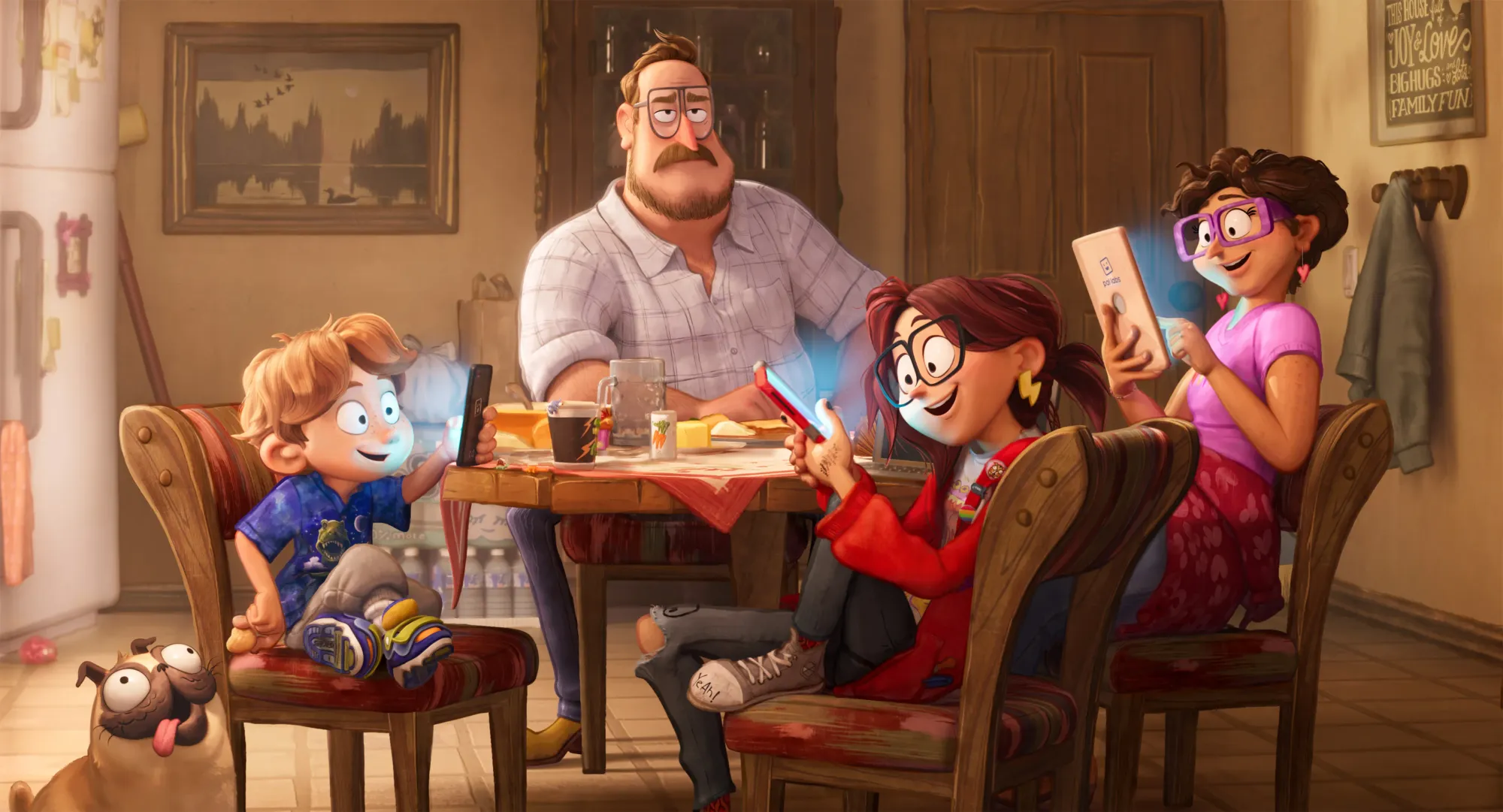
Okay, so this movie isn't new—it came out back in 2021—but it's become the latest movie my children are watching over and over and over again, to the point that sometimes they won't even watch it from the start and will instead choose a favorite part they're into, load the movie there, and watch until the credits hit.
Fuck, man, this flick makes me cry every time. Hell, I'll be on the other side of the house and start tearing up when I hear certain musical notes being hit. Which is probably not shocking to learn when you combine a sap (me) with a movie about a father and daughter relationship (also me) and a parent who hopes they'll find a way to graduate from parent to friend when their kids are older (again, also me).
Do I think I'm as obviously aloof as the dad in the movie (Danny McBride)? Of course not! I know I'm not! But I also don't know what I'll be aloof about until it's too late; it's the very nature of an evolving relationship between kids and parents.
I remember quite liking it back in 2021 but over the course of the past month, I've probably watched the movie in totality, in some mangled form, a half dozen times. And now it's gone from a movie that I liked to a movie I love and, quite frankly, probably one of my favorite animated films. It really seems to understand the complicated dynamics driving modern relationships between parents and kids in a way that has only become more relatable as my oldest becomes, well, older. (She's nine now. She would've been 5ish when the movie originally came out on Netflix. That's basically a generation of time.)
The message at its core is a good one, imo, and it's part of why I managed to have such a good relationship with my parents as I got older: they saw me. Or tried. The key to navigating the maturing of a kid/parent relationship, I think, is seeing one another, and for the parent, it's realizing it's your responsibility to see them before they can see you. Maybe you think they're making a mistake, maybe you don't "get" them. But say you do. You try. Getting that feeling back at you is going to take longer for a kid, young adult, whatever—you know better. You went through this already!
Also, the song that plays over the soundtrack is so good. What a bop.
Rob Recommends: Superman (2025)
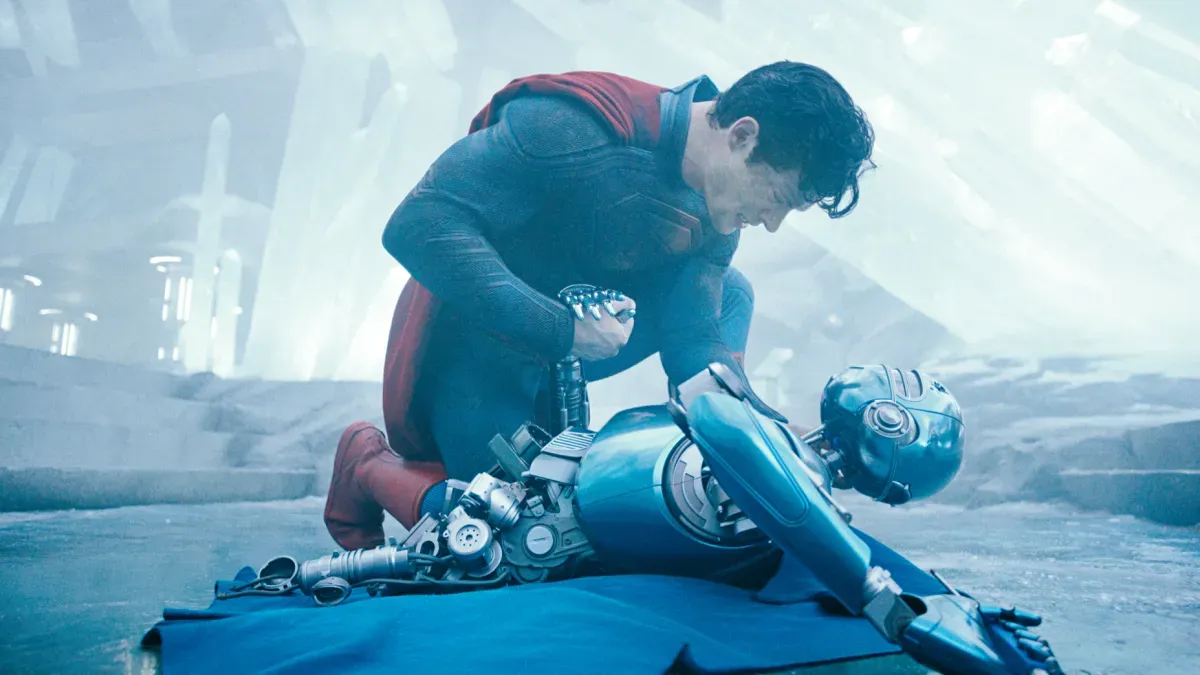
I tend to find James Gunn’s stuff a little grating. Enjoyable, but a bit twee and cloyingly “feel good”. So I was not excited about his Superman and the way it was seen as a return to what the character “ought” to be: pure uncomplicated goodness and optimism. The moment in the trailer where a little kid in some Distant War Torn Land did the Iwo Jima flag-raising with a Superman pennant did not, to put it mildly, inspire confidence.
You know what, though? Superman ruled. Even that moment ends up being more nuanced than expected, as (spoilers) Supes is not going to come save that kid at that moment and the happy outcome is ambiguous even as it’s delightful.
The slightly peevish, needling dynamic between Clark and Lois? Krypto the Superdog being a little asshole chaos gremlin? Alan Tudyk doing what he does best: playing a charismatic robot? Loved all of it.
It’s also fascinating in the ways, like all great superhero movies, it reflects its moment. Superman’s parents are revealed to be would-be colonizers whose tragic backstory does not diminish their authoritarian, violent vision for how Superman should conduct himself on earth. The US government views Superman as a dangerous alien threat to its unipolar world order and banishes him to a extradimensional black site run by a private contractor. In Nicholas Hoult’s Luther and his army of STEM lackeys, the movie has the Musk cult pretty neatly dialed-in. We see Superman helping firefighters a lot. Cops and troops? Not so much. We even have an early scene where Lois nails Clark with a lot of “gotcha” questions predicated on “view from nowhere” reporting that pretends to have no memory or judgment about the subjects of its stories.
All in all, it was a pretty great thing to fire up on HBO Max Plus Discovery or whatever they’re calling it now. It also made me wonder: should I watch Peacemaker?
Chia Recommends: Star Wars Rebellion (with the Rise of the Empire Expansion)

I’m a bit of a mark for most anything Star Wars, so it’s a bit of a shock to me that I’d missed out on Star Wars Rebellion for so long. I’d spent the better part of the late 2010s getting into and then watching the slow “death” of X-Wing, the miniature dogfighting game from Fantasy Flight Games that has one of the best feeling skill curves of any miniatures game I’ve ever played (you have to learn how each ship flies because unlike most minis games you can’t pre-measure your moves, which makes “piloting” feel dangerous and extremely satisfying once you’ve gotten a handle on the “feel” of a certain ship). All the while, Fantasy Flight Games were also making one of the best asymmetric two player board games I’ve played in a long time, also set in the Star Wars universe, whose thematic trappings and asymmetric mechanics are so strong that the second my first nearly 5 hour spanning game was done, I was immediately chomping at the bit to run it back.
Star Wars Rebellion puts two players into the roles of the Galactic Empire and the Rebel Alliance, each working towards their own specific end game goals. The Galactic Empire has to find the Rebel Base and destroy all rebels on that planet (or you know, take the death star over there and destroy the whole planet) while the Rebels have to complete specific objectives that gain them reputation. Reputation is a marker that starts at the far end of the round timer track, and if the round timer ever meets the Rebel reputation marker, then the rebels have convinced enough of the galaxy to join their cause that the Empire is overthrown.
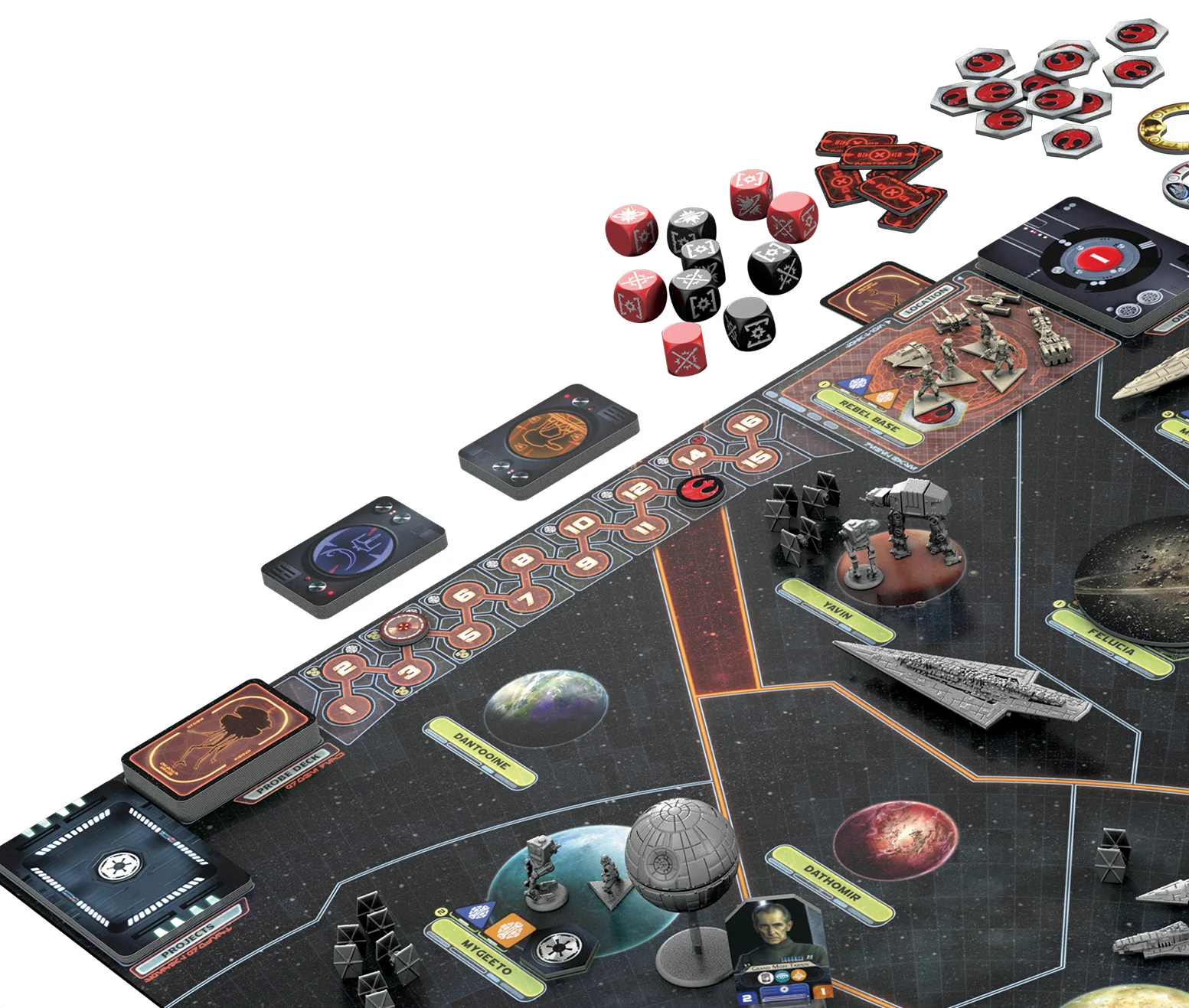
You each plan your turns out by assigning a pool of Leaders to specific mission cards, first the rebels, then the empire. This is important because each leader that doesn’t get assigned to a specific mission can be used across your turns to move your units across the board, initiating combat, or to try to counter your opponents missions. This balancing act of trying to do missions but also being cognizant that there might be something you need to contest directly gives the game a lot of strategic depth, and with the Empire being able to plan after the Rebels it gives this added layer of the Empire always knowing the shape of their opponent’s turn before they have to commit to any missions themselves. It makes the near omniscience of Empire really felt, even if they don’t know what you’re doing, they know that you’re doing something, and that’s dangerous.
The magic of this game comes from this asymmetry and the Probe Deck. Each space on the board is a different system, planets from across all sorts of Star Wars media, and each planet has a corresponding card in the Probe deck. At the start of the game, after the Empire has set up on a randomized set of Empire specific systems, the Rebel Player chooses one card out of the leftover 26 cards to designate as the rebel base. The base has it’s own separate space on the board which allows you to build and move units in and out of while at the same time keeping the actual location of the base secret. Each turn the Empire player is going to draw two new cards from the remaining 25, understanding that if you draw a card from the Probe deck that means it can’t be the rebel base, creating an inevitability dwindling amount of safe spaces to house the scrappy rebellion as the game goes on.
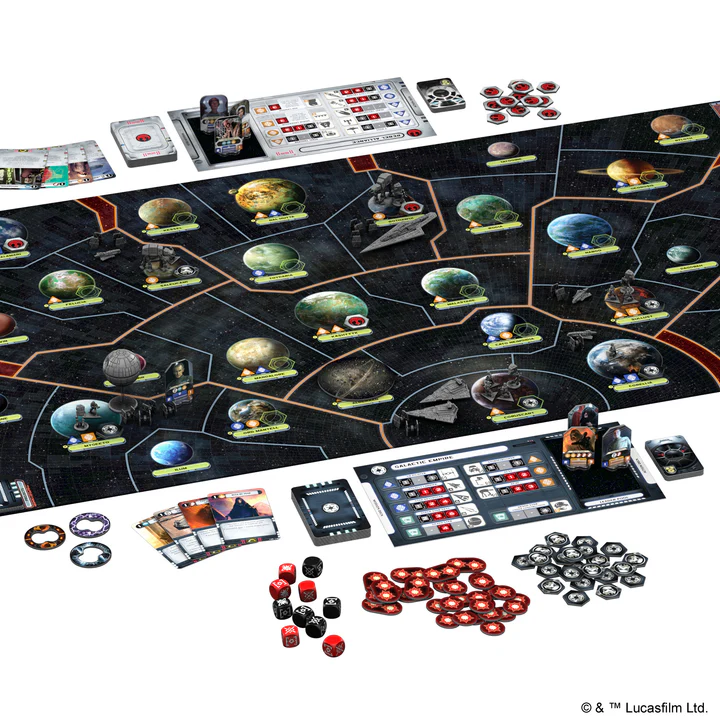
This cat and mouse game, the feeling of slow suffocation as the Rebels, the sense of growing insurgency and popular opinion slowly turning against you as the Empire, is so strong from these mechanics alone that if you were to wholesale shift these mechanics to a different themed Oppressor vs. Oppressed setting it would still be as compelling, which makes for the best kind of franchise based game in my opinion. The Star Wars special sauce sprinkled on top however does give it that extra oomph that makes pulling off certain moments really sing if you’re a fan of the series. In one of my playthroughs as the Empire I was able to take Luke and turn him to the dark side, effectively stealing one of my opponents commanding pieces, while in turn they were able to kill one of my generals with Leia, who in the absence of her brother almost naturally seemed to step into his role as the Jedi in training. It’s really fun thematically, but so strong mechanically that it doesn’t lean on it’s themes to prop it up. All in all it’s an excellent way for two people to spend a really tense and exhilarating 4-6 hours, one that I’m so glad I’ve had the opportunity to enjoy.