
In 1995, Kevin Wilson (then a student at Berkeley) made a Usenet post proposing a competition for short-form text games. The resulting event, simply called the Interactive Fiction Competition, had enough of a response to be repeated the following year, and would go on to become one of video games' very few stable institutions. It predates the IGF and Ludum Dare. It has outlived its 1995 contemporary, E3.
Infocom, the legendary American studio responsible for both the term "interactive fiction" and many of the best examples of the form, had been shut down in 1989. Infocom's demise is a whole other article—it may very well be Activision's original sin. But the medium of text-based adventure games, which had flourished in the 1980s, was at the turn of the decade more or less dead as a commercial enterprise.
Infocom was a product of the chaotic world of personal computing in the 1980s, in which Commodore, Apple, and IBM-compatible machines were all viable options and all mutually incompatible. Their business model was to target every platform at once; text games didn't have to worry about the different graphical capabilities of different machines.
They were one of the first studios to work with something resembling what we today might call a game engine. Zork and its successors are written in a special-purpose programming language, the ZIL, designed specifically to implement them. The games would then run on a virtual machine (a fictional, special-purpose, simplified computer that real computers would emulate). The "z-machine" was the technical secret that allowed Infocom to be so successful in the first half of the eighties; to target a new platform, all they had to do was write a new interpreter, and their whole back catalog could be sold over again.
After Infocom shut its doors, the z-machine was reverse-engineered by hobbyists; first to keep the old games alive by continuing to implement new interpreters, but pretty soon with thoughts of writing new games that could run on it. The Inform programming language, created to do just that, was the main driver of the creation of IFComp.
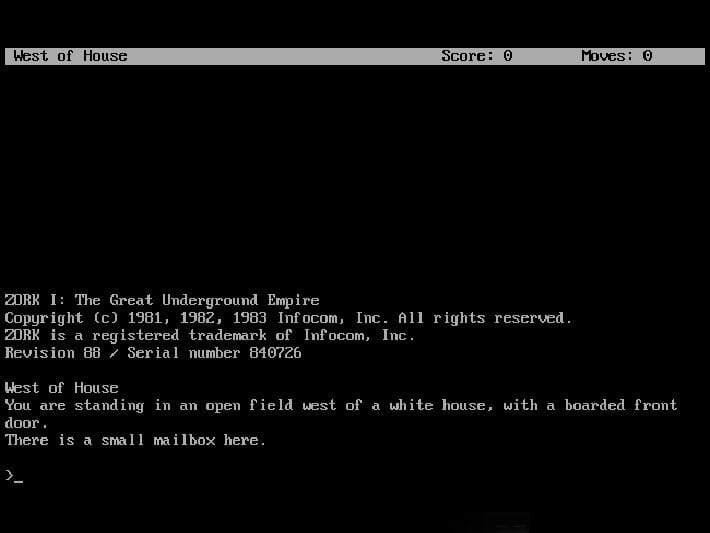
Today, IF is probably the best-preserved cross-section of video game history we have. Every game, from Zork through Infocom's latter-day output, through every game made with Inform from the 90s until today, is playable and runs on any machine you could name; there are almost as many ports of the z-machine as there are ports of Doom. And thanks to the community's efforts in diligently archiving everything, the files to play those games actually still exist.
If Infocom's ZIL was the first game engine, Inform—a successor language, created by and for hobbyists to make new games targeting the z-machine—is one of the first freely-distributed game-making tools. This is a decade or more before Adobe Flash, GameMaker, or Unity existed. Inform codifies the limitations of the z-machine, but it also comes with a ton of baked-in functionality. It provides all of the logic for understanding the commands that the player types in (what is known as a parser). It comes with functional implementations of dozens of systems (an inventory, moving between places, and so on) and the starting point to implement many others. All that an author has to do is specify the material that's unique to their specific game. The existence of specialist tools, combined with the existence of a venue to make use of them and get a small but very engaged audience, led to a community of practice that was deeply interested in plumbing the depths of the seemingly narrow design space of text-based games.
This enthusiast community not only kept the genre alive but advanced it to such a degree that their work is now more influential than that of their commercial predecessors. Past competitors such as Sam Barlow (Her Story, Immortality) and Jon Ingold (80 Days, Overboard!, TR-49) went on to release some of the best story-driven video games of the last 20 years. Ideas honed by that community are foundational to the whole field of narrative design.
Throughout the decades, the gamut of tools used in interactive fiction expanded. The hypertext story tool Twine is definitely the biggest of those additions, but IFComp now encompasses a range of different approaches and styles. The central idea of games presented entirely or mostly through text remains.
Tools that have a direct lineage to interactive fiction authoring systems are now industry standards in indie game development, being used in video games such as Night in the Woods, Norco, and the just-released Nighthawks.
At the same time, IF has long had an arms-length relationship to video games at large. It is a genre and a surrounding community that is insistently noncommercial, relentlessly critical-minded, insular (and at times, though not so much today, exclusionary). It's more like a (large, unruly, eccentric) extended family than anything that could be described as a "fandom."
What really unites all of those varying viewpoints, approaches, and tools is that the text game is a playground of formal experimentation. As long as a mechanic can fit in an IF model of interaction (whether that's typing in commands or clicking on links), there's very little barrier between designing something in your head and having an implementation of it you can play with and try out.
For me this has always been the fundamental value of IF; it's a primordial ooze of wild mechanical or narrative ideas, some of which would be outright impossible with a different presentation. It's a place where makers with very different notions implement their individual visions and publish them for the world to see, sometimes hitting gold.
I think all the time about classics like Aisle, Sam Barlow's game which takes place entirely in one move—you type one command and the story ends; it has dozens of responses for dozens of possible commands, essentially creating a different story for every possible interaction. I think about Andrew Plotkin's Spider and Web, a game that feels like a preview of every twist about player character knowledge or identity in the last 30 years. I think about Caleb Wilson's Lime Ergot, a delirious, telescoping experience where every act of seeing twists the player's perspective in a way that can only work in prose.
Of course, most IF isn't this striking; but a big part of the joy of IFComp is digging through a lot of games looking for the things that are. And even the entries that don't deliver that kind of bolt from the blue often deliver incredible prose, clever twists on genre, themes or settings that I'd never encountered in a game before.
At the same time, this openness to individual idiosyncrasy also enables a lot of odd indulgences and curiosities. Some authors have come back to the comp year after year, submitting similar games, working for an audience of a few people who appreciate their very insular design ideas or sense of humor. People submit extremely personal work, or stories that exist entirely to indulge in a special interest. One of the surprisingly charming entries from last year was essentially a bit of slice-of-life Poirot/Hastings fan fiction.
While IFComp is kind of a precursor to all game jams, it's not itself a game jam; there's no time limit to make a game (though the expectation is that entries are small enough to play through in two hours or less). Some submissions are the product of years of on-and-off work; some are made in a weekend. The Competition's unusual judging process then ranks every single game submitted, from first to last place, based on the ratings of dozens of volunteers—anyone can be a IFComp "judge", all it takes is being willing to rate a reasonable number of games.
This system has led to a tongue-in-cheek quasi-tradition of someone submitting a game that's intentionally very bad, specifically with the goal of sparing anyone else the pain of coming in last. Last year's take on the intentionally-terrible game, Uninteractive Fiction 2, came in second-to-last. The reason why illustrates the strange place IFComp (and many similar institutions) finds itself in now.
The last place entry was a project that relied on using an external large language model to generate most text. The problem is that the API key used to access this LLM service was, at the time of competition, not working. So the experience of playing this game was that first you'd read a lengthy explanation of the game's powerful affordances and revolutionary use of AI, then you'd try something and it'd throw an error. This combination of a game that was entirely nonfunctional, and also openly just a vehicle to interact with an AI, resulted in it receiving a historically-low score that beat even deliberate attempts at coming last.
It (and the entirely human-made sacrificial game Uninteractive Fiction 2) also came behind several other games made with AI. One "game" was distributed as a prompt you were meant to type into your favorite LLM chatbot. The prompt itself was generated by ChatGPT; it felt very much like just an experience of indulging someone else's incipient AI psychosis. Many entries had obviously AI-generated cover art, complete with the unsettling over-emoting and vague racial stereotyping that's rampant in Midjourney slop. It felt pretty grim to see, at the time.
After a lot of heated intra-community debate about AI use, the competition implemented a new rule outright banning AI-generated content from this years' games. The rules are not entirely strict—they still leave open a gap for AI coding assistance, something that I find distasteful at best. And their enforcement is, generously, on the gentle side. One of the games this year uses a cover image that's very clearly an AI image "washed" by a commercial artist tracing over it.
But the rule has worked to cut down the number of low-effort slop submissions, without really dampening the enthusiasm—while there are fewer entries this year than last year, the difference is less than the number of obvious low-effort AI submissions last year, and it's still seventy-three games, a number that would have felt huge even a few years ago.
But even hard rules against LLM usage can't fully exorcise the specter that AI casts over any kind of collective creative endeavor. IFComp was always an enormous contribution of labor, freely given to something held in common. Not only the labor of authors, but the labor of judges who diligently play, rate, and review those entries.
IFComp's culture of "judging" has always emphasized the idea of trying to give everyone a fair chance. The competition website shows entries in a random order; there's some implicit discouragement of beelining for games that seem interesting at first glance or come from established authors. If you submit something to IFComp, someone will play it, give it serious thought, and give you feedback. This really is the main appeal of the competition; not only a chance but a near-guarantee of being seen, of getting useful feedback that helps you hone a craft.
This promise of a captive audience is also uniquely vulnerable to the increasingly prevalent sin of trying to make someone read something that you didn't bother to write. We now live in a world where every time you read something you have to question whether there's another person on the other side of that communication at all. One of the arguments for the ban was that LLM writing in games is a parasitic drain on the attention and effort of judges and reviewers. Someone who didn't write what they published—who very well may not even have read it closely, if at all—can't benefit from feedback on the quality of their prose, or their narrative design choices, or the portrayal of their characters. They can't get better at doing something they didn't do.
But even beyond that, AI feels like an assault on the philosophical foundation of the entire genre. IF carries with it the promise that if you can imagine a system, you can implement it—that every game is a communiqué straight from the author's brain, a direct channel comparable only to traditional prose writing, a construct of pure story and systems unburdened by the production realities of a typical video game.
AI sells the promise that you don't even have to imagine something; that your vague impulses, half-formed ideas, or just the result of a delusional conversation with a machine can become productized for an audience of none. The effect has been immediately toxic to all sorts of institutions that take submissions from all comers—from literary magazines like Clarkesworld to open-source code hosting service Codeberg.
While the product of AI is often low-effort, shoddy slop, it's also very superficially slick. The web is now awash in vibe-coded websites packed densely with eyecatching visual detail and paragraph after paragraph of text that doesn't seem to mean anything. The production of superficially technically competent images is extremely easy for anyone wielding these systems.
Interactive fiction is one of many subcultures that formed, on the internet, around a radically sincere sharing of mutual creative support. There are several in video games, often formed around focused tools like Ren'Py, Pico-8, or Bitsy. But now AI tools create dark mirrors; subcultures of solipsism where people enclose themselves in a self-satisfied cocoon. A recent prominent example of this phenomenon is Suno users who only listen to their own slop. You can see those tendencies clearly in the story of the IFComp "game" that was just some random output from someone's conversation with ChatGPT.
A lot of young people today are getting their first experiences making video games not through openly accessible tools but on walled-garden platforms like Roblox and Fortnite Creative. The companies behind these systems are now openly embracing AI; the logical endpoint of all this is a business model where a person's creative impulse is diverted into spending money on AI tokens so that their own ideas can be fed back to them in a slick, hollow, half-baked form.
It's impossible to predict what the post-AI fever equilibrium will look like, or even if we'll reach an equilibrium at all any time soon. For the time being, the feeling is very much of instability; of not knowing exactly how much we're losing. AI, which has made hardware impossible to own and made it incredibly difficult to fund new video game projects, is an assault on the economic foundations of the video games medium. But even more so, it's an assault on the intellectual, creative, and aesthetic foundations of the medium.
If we're heading into a world where the most powerful people on the planet increasingly laugh at the idea that you might want to do things, think about things, or generally be a human being—where the CEO of NVidia brags about being so cognitively impaired by some combination of extreme wealth and chatbot brainrot that he doesn't know his own street address—is that world capable of producing more Sam Barlows, more Jon Ingolds, more of the talent that has emerged from communities like IF?
It's an incredibly unfair burden to put on someone who's releasing only the first or second piece of writing they've ever published. But the magic of IFComp has been that, yes, when I trawl through all those games that come out every year, a part of me is scanning for that possibility; for the idea that this, this person has a unique vision and a unique aesthetic that changes how we think about the medium. The possibility is alive because I know that it has happened multiple times across the history of the competition. I don't know that any other space in video games has been so productive of aesthetically groundbreaking work.
It is a venue that makes bolts out of the blue seem normal. Will that still be the case a year from now, five years from now, ten years from now?
I haven't, at the time of this writing, given careful consideration to every game submitted this IFComp. I haven't found my bolt out of the blue yet, if there is one this year. But I have picked out a few things that I already loved.
The nature of IFComp is that it is worth it to just dive in and play anything that seems interesting—or use the competition's own random shuffle to just play what's on top of the pile. But there's something to be said for just offering a few safe choices. Like most IFComp games, these can all be played in a browser.
Necromanceers
CEJ Pacian is a veteran author whose work tends towards surreal weird fiction. Necromanceer is a little Baron Munchhausen, a little Locked Tomb, a little All Quiet on the Western Front. Comically grim military fantasy and an interesting experiment in blending type-in interfaces with hypertext. At various junctions in the story, the game asks you to type in the name of someone deceased—so that, as the titular "necro", you can summon their ghost to solve some problem for you. The name-collection mechanic is almost like a deranged take on *Pokémon.*
Residual Income
Striking and very short. Residual Income is a piece of vampire fiction with, if you'll excuse the pun, some real teeth; much less in the sexy-vampire mode and much more in the vampire horror mode. IFComp is often a venue for some of the most detailed and elaborate works of interactive fiction that come out in a given year. But it's also a venue for pieces like this: precisely one concept honed to a sharp point, no more no less, bursting with ideas but not interested in belaboring them.

Forensic Necromancy: A Murder in Nineveh
One of the newer developments in interactive fiction tooling is Dialog, a system for authoring stories that can be played both as traditional parser fiction (by typing in commands) and with a mouse-based keyword interface that is more approachable to those who aren't already fans of the genre. Daniel M. Stelzer uses this to great effect to write games like Forensic Necromancy, which have large and mechanically-interesting worlds drawn with incredibly well-researched depictions of historical settings; in this case, Iron Age Mesopotamia.
Ryan Veeder's Agatha Christie's the Murder on the Orient Express
I mentioned last year's The Little Four, a piece of charming and affectionate Hercule Poirot fanfiction. Ryan Veeder's take on The Murder on the Orient Express has nothing whatsoever to do with that. Veeder's sense of humor is intensely silly, but it's also brutally acerbic; this is the rare parody that works while displaying no apparent affection for the source material. It's also a fairly gentle introduction for those new to parser-based interactive fiction. While there are adventure-game puzzles, much of the game is resolved just by exploring, looking at everything, and talking to everyone. It's not really a puzzlebox so much as a breezy jaunt through an extended joke at Poirot's expense.