It started, as most bad ideas do, with a 3D printer.
In December 2025, I bought myself a Bambu A1 as an early Christmas gift. The intent was to use it as an organizational tool, to create places for all the little fiddly bits in my life.
I was, by no means, going to get into printing miniatures for tabletop miniature wargames.
For organizational tools, the Bambu A1 is a tremendous device. It's an FDM (Fused Deposition Modeling) printer, one that basically works by melting long spools of plastic filament and printing them layer-by-layer to form a brand new 3D object. The result is something much stronger than other types of 3D printers — and far less toxic to anyone sitting in the same room. Seriously, do not consider a resin printer if you don't have a heavily ventilated room dedicated for that purpose.
I printed out organizers for my ever-growing Arkham Horror: The Card Game collection, nü-classics like Arcs and Root, the shockingly thematic card battler Star Trek: Captains Chair, the delightful worker placement game Lost Ruins of Arnak, and the criminally underrated fighting game simulator Tag Team. You know, Dork Organization for Dork Shit.
I knew that printing miniatures wasn't going to be possible. FDM printers suck at fine details like, you know, details on guns or spikes on the variety of Zerg-esque monsters that inhabit grimdark future worlds. Obviously, I'd be using the machine for more utilitarian purposes and not frivolously printing miniatures for wargaming.
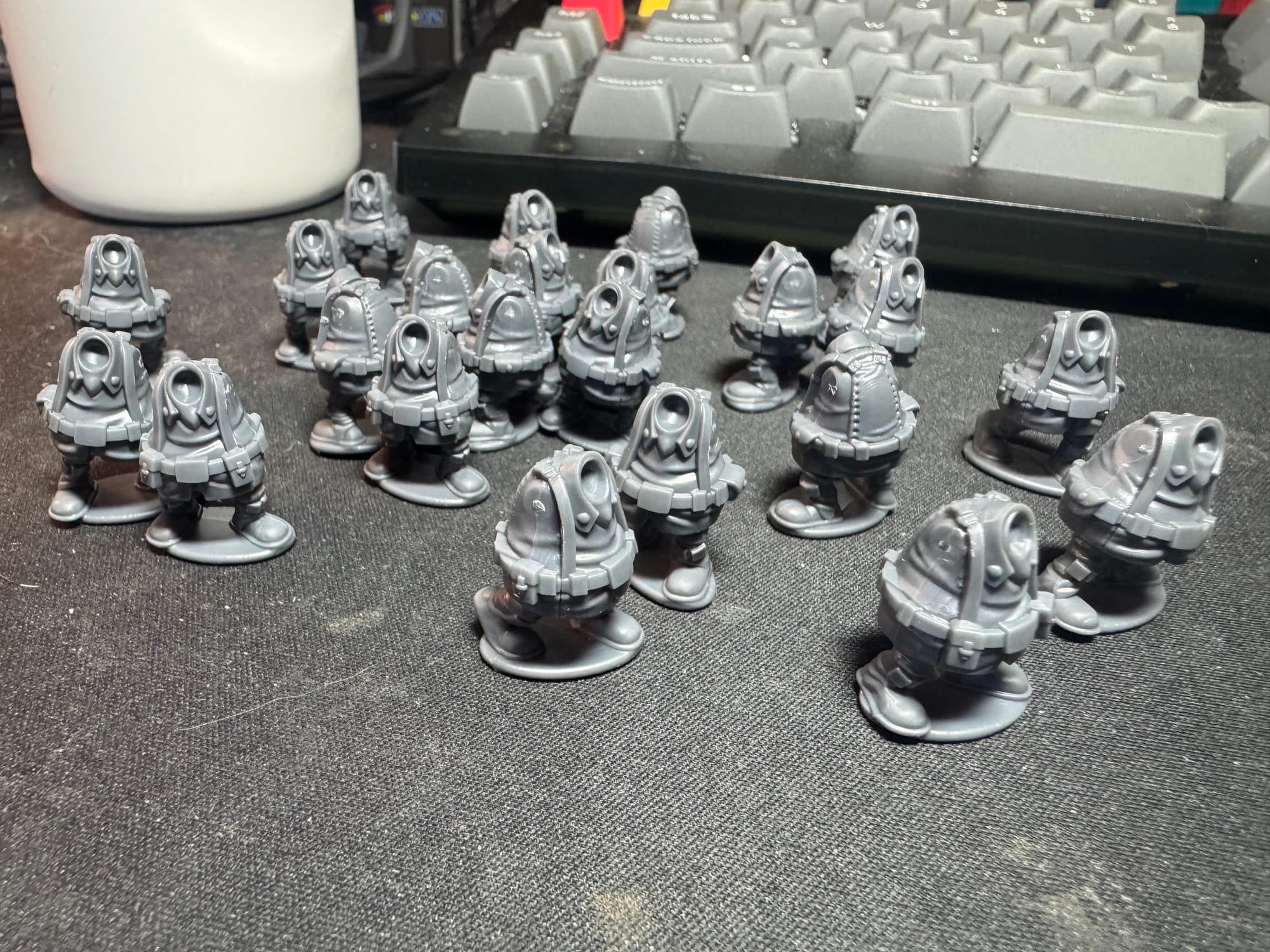
But then I discovered Brite Minis, a miniature sculptor that specializes in what's referred to as "supportless" miniature design. Simplified, classic-looking, easy to print, and distinctively vibey, they drew me in just to see what they'd look like coming off the hotbed of my A1.
They looked great. I fussed over them like a proud bird with her hatchlings.
I love these little dudes, I thought.
Now, what can I play with them?
Touch Controls
Honestly, it was really only a matter of time. I'm a known advocate for solo and cooperative board gaming — Final Girl is probably my favorite game of the last decade, video- or otherwise. I've spent hundreds of hours playing roll-'n'-look-up-a-table-'n'-write solo dungeon crawler stuff like 2D6 Dungeon and Four Against Darkness.
While my childhood and early adulthood was dominated by MMORPGs and 5v5 MOBAs, my mid-to-late 30s have led me down a path of increasingly quiet, small affairs. In the past couple years, I've explored the new explosion of board games (ya'll heard of this Spirit Island thing? Pretty good), spent too much money on living card games (the new edition of Arkham Horror: The Card Game is exceptional, much to my chagrin), and rediscovered a deep, character-defining love of Magic: The Gathering (the single greatest competitive game since chess).
It's the physicality of the games that has really drawn me to them. The feel of moving a piece around a board, playing a card onto a table, and (god, yes) rolling a pile of dice.
Video games have slowly done their best to remove all abstraction from play. The never-ending chase of graphical fidelity in AAA gaming has, for me, done damage to the separation between my world and those in the fantasies of the games. I know exactly what every button press, every keystroke looks like when translated to an animation on screen. There's no room for whimsy, for wonder (at least in AAA).
With tabletop games, the abstraction is everything. You slide your character across the table to symbolize running, with each space on a board symbolizing a few steps. You roll dice to simulate the weird randomness that the real world produces. And in miniature wargames, that dice roll can also represent one of your characters trying something sweet, like leaping across a crevasse and stabbing a demon in the throat.
Or, if you're me, completely screwing that up and falling to your death.
With physical games, the abstraction is the point. It's what makes the cinematic "trailer" for This Quar's War: Clash of Rhyfles kind of embarrassing, while the tabletop wargame is one of the most charming, wonderfully imaginative tabletop games going right now.
There Is Only Quar
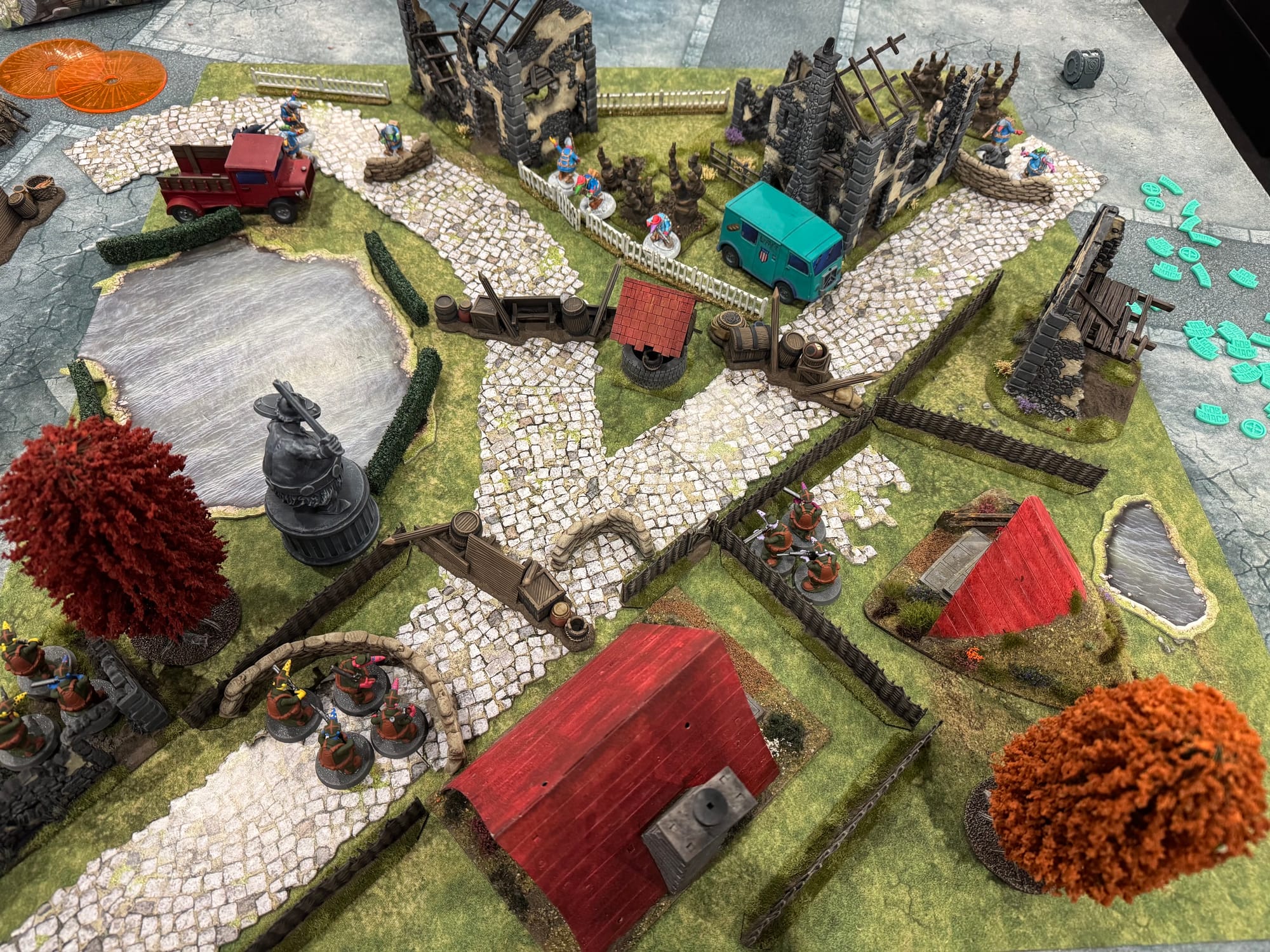
This Quar's War: Clash of Rhyfles is as close to a "main" game as anything else I've been playing since my initial forays into tabletop wargaming. Basically, it's a game about a never-ending World War I, but instead of horrifying trench warfare and shellshock, there's adorable little aardvarks-by-way-of-Jim-Henson soldiers who love tea and smoking cigs. Sometimes they bring their grandma into battle.
Quar is what's called a skirmish game, basically a game where you control a small warband of, typically, 6-12 units, rather than the large-scale armies you may associate with the hobby if you're only familiar with Warhammer 40,000.
It's also adorable. When a Quar gets shot at, they choose to either return fire or Skedaddle, diving behind the nearest bit of cover to gain a defensive advantage at the cost of having to get back up. Their tanks are called "Tractors." They drink tea or eat cupcakes made of bugs to regain health. Their wartime messages are carried by pykpyk, chipmunk-like creatures who carry scrolls across tree branches, granting you the more information on activations or the ability to reroll your opponents' dice. You can spend a resource called Pluck to cheat, but only a little bit, like adjusting a dice roll by a single digit.
The game is silly, fast-paced, and great for the miniature wargame curious. Its core mechanic revolves around you not knowing exactly how many of your units you'll be able to "activate" per turn, which leads to some hilariously unbalanced games, but hey, war ain't fair.
Quar was the first game I bought and painted enough miniatures to field my own squad for. I've since helped teach it at a small convention here in LA, and go to a monthly game night at my local shop (shoutout LA Wargames, the galaxy's greatest hobby shop).
Skirmish Mode
Since Quar entered my life, I've become more and more interested in skirmish-scale games. The 800-ton juggernaut in that particular room is Warhammer 40,000: Kill Team, which I have found pleasure in painting and fielding my Sanctifiers team—I'm a sucker for Space Catholics, after all.
The thing about skirmish games, though, is that they're much more accessible than army scale games. Rather than spending over a thousand bucks on a Warhammer 40,000 army, you can grab a skirmish warband for like $50 or $60. Sometimes $70 if you're messing with the Games Workshop stuff.
That means you can play more of them. And, as it turns out, there's a ton of great ones, especially in the indie game scene. In fact, my 2026 prediction is that skirmish miniature wargames are going to be the next big thing as collectible card games begin their descent after the speculation-pushed highs of the past few years.
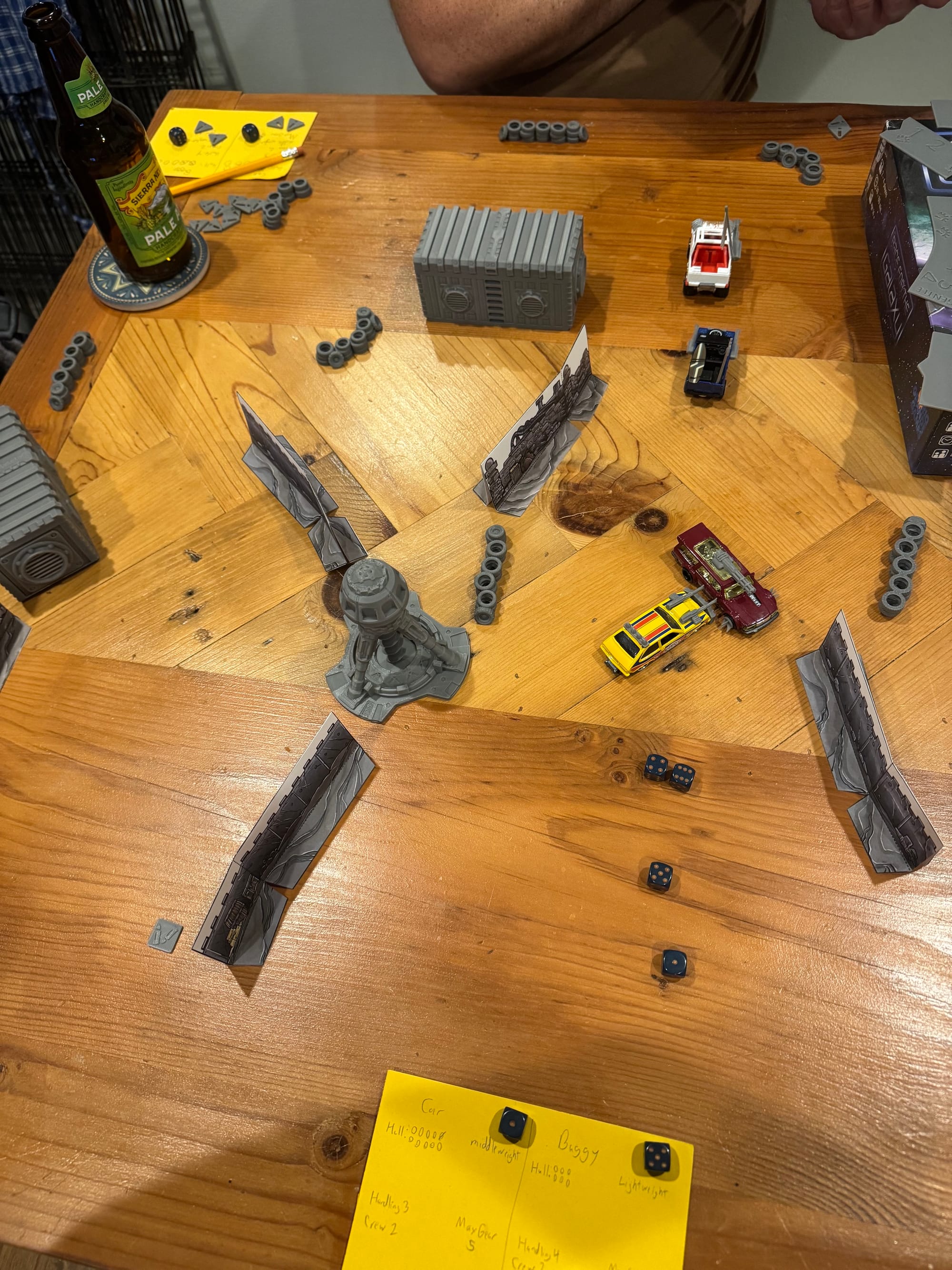
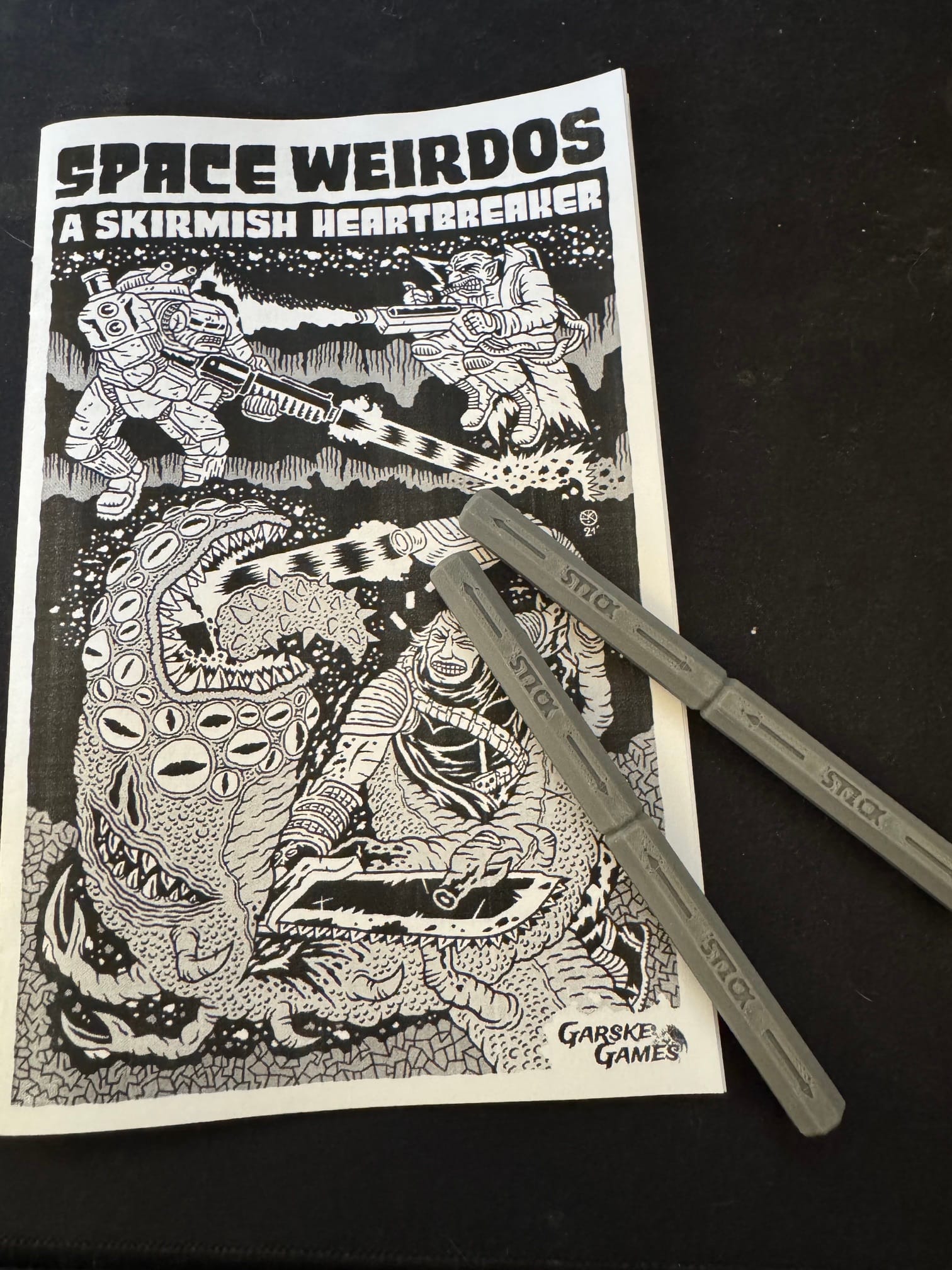
Space Weirdos is one of my favorites, and that's a 16 page zine you can grab for $5 and print at home. I love Gaslands, a game played with Hot Wheels cars. 1490 Doom is the new hotness in the space, and that's all about climbing a castle to avoid a rising poisonous fog before punting your enemies off the parapet. I'm really stoked to get Greathelm to the table, which is played entirely on an 8.5x11 piece of paper. I've even gotten into some games intended to play solo like 5 Parsecs From Home and Rangers of Shadow Deep. For the mech sickos in the room, Flames of Orion is a blast. All skirmish games, all dope.
I really love the customizability of skirmish games. There aren't any fodder units here, only those you care about and have spent time working on. You have to be dedicated to your little roster of dudes.
For most of the games I listed above, you can use whatever you want to represent your little warband. I've used my printed Brite Minis for Spaces Weirdos, knight miniatures I bought from Wargames Atlantic for Greathelm, and figures meant for Battletech to play Flames of Orion. Sure, some companies would prefer you use their official models for their games (looking at you, Games Workshop's Warhammer line), but there's a wide world out there for those that prefer to print out their own stuff. Even with Warhammer, most people don't care if you "proxy" or have other representations of units for their games. It only really matters in official tournament settings.
Sometimes I do feel like I'm missing the grand scale that comes from army-scale games. That feeling of slamming dozens if not hundreds of dudes together, moving entire units across those huge 6-foot-by-4-foot tables you see in hobby shops. Those much larger games dominate the history of the hobby after all, and sometimes I sometimes feel like the new guy in the room bringing his scrubby tastes to the table. There's a long history of miniature wargames involving massive armies of guys, and I'd be sad to see that go away—even if I don't feel the pull to paint up that many dudes.
Crafting Community
Honestly though, even with my smaller unit count games, I've spent way more time prepping for games than actually playing them. Painting 28mm tall miniatures takes way, way longer than you think, and making your terrain pieces look good takes significant time and effort. I've spent hundreds of hours just crafting alone! And that's not even counting all the countless hours watching YouTube videos to learn new techniques, or chatting with more experienced buddies and in Discord channels to learn how they make their stuff look so rad.
For my fellow beginners, I highly recommend just watching YouTubers for painting tips. Sure, you could read this absurd Reddit post and figure stuff out, but that's mad overwhelming. Instead, check out EonsOfBattle, Ninjon, or the mighty Duncan Rhodes. They're all great for learning—or in my case, finding out about—new painting techniques. Just remember: learning to thin your paints is absolutely the most important thing you need to know.
But when I do get them to the table, I'm treated to exclamations about how good my stuff looks, and even though I know I'm still very early in my wargaming journey, that feels good. In this community of wargaming folks in Los Angeles, I'm the new guy, the excited neophyte.
But even I know that excitement to see everyone's painted units, to see the choices they made when designing their warbands and armies. The need to dedicate dozens of hours before even starting a game is unique to miniatures wargaming. No other games, board or video or collectible card, require that investment.
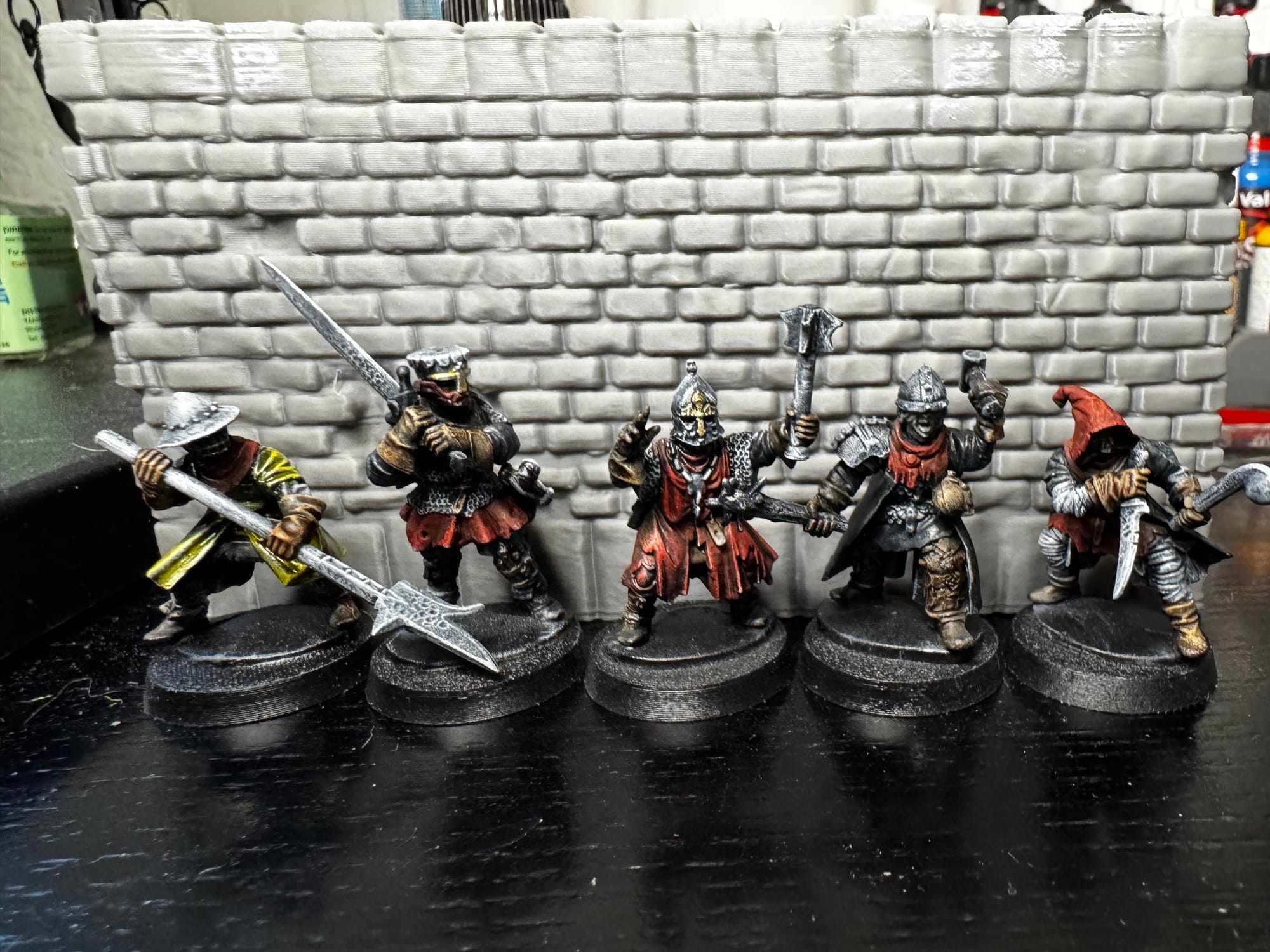
So when people do, the folks around them appreciate it. They bring you in with open arms. And in a gaming world that's been increasingly anonymized, it's nice to stand across the table from someone who has poured just as much time into this hobby as you have. You get to lock eyes, chuck a handful of dice, and pray for the good rolls. Games don't inherently form communities, but they are great tools for creating them.
The wild thing is, right now is the best time there's ever been to get bit by the miniature wargaming bug. 3D printing is easier than ever, and that has coincided with the rise of "miniature agnostic" indie games—games that don't require specific miniatures to play, instead opting for a, "Hey, grab whatever you've got laying around and get them to the table" mentality. The result is an explosion of 3D printable miniatures and games encouraging using whatever you've got (see One Page Rules for a mini agnostic wargame and the gigantic MyMiniFactory store for the constant stream of new miniatures).
That laissez faire attitude extends to the rules of these games, too. Clash of Rhyfles' rulebook opens with a chapter stating "The most important thing is to enjoy the experience... Otherwise the game becomes as depressing as war truly is, and where is the fun in that?" Mike Hutchinson encourages chaos, stating in the rulebook for his post-apocalyptic vehicular warfare game, "In Gaslands, if a rule is unclear, choose whichever option results in the most carnage for all concerned"
In the niche space that's so focused on large-scale conflict and the seriousness of warfare, it's borderline revolutionary for this generation of games to encourage just getting together and playing. These skirmish games allow you to play faster, simpler, and—maybe most importantly—cheaper than ever before. It feels good to finally dive into something that I've always been curious about, but too intimidated to make the full leap.
In truth, Space Weirdos was the first game I truly fell in love with, and not least of all because its 16-page zine style rulebook introduces itself simply: "More than anything, the goal of this game is to get your minis on the table and killing each other. Break out your oldhammer, your newhammer, your Blanchitsu and Inq28’s, your kitbashed Heroclix, the weird 90’s minis that you don’t remember what game they’re from anymore…whatever you got, and get Weird."