
Memory is a recurring, fundamental idea in Latin American fiction. The burying and the unearthing of it. The power that lies in dictating what is retained and what is forgotten.
Gabriel García Márquez’ Buendía family keep giving their children the same names, committing the same sins; recurrence is itself a theme. Stand-ins for an elite terminally committed to their own ahistorical fantasies, they forget the nightmares of their ancestors and those nightmares come crawling out without regard for their forgetting. The protagonist of Kleber Mendonça Filho’s The Secret Agent is hunted by an intricate system of crooked cops and malignant businessmen. When they catch up to him, he leaves behind a son who has his looks, but can’t remember his face.
That someone arrived at the brilliant, obvious-in-retrospect idea of building a Roottrees-alike genealogy puzzle in a magical realist Latin American setting seems like the most natural development of this trend. Of course: What if the Roottrees (the Solanors, in Funeral for the Sun) were a tangled family tree cast from the Buendía mold; what if they were cursed to relive the same tragedies over and over again—and then forget them. On this hemisphere, history rhymes a little too much.
With all these natural parallels, Nicolás G. Cid Delgado’s Funeral for the Sun feels like an object that would need to exist even if deduction games were not having such a moment in the wake of Rootrees and Case of the Golden Idol. This year’s crop of IGF submissions featured Inkle’s TR-49, Jamwitch’s Archives of Trevosa, Evil Trout’s Incident at Galley House, and the upcoming Inkblood—those are just the ones I got around to playing.
While The Roottrees are Dead asked you to place people on a family tree, Funeral for the Sun asks you to draw the relationships between its characters yourself, slowly building a tangle of lines joining together parents to children, lovers to one another, murderers to their victims. And are there ever victims; of the 50-odd people you meet in this game, very few die well.
Mechanically, the game is an interesting synthesis of the Obra Dinn-style incremental deduction from Roottrees, and the tableaux storytelling from Golden Idol (Syncretism and synthesis; there’s another recurring Latin American theme).
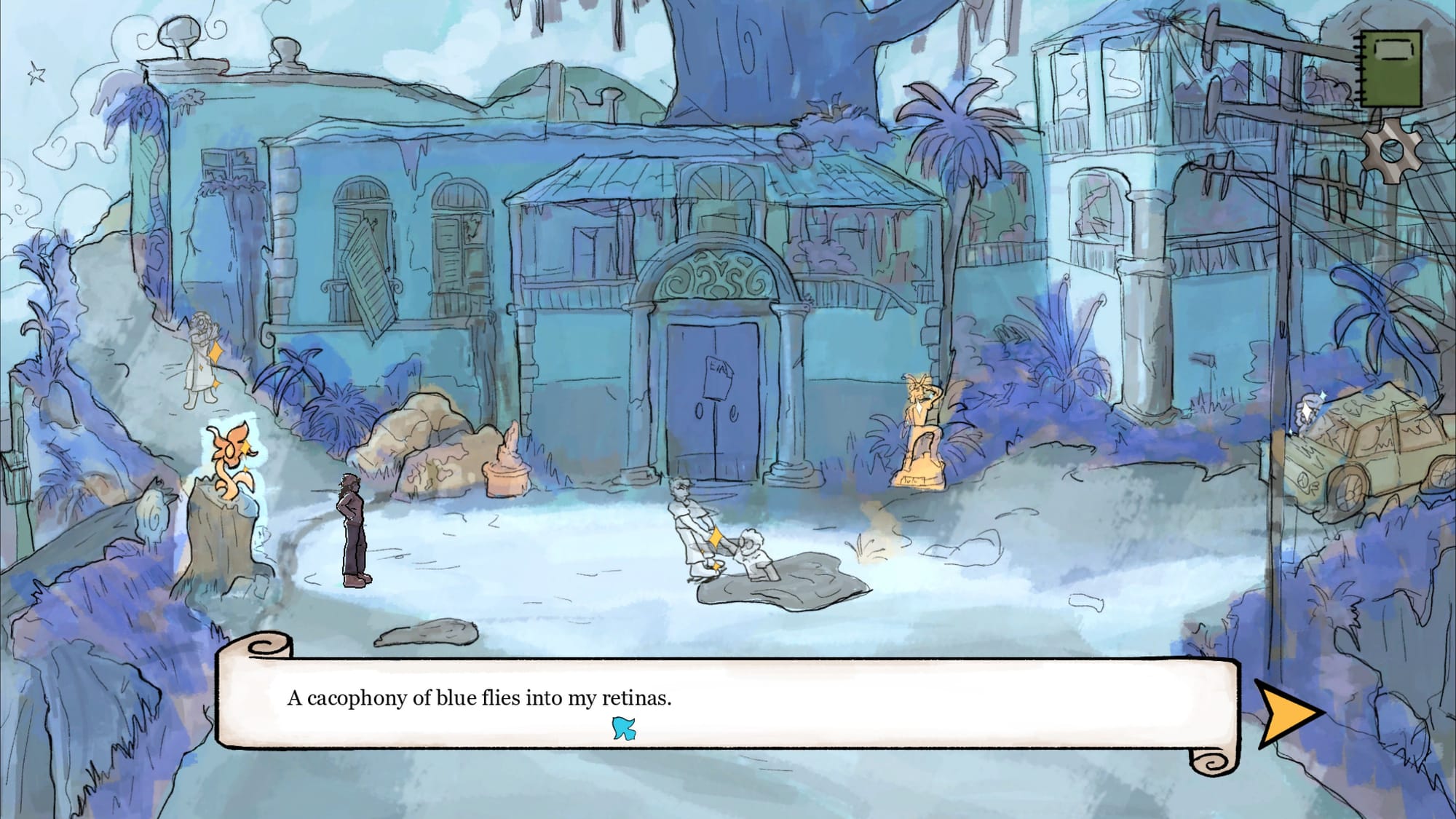
Unlike most other games in this genre (but interestingly, similar to the unreleased Inkblood), Funeral for the Sun has a fully embodied protagonist; the game is presented much like a point-and-click adventure game, exploring a fairly large world of interconnected spaces. The world contains physical evidence and environmental clues, but the main way you glean information is through strange flowers that provoke the protagonist to hallucinate the past; each one gives a glimpse into a moment in time, or perhaps a few moments in time juxtaposed.
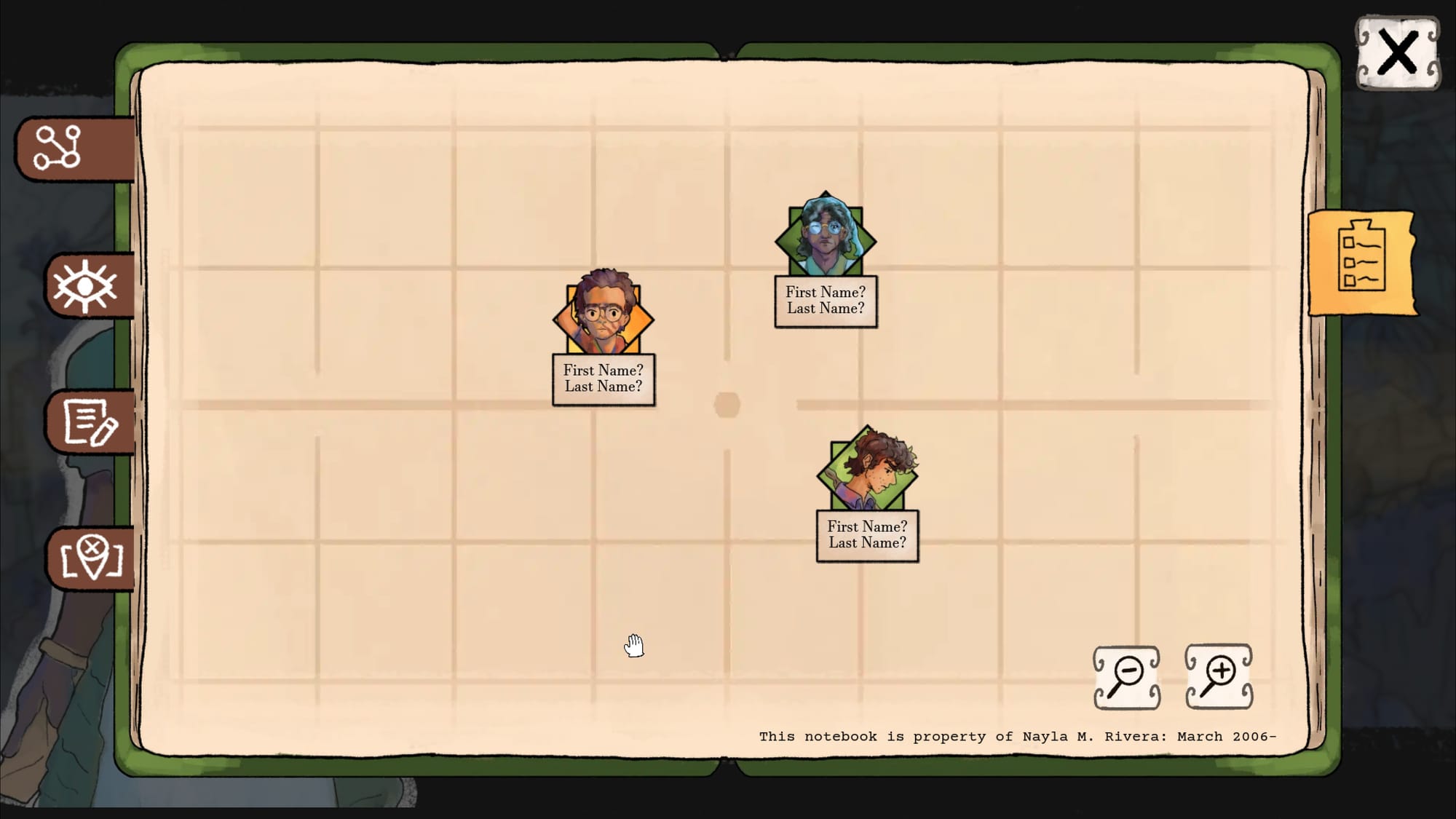
Stitching together a narrative from those loose moments is the central activity of the game. Like in Roottrees, it’s a game of putting names to faces; inferring who’s who in the scene. Funeral adds another twist to this formula by asking the player to figure out when two characters in different scenes are in fact the same person, seen at different times in their lives. As you observe the jumbled pieces of this multigenerational story, you watch children grow up and young adults grow old.
And there are a lot of characters to follow. Funeral features not only the members of the central family but the entire community that lives around them. It has a fairly large third act, the nature of which I won’t spoil, that comes largely as a surprise and contains a lot of material. In total, it’s about a third bigger than Roottrees.
It is impressive, then, that the deduction-puzzle aspect of this game never loses steam; it slowly drip-feeds the player new twists and new design space. There are cases of uncertain parentage, of characters concealing their identity, of unusual naming conventions. There are illicit relationships you need to infer, and murders you have scant evidence to solve. The game always gives you access to a bit more information than you need to progress; in fact it’s possible to finish without finding every last character name and relationship. I found this to be generally a good thing—in my playthrough, I was never well and truly stuck, but neither did I find that the game was rushing me through its material.
All of this adds up to a good version of a deduction game, but what takes it over the top is the strength of the storytelling. Like the other great 2026 game in this genre, Incident at Galley House—another game about memory, now that I think about it—Funeral for the Sun has a more serious tone and more serious subject matter than most predecessors.
It’s aiming at a type of story, and a type of literary storytelling, that people have tried in video games before; What Remains of Edith Finch comes to mind, though I think this game’s narrative is substantially stronger. Specifically, it’s stronger because it actually deploys the social realism of the tradition it’s operating in.
Magical realism is sometimes mischaracterized as taking place in a world where the fantastical and the mundane happily coexist—but here, where the fantastical and the mundane rub up against each other is a site of skin-crawling discomfort. The emergence of the supernatural coincides with profound tragedies and great irruptions of violence.
Really, the most prevalent magic in this world doesn’t quite present as magic; it presents in the cursed way that history keeps repeating itself. Different corpses falling into the same fountain, decades apart. A gringo corporate raider parks his yacht in the same bay that once hosted Spanish caravels. A woman sets herself alight for little reason other than as a recapitulation of a long-lost ancestor’s death.
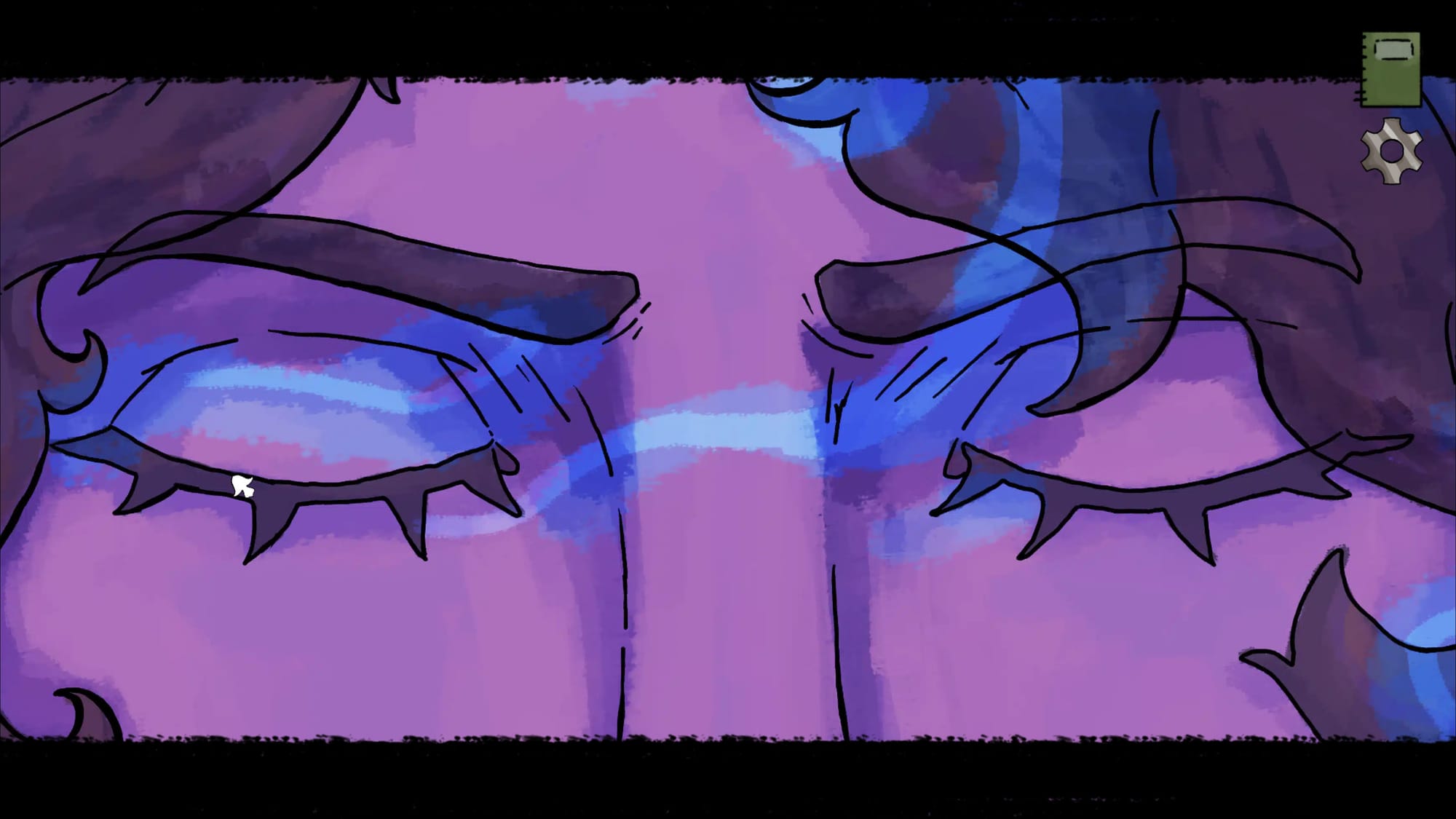
If memory is a recurring theme in Latin American fiction, then colonialism is its hyperobject; the all-consuming, suffocating fact that hangs over everyone and everything, impossible to acknowledge for its enormity. The isolated jungle town in Funeral sits on top of an oil field, and the moment you find that out you can already see how badly it will play out for the people of the town.
This narrative fatalism is one of the game’s strengths. While the game is set in a fictional Latin American country with a fictionalized history, that fiction is a very well-researched amalgam of real history; the names and dates are different, but the general tenor of events is nauseatingly recognizable. The game’s deduction puzzles are often structured to reward this kind of contextual knowledge. It invites the player to recognize how those broad social and historical dynamics are playing out at the level of these individual characters and to follow that thread to inferences about how these characters relate to one another.
This gets at why this game is a real achievement: It’s a story with more emotional and dramatic punch than we’ve seen in similar games before, but in a way where the deduction aspect of the game intertwines with that emotional impact. Many of the deductions here work as emotional payoffs as well as satisfying moments of puzzle-solving.
All of this is wrapped together in a presentation that’s very effective. The illustrated portraits of the characters stand out for their expressiveness; each one feels like a real window into what that person is like, not just a face to pin to a name but a sense of their affect, their attitude, their place in the world, even their view of themselves. At the same time, it can feel visually unpolished. This is a true solo-dev project, and not all of the 2D art here got the same level of time investment and detail.
I really don’t think this detracts from the game in a meaningful way, though. I worry that we’re in a moment in games culture where we expect so much polish and so much perfection out of small indies that people might gloss over a game like this, which has had enormous care and attention put into it even if it isn’t “glossy” in a way that communicates “buy this.”
The scope and ambition here, both narratively and in terms of the actual scale of the game, is significantly bigger than something like Case of the Golden Idol. It is understandable that some of the art is more gestural than completely rendered. But the visual intent of the game—with alt-comic-inspired character illustrations and a color palette that shifts to entirely different colors in different time periods—comes across as carefully thought out and intensely original.
The game’s soundscape is a huge lift to the entire experience, too. While exploring the ruined town of Cierro Milagroso, you hear only an ambient soundscape: jungle animals, rushing water, the wind. But as soon as you enter one of the game’s hallucinatory flashbacks, music kicks in. The original soundtrack is an appropriately syncretic (there’s that word again) mix of rock and Latin American sounds which very deliberately sets the tone of each scene.
In a game where you’re constantly dipping in and out of these flashbacks, sometimes seeing tonally jarring things juxtaposed against one another, the soundtrack works very effectively to give the player an emotional center to hold on to. Many of the people you meet in Funeral for the Sun will live unhappily and die badly. But the game is never not interested in the humanity, joy, and connection that they live out in the memories you’re dredging out of the jungle, and the music works to bring those moments to life.
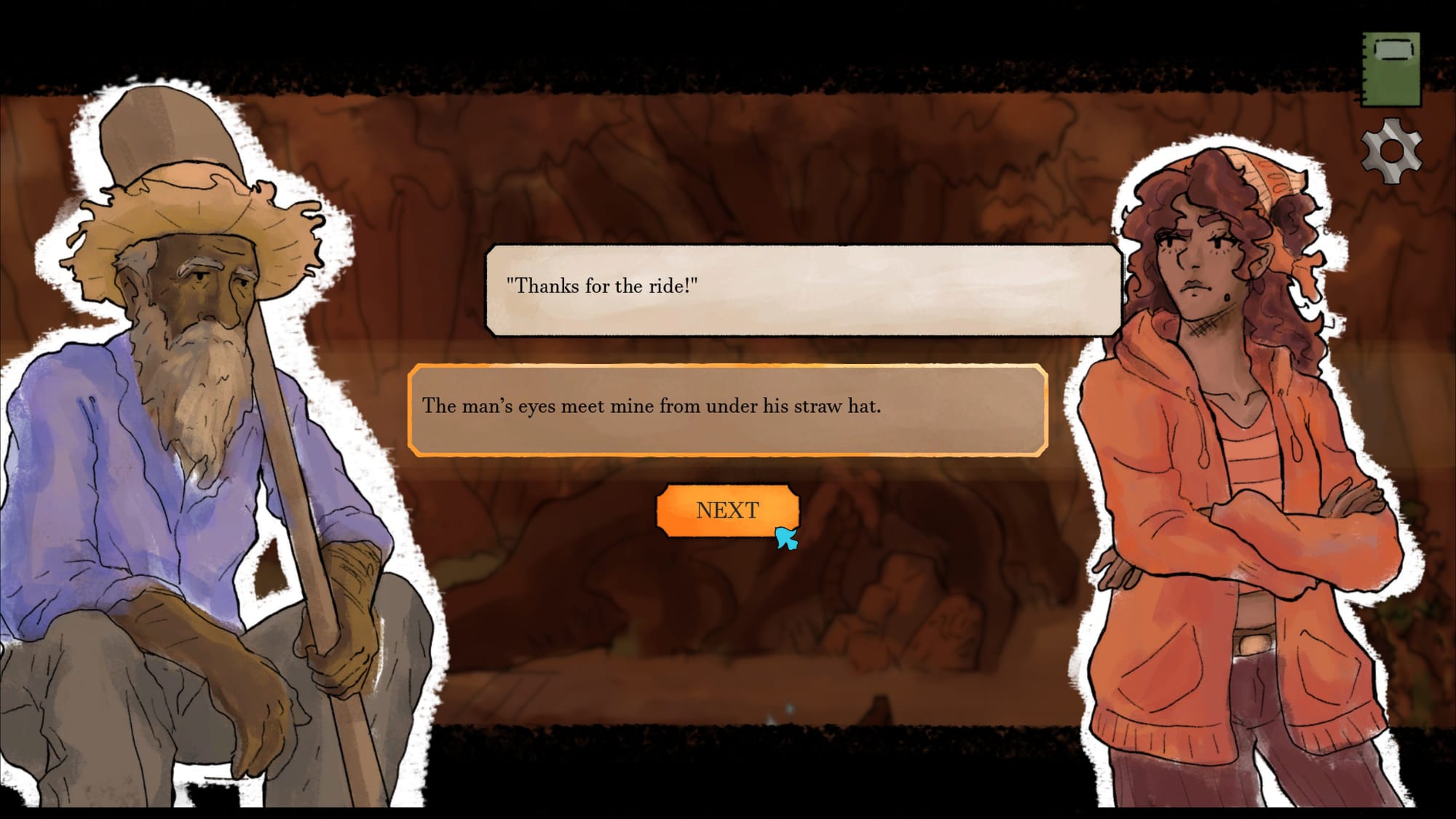
Most games like these are essentially epistolary; they tell their events through documents, letters, texts about people rather than depictions of people. Case of the Golden Idol and Incident at Galley House give you a direct experience of their characters, but neither has the personal, intimate tone that this game has, nor their sense of history. This is a game in which you will see two characters for the first time and immediately realize: These two are going to end up together. Or: These two are going to come to blows. It achieves this largely through solid writing, expressive character portraits, and a great soundtrack.
It’s a game that invites you, and rewards you, for noticing these little dynamics; it’s a game about them as much as it is about logical deduction. It’s a game where the writing, the art, and the music actually deliver all of those scenes a very real sense of character dynamics. It really is working at the level of coming to truly know these people, not just correlating all the facts of their lives.
In front of the Barra Funda metro train terminal in São Paulo there’s a large complex of cultural institutions, the Latin American memorial. Designed by Oscar Niemeyer, the architect of more or less every other grandiose public building in Brazil, the entire thing surrounds a stark concrete plaza. For the center of that plaza, he also designed a sculpture; an angular representation of an open hand, itself made of raw concrete, with a bas-relief in the shape of South and Central America carved out of it and painted bright red to resemble a rivulet of blood. It’s a blunt reification of Eduardo Galeano’s metaphor; the literally concretized Open Veins of Latin America. Over a decade ago I’d commute to school through that station and thus walk past that sculpture. It faces the street, and from the street that wound that never stops bleeding seems like the only patch of color in the entire space, a lonely red stain among the whites and grays of all that concrete.
Blood is another of those recurring, overriding themes. History everywhere is drenched in it, of course; no continent has a monopoly on that. But in Latin America it takes on a particular dual meaning. The root of Latin American identity is buried in the reality of colonized and enslaved people bearing the children of their colonizers; this is something that has been romanticized, that has been mythologized, that has been looked at coldly for the horrors that it implies. That question of memory, too, emerges from the dim awareness that you exist in the wake of profound crimes.
If I have to turn a critical side-eye at Funeral for the Sun, it’s at its tendency to verge towards that romantic impulse; but even as it leans in that direction, it eventually (with fatalistic inevitability, in fact) lists back towards a much dimmer view of history. One of the very first leaps of deduction in the game is about recognizing a scar, a wound, on someone’s face. Again, the three kinds of relationships the game asks you to suss out: parentage, coupling, and murder. Blood that ties; blood that mixes together; blood that spills out into the black earth, opening doors that never really close.
Later on, the game asks you to realize that two characters with similar scars are not in fact the same person—they are simply victims of a great recurrence of events that they themselves would hardly understand. The blood that keeps pouring out of those veins collects in strange loops; characters echo each other, unwittingly recapitulating crimes that happened far away in time but distressingly close in space. History rhymes a little too much. The more you walk the bombed-out town and its ruined oilfield, the more the tar coming out of the ground starts to look like the welling up of blood.
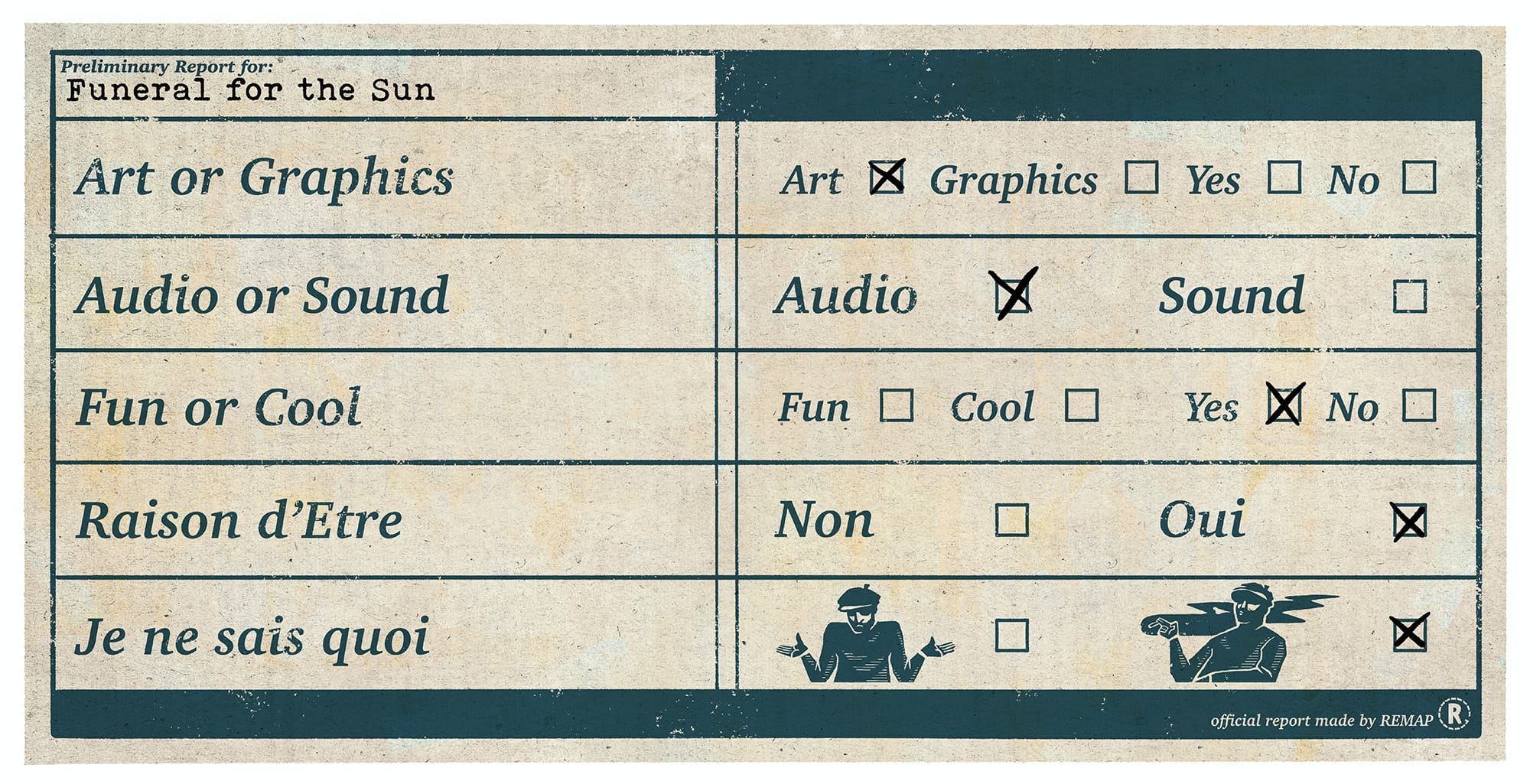
Funeral for the Sun retains a sense of mystery even after I had named most of its characters and drawn most of the arrows between them. Appropriately to its magical realist ideals, it contains both facts that you can capture and numinous ideas that are never really meant to be fully explained. I think the ideas and images here will sit with me for an unusually long time. The game raises the bar for the genre, in terms of narrative ambition and thematic depth.
It is a must-play for fans of deduction games; it may also be your entry into the genre if you thought The Roottrees are Dead was too dry. I think it will appeal to anyone who loved What Remains of Edith Finch. It is easily one of the best games of the year, and in my view the best out of an already very strong crop of deduction games.