It’s never been harder to have your game get noticed. Most websites are dead or understaffed, platforms like Steam have gone all-in on inventory over curation, and traditional advertising feels like burning money. One path had potential, though: going viral on social media. If a short clip of your game could garner attention on places like TikTok, it could drive attention (and wishlists) on Steam.
But that potential blessing has become an unexpected curse in the AI age. What if your viral clip contains enough for a random person to build a copy of the game you’re not even done making yet? This is not a hypothetical, either; it’s a very real fear and it’s already changing how games are made.
“I had this joke in my head that I was going to make a clone of my own game,” said Sloppy Forgeries designer Jonah Warren during a recent interview.
Sloppy Forgeries is a game about trying (and humorously failing) to replicate classical works of art. With an imperfect set of tools, you are tasked with copying genius. The fun is found in the chaotic imperfections and the anxieties of a time crunch. Ironic, then, that Sloppy Forgeries is only being released now, during one of the most chaotic release seasons in history, over fears of being copied.
To be specific: fears it would be copied more. The copying had already been happening.
Now, the basic conceit of Sloppy Forgeries—trying to copy a picture and doing so poorly—is not new. Most game ideas rarely are. It’s not exactly Pictionary, but you can see the line connecting Pictionary and Sloppy Forgeries. There’s 2023’s Clone-a-Lisa, where you “paint a forgery in 60 seconds” of the Mona Lisa. Forgeous played with similar ideas and also launched in 2023. Sloppy Forgeries itself is an idea that’s been in Warren’s head for a long time—the game was shown at E3! It's been shown publicly, in some form, since 2018.
Picking up where other creators have left off is bedrock to game design. The medium demands it. But the line between inspiration and plagiarism is very slippery in 2026, and the time between a good idea and a cloned idea has never been faster. Control over copyright has never been looser.
“That it [cloning] can happen now before you release the game to me was the worst,” said Warren. “If these [copies] come out after me, whatever, that's totally fine. I have at least made my mark.”
art19:2ca92bd8-646c-45f7-9cb7-65d0d3f2032b
What Sloppy Forgeries landed on, what makes it feel distinctly unique, is a few things.
One, it’s the Jackbox-inspired pressure cooker nature of mimicking a masterwork art piece while playing with friends or strangers. The game’s approach to abstracting classical art is a specific aesthetic choice. The tools available to the player—colors, brush sizes—are a specific design choice. Finally, the way “scoring” is conceptualized and visualized to the player is a specific UI choice.
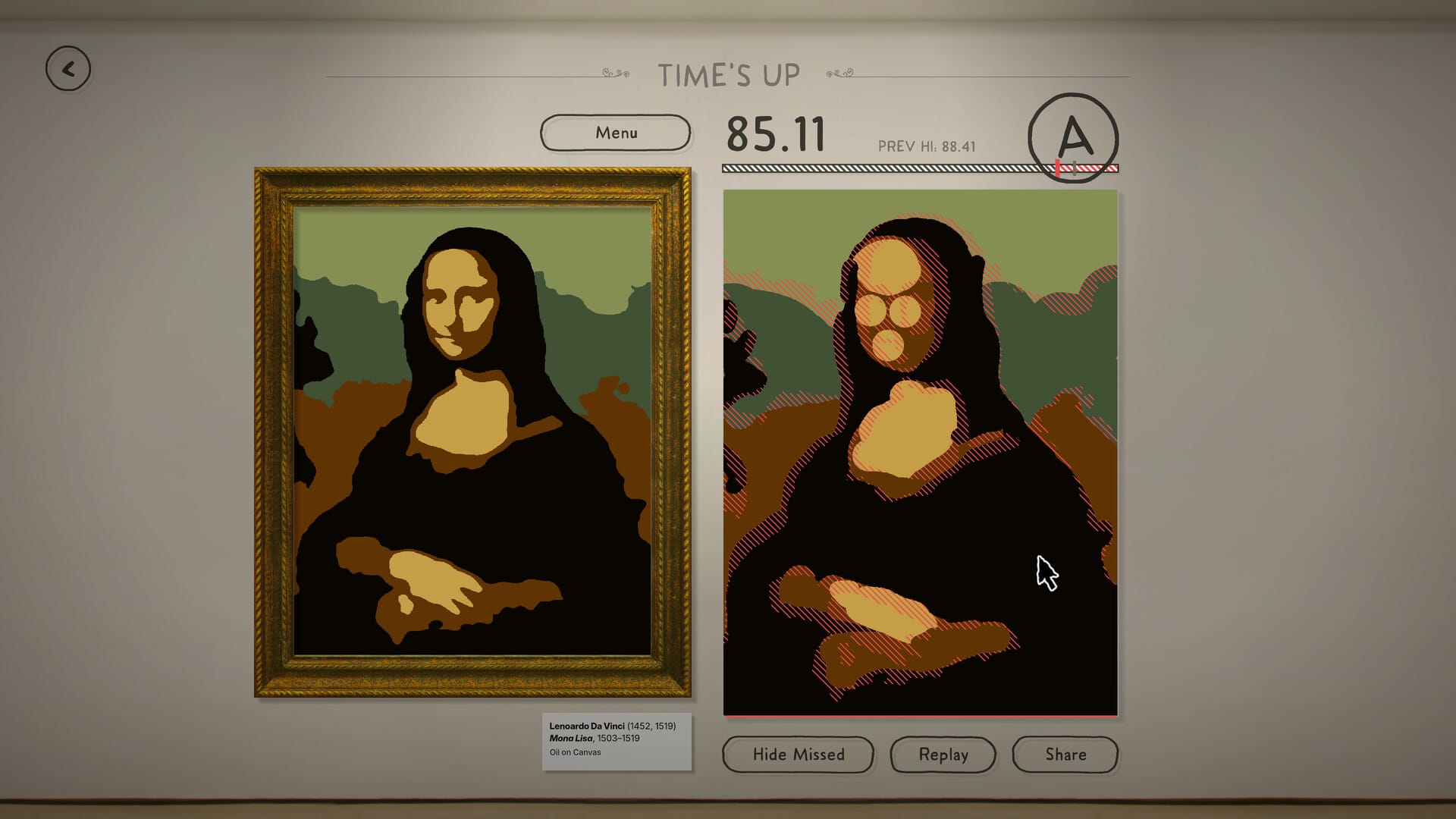
Sloppy Forgeries was supposed to be released a few months from now. Sure, maybe a video game is never “done,” but Warren had a specific roadmap for what he wanted to include in the game at launch. An unexpected event this summer began a pivot that continued to play out this fall.
“I’d posted some clips that started to take off and go a little viral,” said Warren. “There’s this thing on Instagram where people just say, don't let Roblox devs see this. They're just gonna copy it.”
Warren was posting clips on Instagram with tens of thousands of views. He was following the playbook to increase his chances at exposure. And if you check the comments, it’s exactly how Warren describes it.
“Copying this shit on Roblox and monetizing it heavily,” joked one user in May.
The monkey paw curled, and on June 25, just over a month later, a clone called Closest Painting Wins was on Roblox. The game has been played more than 4.5 million times. At the bottom, the game’s developer notes that Closest Painting Wins was “inspired by Sloppy Forgeries.” But due to limitations in Roblox’s interface, there’s actually no way to include a link to learn more about it.
Warren, however, isn’t so sure that was even meant in good faith.
“I think they probably put it there so that it showed up in Google,” he said.
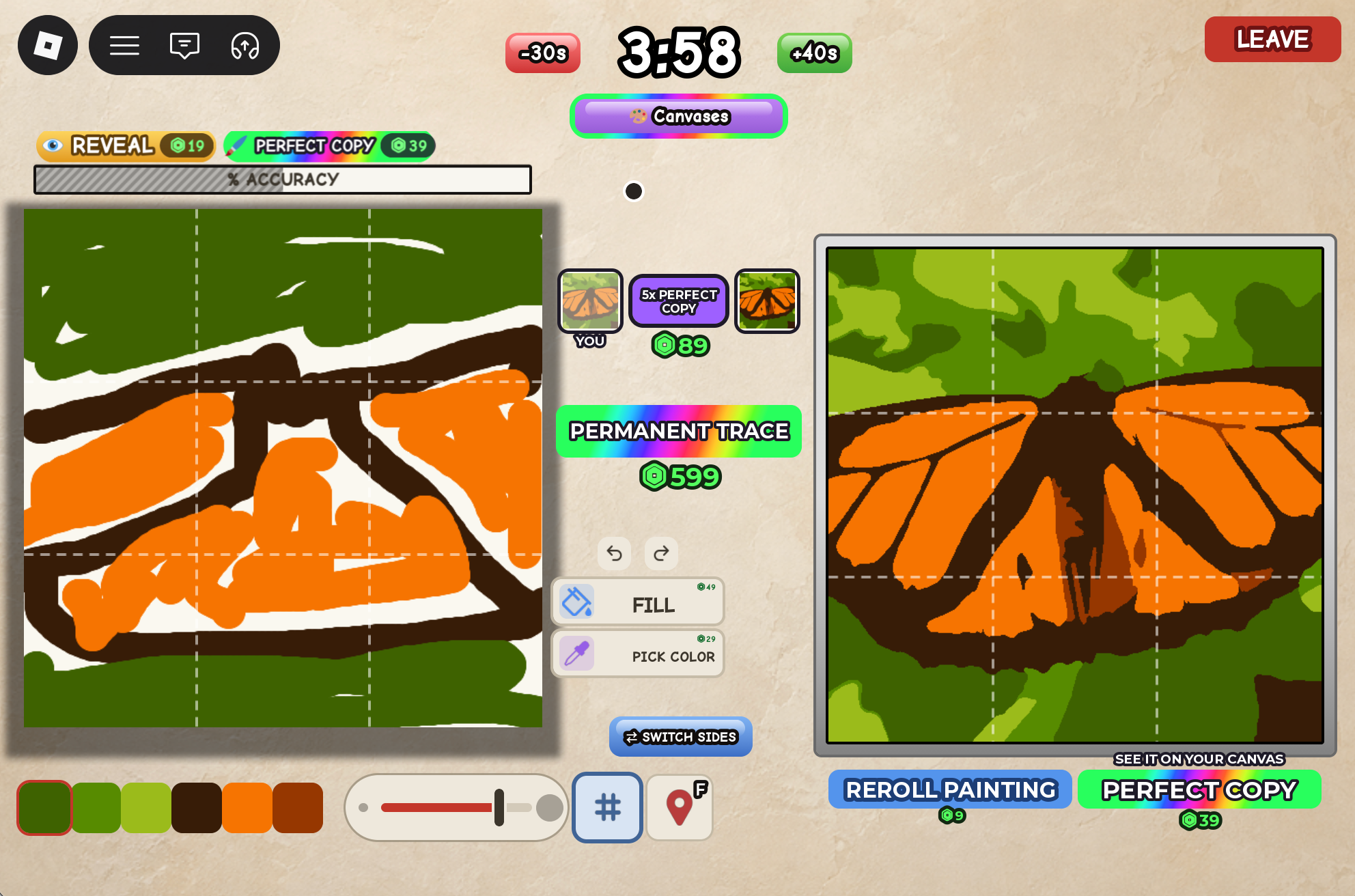
Closest Painting Wins’ developer, a Roblox creator by the name of faderanat, did not respond to a request for comment. Warren has also never heard from the creator of Closest Painting Wins.
Roblox clones are not new. What is new is the rapid pace that Roblox has fully embraced AI-assisted tools for creators. Roblox, like Steam, wants as much content on its platform as possible, and unlike Steam, there are no AI disclosures required and the audience is far less discerning because….they’re kids. Children are not flicking through games worrying about AI. It’s just content.
(It's not known if Closest Painting Wins used AI tools.)
It’s not clear if a Roblox clone is a death sentence for a game. Is it closer to piracy? A person who plays Closest Painting Wins on Roblox was probably never going to buy Sloppy Forgeries on Steam.
“Since you can't really copyright ideas, if you do have a viral idea and it goes to other places like Roblox, which has a largely parallel audience to Steam, you can be flattered, but it won't necessarily take away from your sales directly,” said Simon Carless, founder of the game research and data analytics company Game Discover Co. “But it's definitely an indication that you need to get to market as quickly as possible!'
Mostly, it bummed Warren out.
“To be honest, I was pretty worked up about it when it happened,” said Warren. “I was checking the stats and like, is this gonna blow up? If it landed on Roblox's front page and became Dress to Impress, then I would have been upset.”
The competitive fashion game Dress to Impress has, at times, dominated Roblox, and is one of the rare games whose popularity spiraled to the point that it completely escaped containment from it.
Closest Painting Wins became popular but not written up in Vogue popular.
“That it [cloning] can happen now before you release the game to me was the worst. If these [copies] come out after me, whatever, that's totally fine. I have at least made my mark.”
Warren’s focus then turned to getting Sloppy Forgeries to a new definition of the development finish line before cloning was more problematic. But it was also causing him to second guess everything about his old plan. One of his marketing ideas was sharing the abstracted copies of paintings that he spends hours and hours working on for the game. Should he stop putting them on social media?
“I did start posting less frequently and I didn't put the new stuff up as much,” said Warren. “And then I was starting to think, should I release this earlier and faster?”
After the Roblox incident, Sloppy Forgeries was supposed to come out in January. That would give Warren the rest of the year and through the holidays. Plenty of time. Then, the Steam clones started.
A clone called, of all things, Carbon Copy. It would be humorous if it weren’t so equally audacious.
Carbon Copy was more daring than Closest Painting Wins. Some of the artwork being featured was the same. The aesthetic was very similar. The interface was—excuse me—borderline a carbon copy.
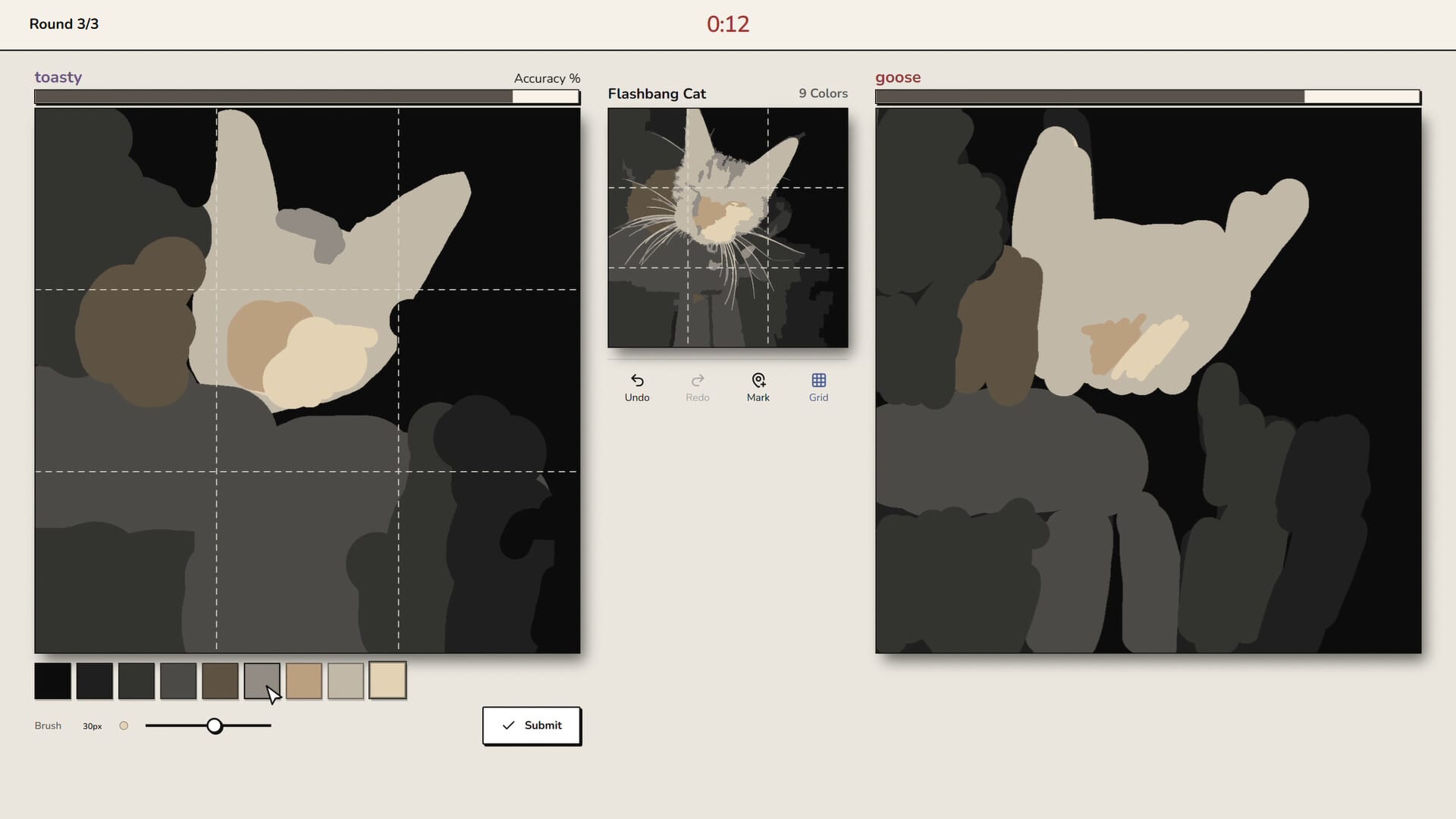
Warren ended up filing a claim with Steam, based on an in-progress copyright claim for his own game, and, eventually, it was taken down.
In early September, an Instagram handle by the name “playcarboncopy” posted a social clip that went extremely viral, reaching audiences several magnitudes higher than anything Warren had previously accomplished with Sloppy Forgeries. Hundreds of thousands of people saw this clip.
One of the top comments?
“Get ready for the Roblox copy and paste!” wrote one user.
The Steam page is no longer up, but evidence of it exists online. The viral Instagram post notes Carbon Copy’s “Steam release was unfortunately delayed due to an ongoing copyright dispute.”
“Sloppy Forgeries initially inspired us to explore competitive speed-painting,” said a person who identified themselves to Remap as “the main developer on Carbon Coby” when contacted via an email address listed on the game’s official website. “However, beyond that initial inspiration, we did not reference Sloppy Forgeries during our development process. We built Carbon Copy with our own ideas for its gameplay, multiplayer experience, and visual design.
The same developer denied using AI tools to make Carbon Coby, and claimed its “artwork and audio were either created by our team” or using “CC0” materials. (CC0 refers to “creative commons zero,” or artists who handwave copyright entirely and allow work to, in essence, become public domain.)
The main difference between the games, the developer argued, was Carbon Copy’s emphasis on allowing users to upload their own images, a feature that’s also coming to Sloppy Forgeries later.
“Our release plans were based entirely on our own development schedule, not Sloppy Forgeries' release date,” said the developer. “We simply intended to launch Carbon Copy when it was ready.”
The developer did acknowledge the game’s page was removed from Steam due to “a response to the copyright complaint itself, rather than a finding that copyright infringement had occurred.” It prompted them to “pause development.” Warren told me that the Sloppy Forgeries copyright application is “being processed” and involves the game’s “unique combination of UI/features.”
Warren produced a side-by-side comparison of the two games. You can be the judge of where this falls on the spectrum between inspiration and cloning.
Above, Sloppy Forgeries. Below, Carbon Copy.
Is that a clone? Is that inspiration?
In the end, Sloppy Forgeries is now available. (We actually streamed ourselves playing some of it last weekend.) The die has been cast. The clones might still come. But the game is, at least, out, even if, as Warren told me, “definitely soured my experience on game development a little bit.”