
Warning: What follows includes what some could feel are spoilers for the endgame of Cairn. It includes extensive discussion about a major decision at the end of the game.
You spend most video games being incrementally challenged, step by step, before arriving at the proverbial mountaintop and being asked to complete a final gauntlet. Put it all together, you bad ass gamer, and prove you’re The Best. There is no proverbial mountaintop in Cairn—it’s a literal mountaintop you’ve spent the better part of 10ish hours slowly trying to reach. In theory, it’s the whole point of playing Cairn, and the central motivation for its main character, Aava.
Yet, it’s at this point, when the endgame feels within your grasp and emotional victory—for you, for Aava—is near the game asks a shocking question: What if you just climbed back down?
“Go back down,” the game beckons. “Continue the ascent,” the game counters.
“The mountain is in my gut, deep inside,” mutters Aava, contemplating the decision, one that might be better for her life on the ground but could feel like failure while surrounding by rocks and sky.
“No, I think the mountain is all in your head,” replies Marco, a much younger climber you meet along your journey, one who also thinks you should head down. “You can heal if you want to.”
Brother, are you a bad enough gamer to prioritize your mental health?
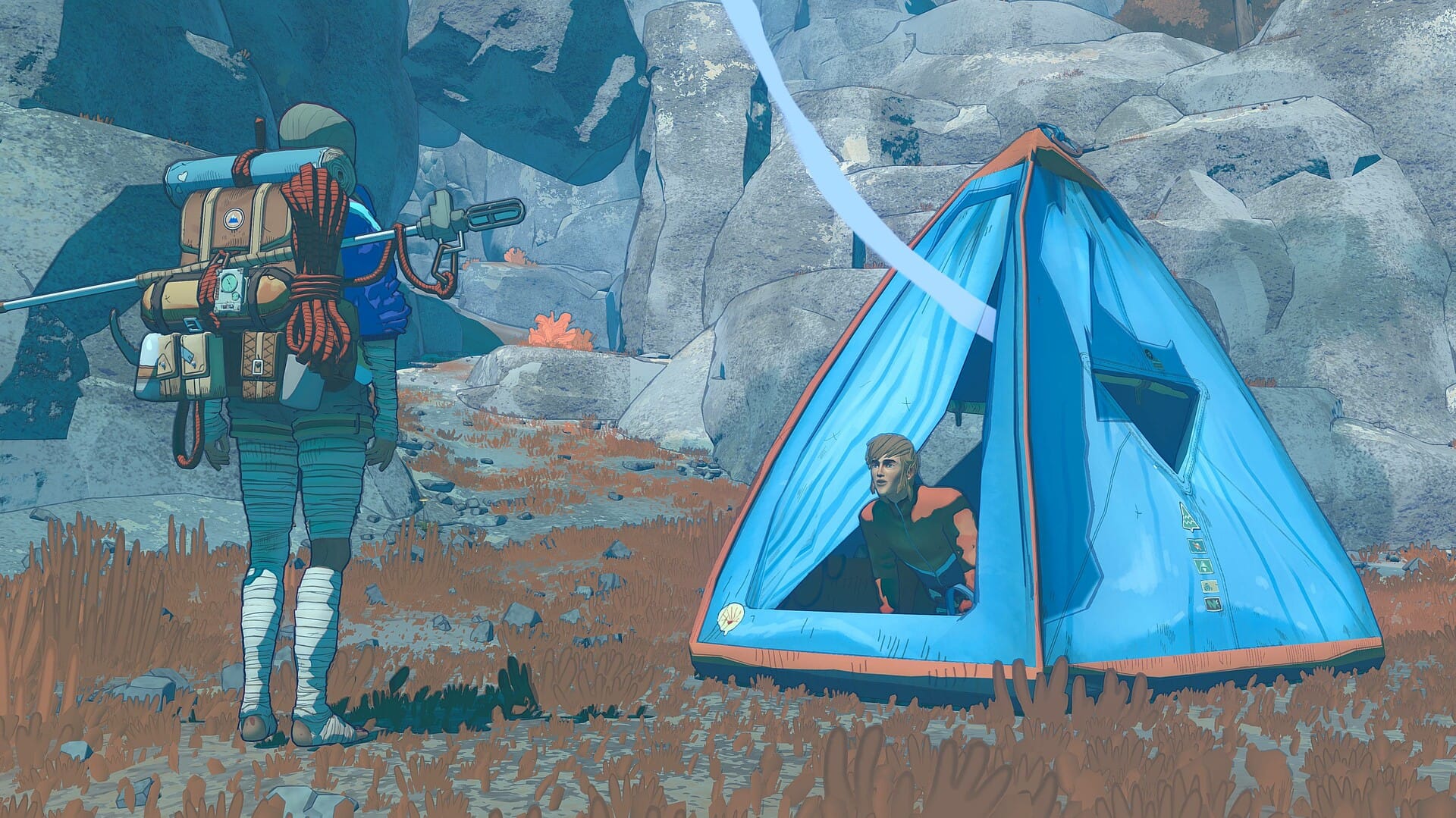
“There is always a moment where, if you do a hard climb, where you can't you can't push it away anymore that you might die and it's very present and it's in your face and you have to address take a decision,” said Audrey Leprince, co-founder and CEO of Cairn developer The Game Bakers, in an interview. “I think this is part of climbing, this is putting your life on the line, and deciding you're going to do it, even though it might cost you your life.”
As I recently highlighted on Remap, Leprince’s own father was an alpinist who directly inspired and consulted on Cairn. Her father was even part of climbs where many people lost their lives.
There’s a version of Cairn that’s purely a skill test. That version of Cairn would also be excellent, because Cairn does not wholly rely on its moving narrative to be successful. What makes Cairn remarkable is that it’s both a tremendous climbing game paired with an emotional story with real stakes. And while Cairn does not have a “good” or “bad” ending necessarily, it does tug at what you think is good for the main character, versus what’s good and satisfying for you as the player.
“We wanted the player to decide if they're gonna risk the life of their character,” said Leprince. “To do it, we pushed a little bit [on] the fourth wall there and by making the player decide ‘I'm gonna be a gamer and I’m just gonna go to the summit and that's what I know you're expecting me to do it, because we're playing a video game!’ and at the same time, the character is telling me [something different].”
Signing up is free!
By signing up—again, it costs nothing!—you can read the rest of "Cairn Pits Players Against Their Greatest Enemy: Themselves," and receive free newsletters and emailed articles from Remap!
Sign up now Already have an account? Sign in