
Amberspire: A Fascinating, Incomplete Take on the City-Builder

Featured Review Feature
Dia Lacina

In the months leading up to Amberspire, I had hoped to tell you a story. How, once, there was a City. A forge-world of kilns and furnaces. Where banners depicting soot-smeared workers proclaimed "The System is Built on Sixth Moon Steel" to the populace passing in the thoroughfares below. How trade ships bore the fruits of the Sixth Moon’s riches and ingenuity to the other Five clustering against the namesake amber glow of their gas giant, while merchants sipped alien wines from crystalline goblets in their villas overlooking swells of viscous moon-water. I’d reveal that their story was one of hubris and irony, one where the golden age they had painstakingly constructed and took for granted as their due for such cleverness was always doomed, and I’d explain that if you looked closely enough you could see the fatal flaws being built into the keystones of their monuments. 

By the book, Amberspire is the second game from Bithell Studio's Lunar Division. It is a turn-based 2D science fantasy city-builder that is powered entirely by generating and expending pools of dice. Amberspire is a game of grid-based, interdependent construction, of rhizomatic population growth, protean weather conditions, and a deck of consequential event cards. It has tiered progression, a clear win condition, a physical manual with little Destiny-like blurbs of lore, even a real consulting historian to bring it all together. If this sounds fussy, it isn't. Because really, Amberspire is a game about rolling dice and leaving a trail of forgotten cities in dust. 
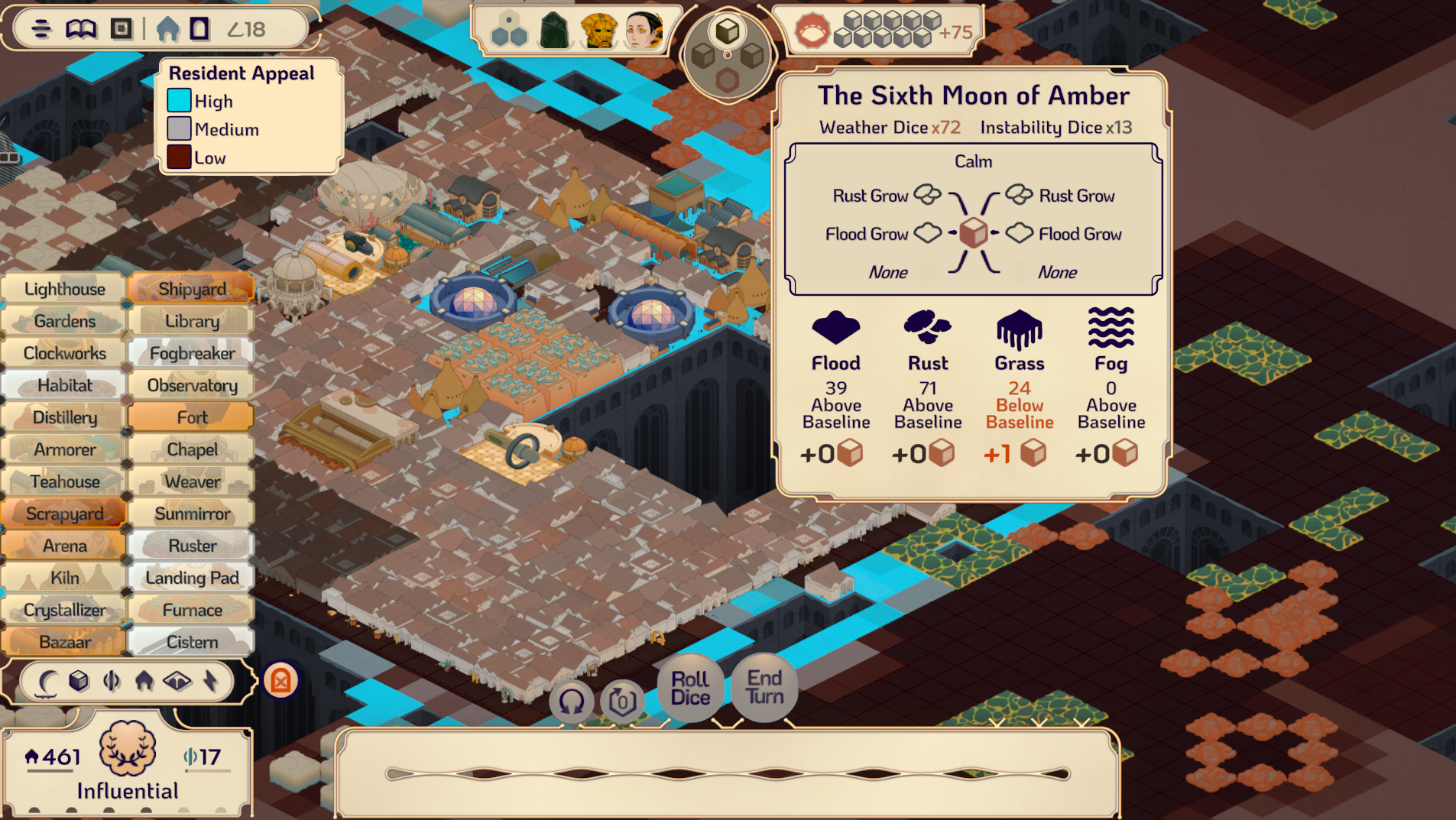
A screenshot showing a tile-based city layout, with a dense building selection interface on the left-hand side and a dice probability table on the right.

Amberspire is not a game that will construct your stories for you, however. The Sixth Moon is filled with courtly peril, mercantile intrigue, and cataclysm, but it requires a player willing to fill in those spaces. Invent those spaces, really. And to do that you’ll be rolling a lot of dice, and making things up as you go along. Gameplay is cyclical, taking place in four turns over one cycle. Three of those turns are for the player to freely place buildings, roll dice, and distribute the resources they generate. On the fourth turn, the computer gets to roll. This is where your beautiful moon-city gets Pompeii’d. Well, at least that’s the expectation. 

Mechanically, Amberspire constantly runs the risk of losing the gravity grounding its dice in the locations and concepts imperiling the pleasantries of the Sixth Moon. Because while ambient grooves of lunar chill swirl with a warm verve around the soft palette illustrations of an alien Venice, when the atmosphere is ripped away like an aesthetic caul, it reveals that underneath everything is just a game of Yahtzee with a few more moving parts inventively cannibalized from other board games.

Population and Influence are the two main stats of Amberspire, and both are required to advance through the tiers of Renown, unlocking new structures and eventually winning by accruing enough of both to establish a Golden Age. Landing Pads and Starports bring people in fast, and you build Influence with locations like Arenas and the Bazaar. Population goes down sometimes, there are some larger calamities that can happen in events, and then small scale tragedies and misfortunes during the weather phases.
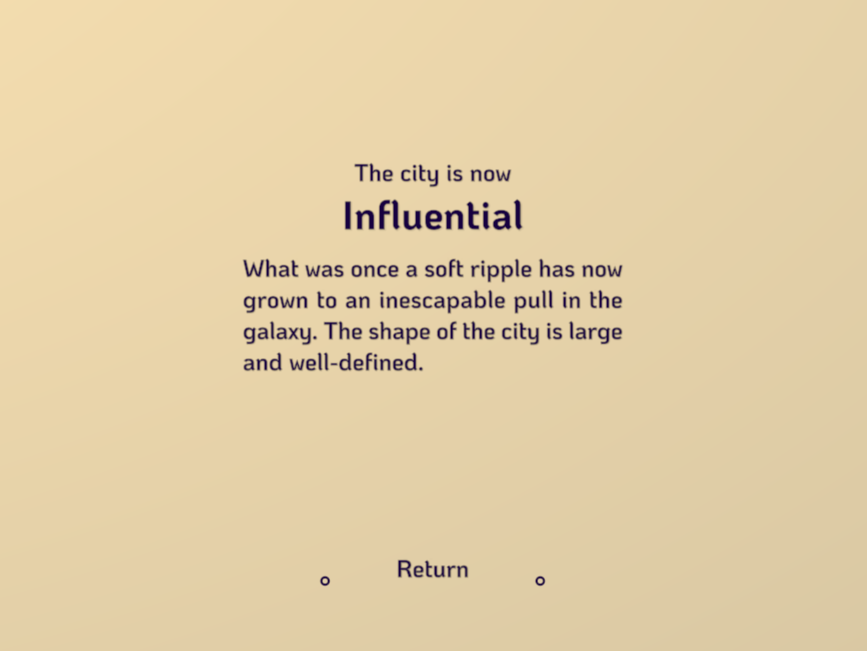
A progress card saying "The city is now Influential. What was once a soft ripple has now grown to an inescapable pull in the galaxy."

Influence is the measure of your city's status. This is a resource generated from marketplaces like Bazaars, Arenas, even Temples. The places where outsiders might come to see how impressive your city is, where traders congregate for business, and the wealthy get rowdy (or overly pious). Influence is how you purchase tiers of Renown, the societal advancement ranks that unlock new classes of buildings. Only by advancing to the top tier of Renown can you "win" at Amberspire. That means, if there's one way this game will absolutely fuck you, it's in modulating how much Influence you have in a given time. Each societal advancement tier burns your accrued Influence. It is the cost of doing business. Like going from a senior in high school to being a freshman in college, not only does the cost of advancement go up, you have to start from the bottom all over again. To make matters more dire, events might lessen your population, but they will absolutely drain your Influence pool. Not only can you spend Influence to choose an outcome, but many outcomes will drop you by huge amounts, even an entire Renown tier. One time, I lost two tiers back to back. You'll never guess what happened to that city. The histories don't even speak about it. They were a cursed people, doomed forever from making contact with the Frame. 

Placing a new structure and rolling dice to construct it becomes a chain of dependencies. I want to build a Spaceport, which requires Intrigue. A Salon generates that, so I must first construct a Salon. Players can construct not only a larger, more vibrant city, but the very fabric of the narrative from these flowcharts. Players who are used to building out their stories from the spreadsheets of 4X and Grand Strategy games will no doubt know exactly what I mean, but even those will offer up more concrete details—the pederast uncle and conniving cousin who have been plotting your doom since the balkanization of Big Portugal or your centuries-long holy war against Theodosia. There are no individual players on the stage in Amberspire, only high level factions without named representatives who show up as suggestions in their introductory notices and the very occasional event card. You’ll have to fill in that Frame representative who undercut your Weavers guild and decimated the textile industry for a generation. I imagine her as a ball-busting Talisa Soto in a gravity-defying mantilla. She has exquisite taste in jewelry, and touches people when she talks to them. 
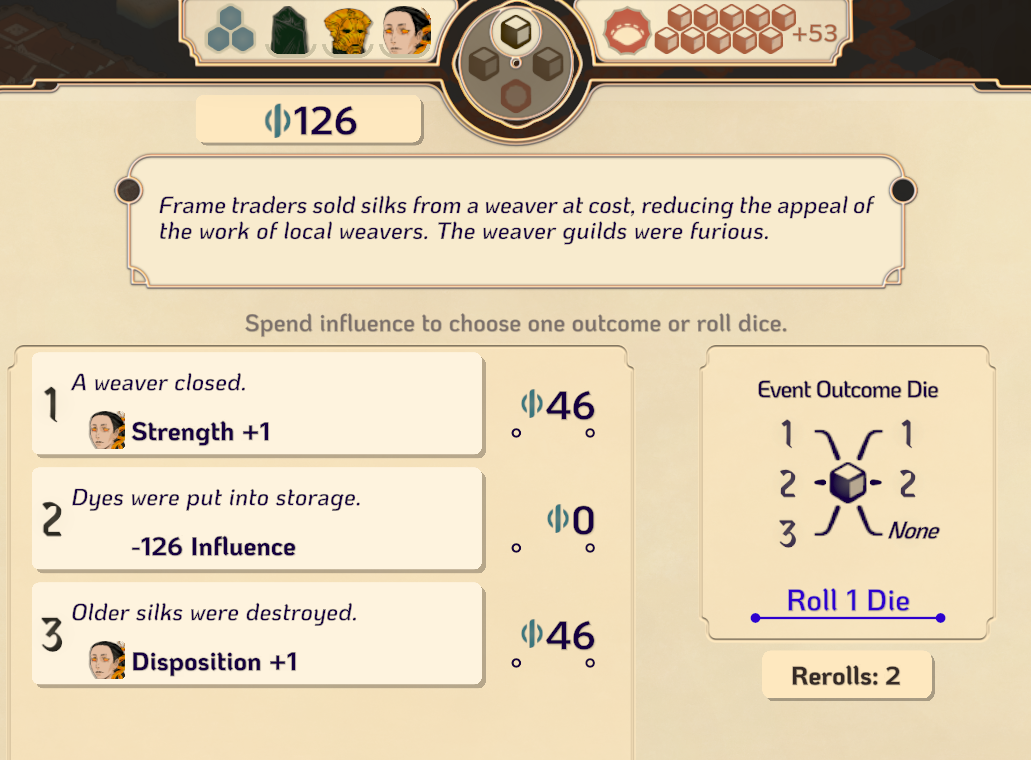
A screenshjot showing an event resolution page, where bad things happen no matter what.

That’s the kind of storytelling I’m happy to do in a pinch, but even I must admit that I wish Amberspire took the lead a little more often and gave me more and more evocative details to create with. There is a very delicate line between too much worldbuilding that can railroad players into one way of thinking about a space, and too little that becomes a lawless all-you-can-eat imagination buffet for some, and a cul-de-sac of abandonment for others. While Amberspire positions itself as being interested in the tidal flow of civilizations and the strata of history, I'm not sure it ever truly achieves this.

So many of the questions that come up when the dice rolls start suffering could be answered with—does the moonrace not understand the concept of public transit? Actually, fuck public transit, does no one have a friend with a truck? This is where things begin to fall apart, even for me.

All actions are prompted and adjudicated based on the outcome of dice. Events, weather, factory productivity—it all comes down to a fistful of d6s. What do you want to build? How do you remove the nightmare terrain? Dice. Naturally, I'm in heaven. I am a dice-roller at heart. I live for the muted clackity-clack in my palm and the secretive rattle behind a GM screen. Those Chessex cubes that come packed with 36 of the six-sided fuckers just ready to explode across a dining room table during Shadowrun? I'm addicted to them. That's why, whenever Amberspire offers the possibility, I choose to accumulate more and more dice. More dice, more potential possibilities. 

Another event resolution screen. "A freighter that entered orbit hoping to land had an engine failure. IOt plunged toward the city, the glow of disturbed atmosphere wrapping around it like a cocoon." The options are to allow a crash or pay 80 influence to avert it.

This also means that Amberspire lives and dies by its dice. And like a cursed 19th century sailing vessel—sometimes, not even the weather will do anything. If you're familiar with those unfortunate long holiday afternoons where games of Monopoly turn into thimbles, race cars, and Westies chasing each other from Mediterranean to Pennsylvania never landing on properties to either bankrupt or further develop, you know how excruciating these interminable periods of meaningless dice rolls can be. If in those moments, you ever wished there was another interrupting factor to short-circuit the game back into an active phase, that’s exactly how I felt when I began abandoning many of my cities. Stuck between the 4th and 5th tiers of Renown, I start juggling dice I don’t need just in the hopes I’ll luck into triggering events. Even catastrophic outcomes are better than turn after turn of dice you can’t discharge, this game's equivalent of stacking $200 every circuit, but never landing on the properties you need to build hotels. 

It is likely that I am a monster, I think, as I watch the weather dice stack up gleeful that something interesting and dreadful will happen to my city. Clearing out underperforming, or just plain old, structures that no longer serve my needs comes with a penalty—Instability Dice—a manifestation of disrupting the delicate layer of the mausoleum moon's surface and the people who live on it. Whenever an event gives me an outcome for more Instability Dice to roll, I blow on the virtual die hoping that's the number that comes up. There’s options to spend Influence to avoid this. I never spend Influence on events, no matter how dire. It’s too precious, too easily taken away, and vital for winning the game.

I'm told that the time I achieved a whopping 73 Weather Dice on top of 13 Instability Dice is a bug that has since been patched out. In reply, I said, "No, put it back." Maybe I am a monster. But if there's one flaw in Amberspire, it's a need for more things to happen.

A report card for Amberspire. It has Art not Graphics, Audio not Sound, It's Cool more than Fun, it lacks Raison d'Etre, but possesses je ne sais quoi

A frequent complaint I hear from people who bounce off these games where story is not delivered in the form of an Apple TV prestige drama, is that they don't conceive of how narratives arise from these sorts of ephemeral, aesthetic, and symbolic links to arithmetic and linguistic functions. It's definitely a muscle group that needs to be developed in order to take a spreadsheet and see beyond the cells and values to tell the story of how a civilization allowed itself to be barricaded in their own red-tiled insulae by fields of moongrass. 

When I go round after round unable to advance my infrastructure projects because the dice I need are generated by buildings "too far away" from the construction zone, or our Centrifuge has broken down for a generation and only creates bad weather instead of the antimatter it's been tasked with (and no one ever stopped to repair it), my storyteller muscles get fatigued, flood with lactic acid, and Amberspire becomes a game about playing Whack-A-Mole with the End Turn button until I get bored and delete the city rather than continue to coast, waiting for a narrative oblivion whose arrival is computationally impossible.

A close up of a city threatened by advancing Rust, effectively signaling this area is doomed despite the placid crowds.

That's when the hard questions creep in, opening breaches in the fragile bubble of verisimilitude that sustains one’s investment in a story, or a set of tasks in a game: Why can my civilization build century ships and conduct interstellar trade, but we can't get tea from one side of town to the other? Where is the foreman that's supposed to be in charge of the Kiln output? What is wrong that our crystallizer refuses to produce crystals? If Residents get to choose where they live, why does it matter if my Landing Pad is out of nearby living space?

Amberspire never properly names its people. Amberites? Spirians? The Moonrace? "Residents" is how the game refers to them—a transient name for a transient statistic. The Residents are built to toil, expand, achieve, and ultimately be buried by the crush of history. Regardless of divine stewardship or human grit, this end is inescapable. No matter how glorious and long-lived their Golden Age ends up being, the opening narrative crawl of Amberspire is the promise of Cassandra. It's intimated that the very seed from which new cities begin has been sifted from the dust of a previous great city. We all begin at that colossal wreck of Ramesses II, and we won't be there to witness their downfall, but I like to imagine that every new city I start is the next strata up in the geological record. The remnants of previous games building up beneath me like an unruly Steam library I'll never quite wrangle. 

There is a win state in Amberspire, but there's no actual fail state. Every good ending comes to a bad end…eventually (and one we never see). The game skirts around providing options for bad endings. You only know about Pompeii because it was built downwind of a pyroclastic bomb. You'll never know about the cities I deleted. And by the time I pulled the trigger, I had mostly forgotten the stories I built for them, too. All the cities of the Sixth Moon of Amberspire are built on a tomb. This is what truly separates the taut menace of Lunar Division’s The Banished Vault from the languorous Monopoly on a southern porch, where the days are so long and humid the money begins to curl.

Character art and info for the Gardeners, itinerant planet-formers and conservators that go around the galaxy doing landscaping. They wear cool green robes with an upsetting veiled headpiece.

I have created and abandoned more cities in the last two weeks than I have drafts of this review (over 13 at current count). Very few cities survive. Amberspire affords you three save slots at a time, three cities. That means many of those cities I started, guided along a path towards a Golden Age, and then abandoned like a fickle god, were destroyed. Erased from the surface of the Sixth Moon of Amber. Whatever trace of their civilizations mixed with regolith, swallowed by fog and flood, grown-over by silica grass, eaten by rust. Maybe some got off-world in time. Becoming part of the cosmic flux of residents, joining the cosmic Lantern as passengers in the cloud layer of the gas giant, finding new genetics for a new life with the Gardeners. Or maybe they're still falling, down-down toward the planet’s core, through layers of glory and failure, among the honored and forgotten dead, into the depths of the mausoleum moon, joining the unknown millennia of cities that were once successful, too. 

Dia is queer, brown, and usually pissed off. She spends too much time thinking about media, not enough time being asleep, and would rather be singing a song to her fish.

Share
Success! Your email is updated.
Your link has expired
Success! Check your email for magic link to sign-in.