
Even if you haven’t played the Plague Tale video games, there’s a good chance you remember the damn rats. The endless rats. The screens of rats pouring out of every corner, flooding the screen. A stomach-churning, potentially phobia-triggering amount of rats. Enough rats that for the sequel, Requiem, the developers published a video on YouTube explaining their “rat tech.”
But A Plague Tale: Innocence (2019) and its sequel, A Plague Tale: Requiem (2022), have always been so much more than a morbid playground for digital rodents. They’re home to moving stories of bonded perseverance in the face of unyielding terror, as seen through siblings Hugo and Amicia. Hugo, a child burdened with a terrible power and little hope of salvation. Amicia, a sister desperate for a cure—or to be left alone by those who wish to exploit them.
They are also, in a world where companies continue to toss developers onto a mass layoff pyre in pursuit of a live service lottery ticket that rarely cashes, delightfully straightforward adventures that feel like the kinds of games we used to get all the time. Are they the best stealth games you’ve ever played? No. Are they trying interesting things? Yes. Games that know their modest ambitions and work in and around them—punching in, around, and sometimes above their weight. We often call these “AA” games. Whatever you want to label them, we need more.
With this week’s Resonance: A Plague Tale Legacy, developer Asobo Studio turns its attention elsewhere. Instead of picking up on a delicious loose thread at the end of Requiem—more on that later, promise—Resonance acts as a prequel, side story, and backstory to Sophia, a charming character in Requiem who often aided Hugo and Amicia. It also ditches the previous game's notable emphasis on stealth for action. Parries, dodges, combos. You also don’t need to know a lick about the broader story to jump in, even if longtime fans have reason to come along.
“After spending seven years alongside Amicia and Hugo in the Middle Ages, we felt it was time to open the window a little wider, explore another era, and keep moving forward as a team,” Asobo Studio chief creative director David Dedeine told me recently. “[...] We knew from the beginning that moving into combat would place us in a highly competitive space, but as a studio, it was important for us to take a step into a more popular genre while staying true to our DNA.”
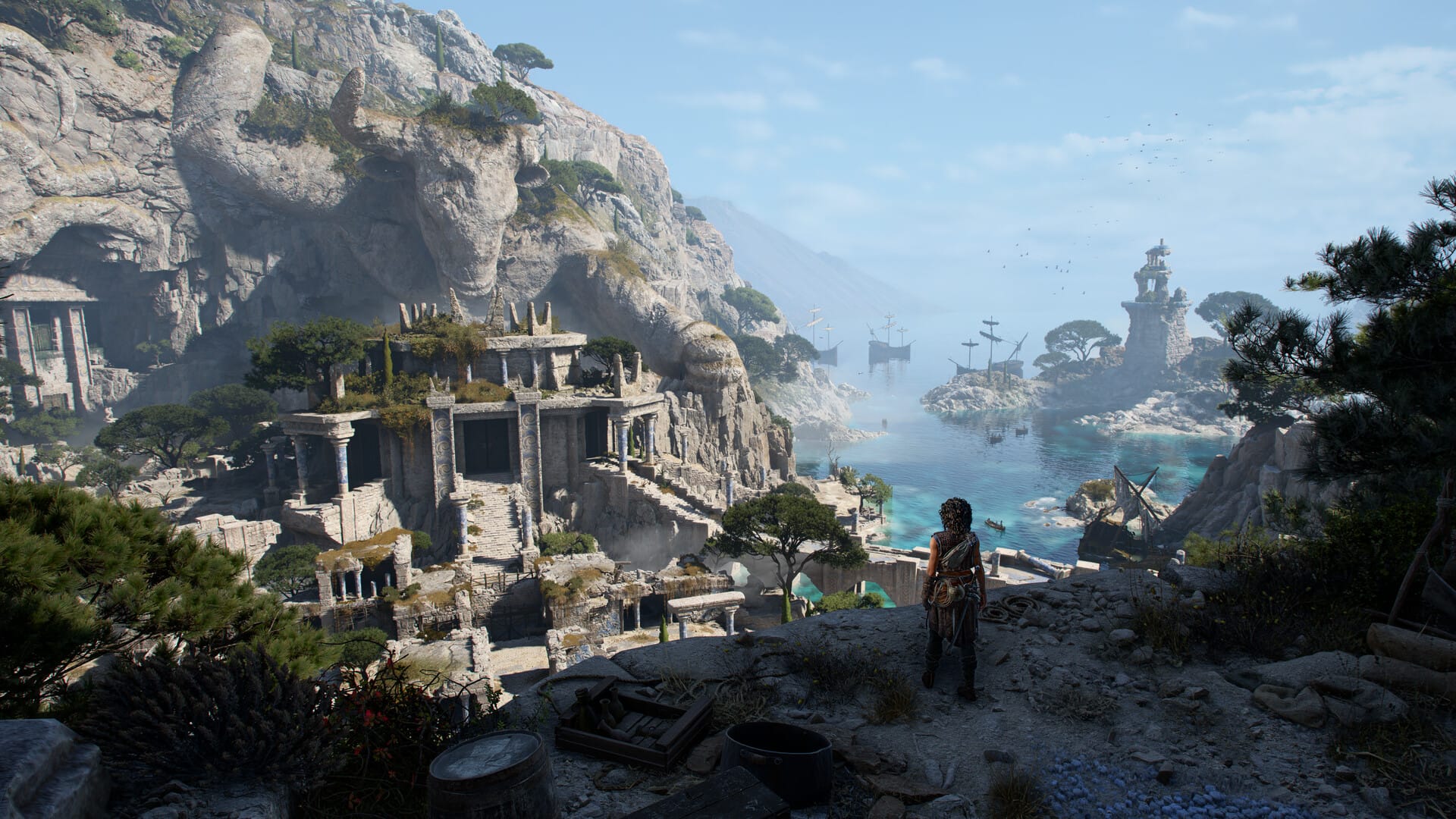
Most of the risk pays off. I’ve played (and finished) Resonance, and while the decision to make a melee-focused experience has the consequence of frequently flirting a little too close to the sun by inviting comparisons to games with more robust systems, it’s worth the imperfections. Sophia’s journey is full of the stomp-on-your-heart emotional beats you’d expect, all told through the lens of many, many fun puzzles and, I venture, the most hauntingly gorgeous world you’ll explore this year. There are a half dozen Keanu-esque “whoa” moments within Resonance, and you will frequently be pausing the dramatic action to snap a screen shot of what you’re seeing.
The sense that you’re walking through a painting should, perhaps, maybe not come as a surprise when you realize Asobo Studio is also behind Microsoft’s Flight Simulator. The same engine that powers Flight Simulator powers A Plague Tale! The vistas of France and Crete now make a lot more sense, even as Dedeine points out there’s no design overlap between them.
“We have always been very eclectic,” said Dedeine, who co-directed A Plague Tale: Innocence while also simultaneously directing Flight Simulator’s 2020 edition. “At the very beginning of the studio, it was a necessity to survive, but step by step it became a real strength in many ways, allowing us to work on very innovative games, from Fuel, to Rush to Fragments, for example.”
“AA games often allow for more creative freedom and don't necessarily require you to check every box. As a result, you can take a much more tailored approach to the experience you're building, potentially creating something unique and even outperforming some AAA games in specific areas. In my opinion, many players still love that approach.
With Fuel, the studio notched a Guinness World Record for the largest playable open world at the time, while Rush (Kinect) and Fragments (HoloLens) had them playing with new hardware.
Since 2019, though, the focus has been on these two franchises, even if one becoming a franchise was probably more likely than the other. 2019? A Plague Tale. 2020? Flight Simulator. 2022? A Plague Tale. 2024? Flight Simulator. 2026? A Plague Tale. Beyond this? To be seen.
A Plague Tale conceptually began with two ideas: Asobo wanting to build their own world, then looking at the world physically around them (France) for inspiration on what story to tell.
“Games like The Last of Us had demonstrated that it was possible to tell mature, emotional stories within that kind of experience,” said Dedeine. “The idea of a brother and sister then emerged, and it immediately felt compelling. The contrast between their innocence and the cruelty of the medieval world created fertile ground for player attachment and drama.”
The story of siblings in a heightened version of the Middle Ages, aiming for a “blend of realism, gloomy poetry, and innocence," was there from the start, but the presence of the rat swarm came a little later, as they searched for “something” to “make the project truly stand out.”

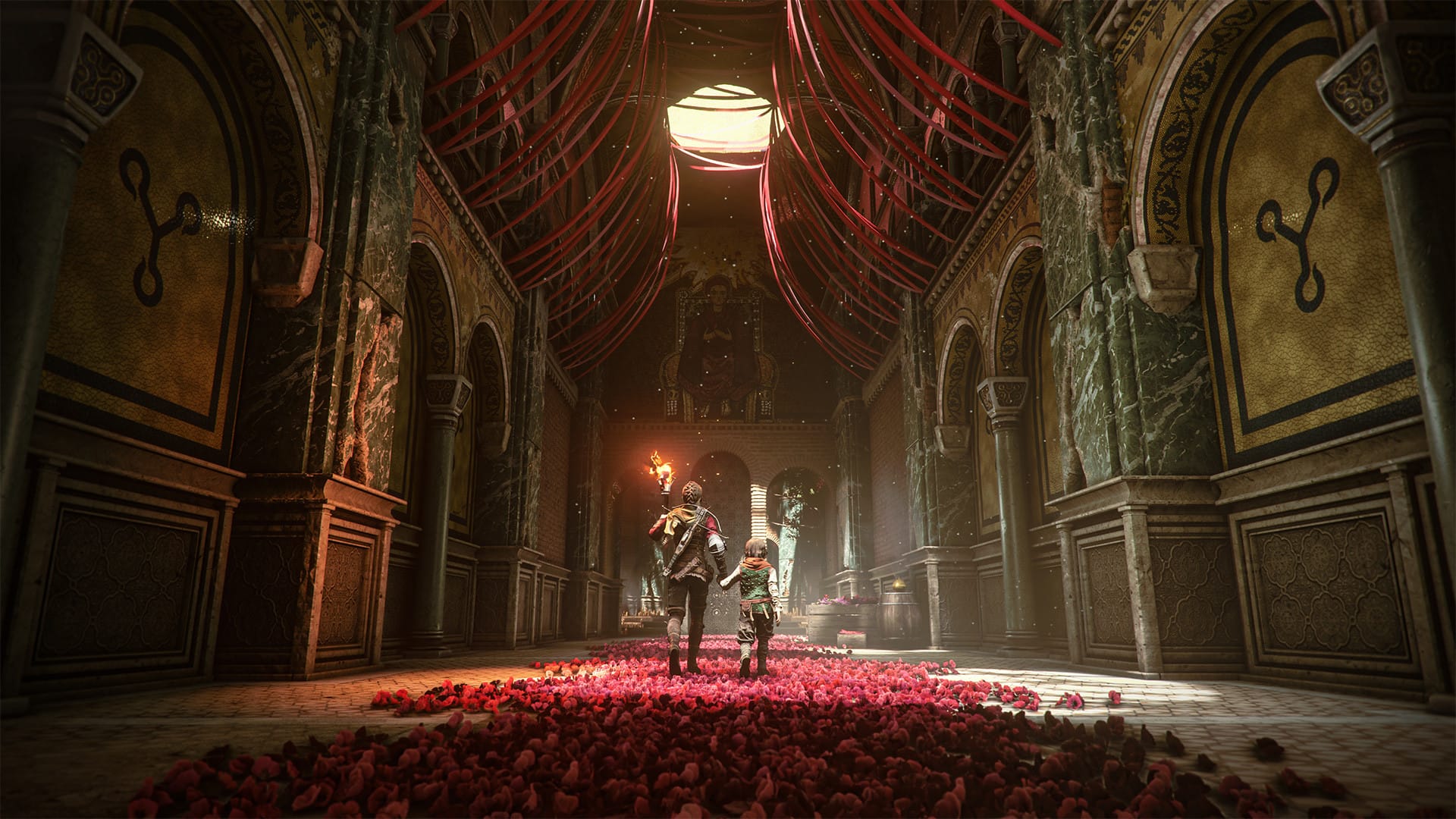
They definitely nailed that part, and while the rats are (sadly) not present in Resonance, it’s replaced with another omnipresent threat that will have you asking “Is this yet another chase sequence?” with both delight, despair, and repetitive annoyance. What they also nailed across Innocence, Requiem, and now Resonance, was a sense of doom. From afar, it appears that Hugo, Amicia, and Sophia are playing their own Uncharted, as they scramble around enemies and crumbling buildings. But there are very few laughs in these games. Hope is the sense that another day is coming, not ultimate salvation. To spend time with one another is, itself, a reason to keep going.
Like being sad? Welcome to A Plague Tale, friend. Oh, also, it’s sad children, who are constantly not only fleeing danger, but suffering physically and emotionally nearly all the time.
Cue the sound of a birthday party kazoo!
“Putting two children in the middle of such a harsh and cruel world immediately increases their vulnerability and, in turn, makes players much more invested in both the story and the gameplay,” said Dedeine. “We also wanted to create a grounded world and atmosphere, and the French Middle Ages during the Black Death provided a particularly brutal backdrop. Violence, fear, and death were everywhere. But all this darkness serves another purpose: it makes the few moments of joy, hope, and tenderness shine much brighter, even the simplest ones.”
That these games spend so much time in such darkness probably says “a little bit about us, too,” Dedeine admitted.
Besides death, trauma, and rats, one of the commonalities between all three games is a companion. Hugo and Amicia are almost always together in Innocence and Requiem, while Sophia has a friend, Leni, along for the ride. For Dedeine, beyond trying to craft memorable characters, it serves a practical purpose related to one of the design limitations of video games.
“Unlike in a movie, the character is most of the time seen from behind and relatively far from the camera,” said Dedeine. “As a result, it's much harder to convey their thoughts, emotions, or motivations if they can't express them through dialogue. At the same time, having a character constantly talking out loud while alone can quickly feel artificial and repetitive. That's why companions are often such an effective storytelling tool. If there's a strong contrast between the characters, it naturally fuels conversations and allows for more organic dialogue, while also helping the player better understand the protagonist. The challenge, of course, is making those companions meaningful and interesting in their own right, rather than turning them into simple sidekicks or backseat commentators.”
You can’t imagine Hugo without Amicia, and by Resonance’s end, the same of Sophia and Leni.
It is easy to imagine a world without many games like A Plague Tale, however. The games stick out because the games that look like them, the God of Wars and Uncharteds of the world, are hugely expensive and arrive, at this point, once per generation—if we’re lucky. What happened to the modestly budgeted video game aimed at an excited niche? Funny enough, many of them come from Focus Entertainment (previously Focus Home), the publisher behind A Plague Tale.
Snowrunner? Focus. MIO: Memories in Orbit? Focus. Banishers: Ghosts of New Eden? Focus. Warhammer 40,000: Space Marine 2? Also, yes, Focus. The list of Focus Entertainment games on Wikipedia is a long list of “I liked that” and “Did they make that?” bangers one after another.
Dedeine credited “a great combination of factors” that’s allowed Asobo Studio to thrive this way.
“We use our own engine, our own tools, our team has been making this type of game for more than 20 years, we have an excellent and productive relationship with our publisher, our pipeline is robust and has improved year after year, success attracts talent, and the team is compact and truly passionate about video games,” said Dedeine.
In some ways, it feels like making games like this has become a lost skill, in part driven by the money funding video games chasing after the aforementioned lottery tickets, resulting in the regular and anticipated destruction of teams who won’t get a chance to work together again.
“AA games often allow for more creative freedom and don't necessarily require you to check every box,” said Dedeine. “As a result, you can take a much more tailored approach to the experience you're building, potentially creating something unique and even outperforming some AAA games in specific areas. In my opinion, many players still love that approach. They appreciate games that know exactly what they want to be and deliver on that promise with confidence. I believe our industry needs that variety. AA games and AAA games serve different purposes, and that's precisely why they complement each other. AA needs AAA, and AAA needs AA.”
With any luck, Dedeine and Asobo Studio will keep the fire alive.
As for what’s next, Dedeine was understandably tight lipped. Resonance does not meaningfully advance the story of Hugo, Amicia, and the threat of the mysterious Macula any further, which leaves the end of Requiem, which suggests an Assassin’s Creed-like jump into modern times, an unresolved tease. As for whether Asobo will ever deliver on that tease remains to be seen.
“I really hope it will,” Dedeine. “In many ways, Resonance already starts exploring that idea, but I'm afraid I can't say much more at the moment!”