
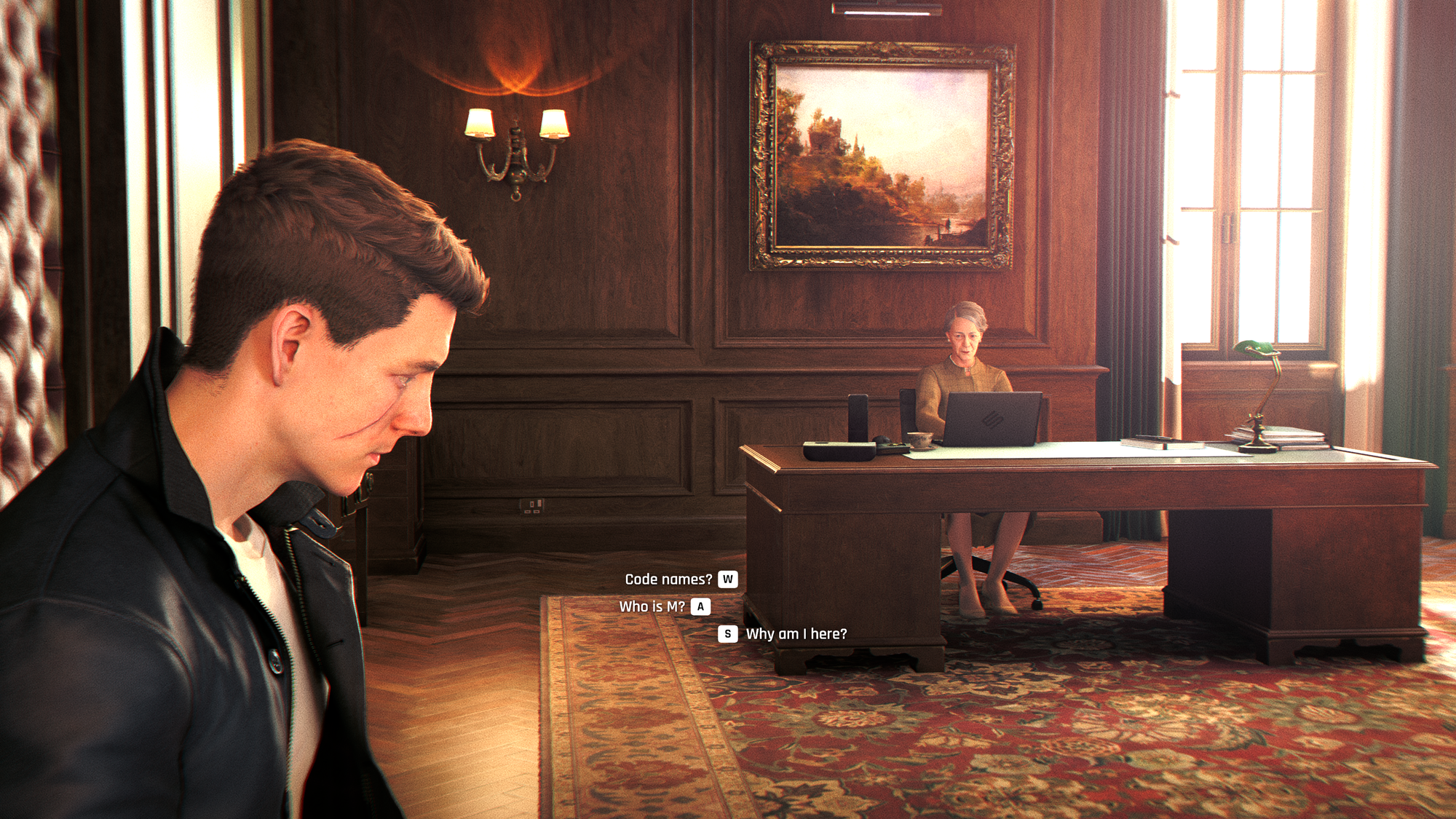
Early on in GoldenEye (1995), the newly-recast James Bond has his first sit-down meeting with the newly-recast M. Judi Dench plays M as someone who's habitually forceful, brusque even, in a way that feels calibrated as a defense against the casual misogyny of the world she inhabits. She's there to leave no doubt as to her ability and authority, because she can't count on being taken seriously by default. The scene acts as a thesis statement for her version of the character.
But it also acts as a thesis statement for the whole 007 franchise from there on out. She explicitly calls out Bond as a misogynistic dinosaur and a relic of the cold war. The implicit question looms over all of the Pierce Brosnan films and, then, over Daniel Craig's as well: What is Bond for, now that the Cold War is over? Why would the world need him?
The idea is itself a bit of a construct, of course. In the old movies, Bond is never really a cold warrior himself. The conflict is a backdrop, a justification; the actual antagonists are not the Russians, but instead flamboyant madmen with supervillain aspirations. The question sticks, because the world of 1995 is so drastically different from the world of 1989. And then when Daniel Craig rolls around, the world of 2006 is once again drastically different from the world of 1995.
This question—What do we need Bond for?—gets answered over and over again in the movies, with varying levels of success. The Brosnan movies themselves go back to the old Bond well of a villain trying to ignite the cold war twice, in spite of the theoretical end of the cold war, by invoking China (in Tomorrow Never Dies) and then North Korea (in the inimitably terrible Die Another Day). The Craig movies briefly flirt with applying a Global War on Terror coat of paint to the old Cold War hulk, but opt instead to dive into a mire of comic-book mythologizing.
Right now, the Bond franchise—long an idiosyncratically-run British family business—is being digested by Amazon, to become part of their ever-growing "IP portfolio". It feels almost as if Jeff Bezos grabbed it in the impulse buy aisle before checking out The Lord of the Rings.
Of course, the question still looms: What do we need Bond for? I can't imagine that whatever Bond movie comes out of Amazon's bowels will give as satisfying an answer as IO Interactive's 007 First Light.
The game has to carry this burden twice. Once, for the Bond franchise, and once for the AAA action-adventure game itself. These kinds of huge, lavish video games have become so expensive and so slow to make that every one is not only an event but a sort of argument for the form itself. Never mind Bond; what do we need Nathan Drake for? An almost unimaginable amount of human labor—and often, human misery—goes into building these digital cathedrals.
Do audiences still care about seeing all that money on the screen any more? We live in an era of plateauing graphical fidelity. The PlayStation 5 is six years old; a putative PlayStation 6 not even on the horizon yet. And PS5 games don't really look all that much better than PlayStation 4 games, they just load faster. Nowadays I look at the delicate hair physics in the trailer for God of War Laufey and think: That's at least 20,000 more copies they need to sell just to pay for the hair.
Inevitably, as someone who's been in these kinds of scope and budget conversations, I will look at a game and imagine a cheaper version of it. If you didn't shoot for cutting-edge visual realism, could you still capture this experience without spending the GDP of a small country? If a work of art is going to be as brutally expensive as a typical AAA video game, it needs to give you something that simply could not exist anywhere else. The answer to that question can't simply be more detail and more fidelity slathered on indiscriminately; it can't be horse testicle physics and lavish motion capture for every variation of the player character stealing something from a cabinet.

There is no plausible "cheaper version" of First Light. This is a game that very easily clears the bar of feeling, unironically, like a premium product. So much of what this industry produces wants to brand itself as special, luxurious, and unique while being clearly none of those things—the digital equivalent of a Beats headphone. First Light really does have a unique reason to exist, which is the incredible fluidity with which it moves between the different facets that make up Bond.
It is very reasonable to make a game that is one thing; it's unreasonably difficult to make a game that is everything. But ultimately that's what Bond is; he's a charming social chameleon, a trained killer, and a silent assassin. He moves, without losing his cool, between infiltration and open combat. He's a quintessential action hero with a boundless skillset. The man's been to space, for God's sake.
And that idea is where this game lives. IOI obviously have world-class experience making games about stealth and social engineering; their Hitman trilogy is a masterpiece of the genre. But this isn't a stealth game. Nor is it an action game with decent enough stealth sections. It's not even an immersive sim that gives you stealth and combat as coequal options.
Rather, it's a game that treats those things less as discrete activities and more as different points in a spectrum of action. Being caught by patrolling guards is not a game over or a reason to reload to a checkpoint; it's a transition to either talking your way out of the situation, or using violence to contain it.
These aren't mere recovery options—like the fast-talking in Star Wars Outlaws—but active possibilities. You can play the stealth game up to a point then choose to go loud when it feels opportune to do so. You can casually waltz into a room full of guards, tell them you're the building inspector, and walk past them.
None of those things are completely novel, but novelty isn't the value here. The value is in the extremely graceful and fluid way in which these different modes of play overlap and interact. One thing flows into the next as naturally as it would in a Bond movie. That is extremely hard to achieve with grace.
The game is made out of discrete little chunks strung together into fairly long chapters, and each chunk may limit your affordances; sometimes you're in a public area full of civilians where you must maintain your cover. Sometimes, conversely, you're in an open firefight with no choice but to start shooting.

It's a remarkable achievement that it never feels stifling to play through these segments; it never feels like an artificial restriction or an invisible wall. The boundaries of player affordance always feel narratively motivated, clear, and natural. And then you might enter a grey area where those options expand, and that feels natural too. You can be undercover at a party, eavesdropping on the guests; walk through a door into a traditional stealth section; get caught by a guard and quickly contain the situation by shoving him off a window; then find yourself in a dialogue sequence where you need to convince an antagonist to unwittingly help you.
Those transitions between one mode of play and the next work so well because a lot of care was put into how each piece fits together and how the overall story of each chapter is structured. First Light is extremely thorough about nailing the details that really matter. A lot of AAA games feel like expense has simply been lavished on every aspect of the experience in an indiscriminate way, without a real sense of targeted attention and care. First Light certainly looks and feels like an expensive game full of lavish detail, but that detail is applied surgically where it's really making a difference.
This is a game which will happily abstract away the act of picking up ammunition from the guns of fallen enemies; it's not interested in slowing you down with some laborious animation for the sake of verisimilitude. When you push down a shelf onto an enemy, the broken bits and pieces of furniture simply disappear rather than become lingering physics objects.
But when Bond throws someone out of a window? You bet they recorded dozens of unique voice lines to give him highly specific post-mortem quips. You bet there's a bespoke excuse for Bond to be in any room he might try to bluff his way through. You bet the third person camera has been delicately tuned so that it'll push in over Bond's shoulder when you lean against a railing. You bet that every time you see Moneypenny, she's wearing a completely different and extremely cool outfit. Rather than treating detail and fidelity as goals in itself, it's nailing the things that really matter and letting the things that don't fade into the background.
An obvious point of comparison here is Rocksteady's 2009 classic Batman: Arkham Asylum, and its sequel Arkham City. Those games were released in an era where "licensed video game" meant a rushed movie tie-in populated with journeymen voice actors doing their best Sean Bean impression. Arkham City was, instead, committed to its own unique, free-standing interpretation of the character; it had the liberty to take what it wanted from the canon and use it in ways that suited itself.
First Light is, similarly, perfectly happy to engage in video game abstractions and depict a heightened world; it is a true video game interpretation of Bond. Of course you can pick up any battery-powered gadget you run into and use it to power Bond's watch strap that shoots lasers. Of course every single gadget is conveniently blue so you can spot it from across the room. Of course every firefight is populated with red barrels that explode when you shoot them. This game is genuinely trying to interpret the Bond character and milieu through a video game lens, even to the point of silliness.

It feels like IOI studied those Arkham games when planning their own interpretation of James Bond; this game features, by my count, three moments that read as directly inspired by Arkham City's extremely memorable Mr Freeze boss fight. It recombines familiar Bond elements into a new version of the character that is neither Brosnan's jaded aristocrat nor Craig's damaged soldier. Mythology is taken slowly, in broad strokes, and in the interest of serving the game rather than playing the hits.
Our Bond here is a younger Bond, freshly recruited into the newly-rebooted 00 program. The first several hours of the game are, in essence, an extended tutorial that is also Bond's own training regimen. But calling it a tutorial does a disservice to what IOI has built as the first act of this game. It's a smartly constructed on-ramp that's not really in any hurry to introduce all of the disparate elements of the game—shooting, stealth, social engineering, driving, platforming—and all their intricacies. It's building up Bond as a character in tandem with building up the player's skillset, preparing his arc at the same time as it readies the player to handle the first "real" level of the game.
This game includes a training montage—a properly interactive training montage, in which the game will rapidly cut between little bite-sized chunks of activity, partly teaching the player, partly reinforcing ideas that were already presented, and partly doing character development. But that montage comes about an hour into the game, which actually starts on the inciting incident of Bond's spy career—a botched SAS mission in which Bond, a helicopter aircrewman, is the only survivor.
A lot of AAA games try to bake tutorialization into their storytelling to fairly grim results, often adding up to characters brutally over-explaining at the player over an earpiece. First Light's unhurried approach works beautifully here, and it signals the most impressive thing about this game: nothing really feels like an afterthought, and narrative isn't used to spackle over structural failings.
Big video games are always subject to what is known in the industry as "thrash": something changing partway through production and forcing work to be adapted or thrown out to align with it. Levels get redesigned or moved around. Mechanics get changed or cut. Narrative is often left holding the bag, tasked with stitching the story together after foundational aspects of the game change. Matthew Seiji Burns' The Writer Will Do Something, a sharply funny (and, to a certain kind of industry creature, incredibly distressing) story about this process, is over ten years old at this point.

But the reality that it portrays has never really changed—just this week, the gameplay reveal for God of War Laufey gave me distinct "things were moved around" vibes, though that may be an artifact of the game's critical path being compressed just for the trailer. And in all fairness, First Light does contain a couple of noticeable stitches in its story. But it's otherwise a remarkably coherent piece of storytelling, which speaks to an enormous amount of care, time, and planning being put into nurturing that story.
The game has the luxury of not front-loading all of the tutorial or hurriedly cramming information into conversations because the mission design, level design, and narrative design are actually fully in concert and working together. Tutorials arrive safely before the things they need to tutorialize, but are otherwise free to find their way to the most comfortable place in the story.
For example, the game's first taste of driving also acts to introduce Cressida Bright, one of Bond's fellow 00 trainees and an expert driver. Lennox Monroe, another trainee and an archetypal tough guy, doesn't act as the first introduction to hand-to-hand combat; but sparring with him unveils some of the nuances of the combat system. And then, not long after, you end up in an extended fight sequence with him that lets you stretch those skills a bit but mostly serves as characterization.
This structural confidence is really noticeable in the early hours of the game but it carries throughout. Foreshadowing, themes, character arcs, everything is woven seamlessly into the flow of action, often through small incidental moments that become important later. In a game of this scope, with so many moving parts and so many demands to realize any given moment, it is a genuinely impressive achievement.
It wouldn't really matter, of course, if the story wasn't also resonant and surprising and downright fun. First Light deftly blends Bond sensibilities with IO's Hitman-honed penchant for ripped-from-the-headlines stories. All the Bond hallmarks are here: go to exotic locales, meet beautiful women, shoot faceless bad guys. But IO's writers find ways to make the character and his world feel vital and relevant in a way I'm not sure any of the movies ever have. In a way, Bond's rogue's gallery of megalomaniacs feels more at home in the world of today—what is Jeff Bezos if not a real-life supervillain—than in the midcentury. The world of criminal luxury that Bond moves through is populated with characters that feel like they stepped right off a Hitman level: relentless social climbers, amoral operators, victims of chronic affluenza.
First Light's heart is in how it handles the idea of Bond as a relic of a bygone age: MI6 has a quantum supercomputer in its basement running an AI that's supposed to replace the grimy HUMINT of agents on the ground with a shiny, privatized SIGINT product. The version of the 00 program that Bond is entering is, itself, a reboot; a new attempt at something that maybe the world has no need for. The ideas being played with here are clear from the outset, and in some cases even well-worn. But where they ultimately lead—which I won't spoil—is genuinely smart and surprising.
As much as it may flex its themes, the story is still primarily about the fun of its contrived set pieces; this is a game full of moments that are clearly meant to be the sickest thing you've ever seen, up until the next thing coming up in the game. This is a game where you see one of those gigantic dump trucks they use to haul rocks out of quarries and immediately know: you're going to drive this, probably right through several people, later in the level. This is a game where you arrive at one level piloting a luxury speedboat, not for any reason other than that Bond arrives at places by speedboat.

All of this is lifted by IOI maintaining their extremely high standard of art direction. While the game isn't trying to ground itself in cinematic visual realism, its world is obviously drawn from real design, architecture, and fashion. It feels crafted by artists who were allowed to go outside and look at the real world as a guiding reference for the one they were making—instead of raising an inbred brood of photobashes in a basement. First Light especially has an eye for, and a love of fashion; I can't recall the last time, in a AAA game, that I got such a sense of personality and style from what each character is wearing at any given moment.
More than anything, this game gives off an overwhelming sense of craft and respect for craft. To give a concrete example: First Light has ledges you can climb, and therefore it's riddled with visual cues that help you spot climbable ledges. This is the dreaded "yellow paint" which players do demonstrably need to navigate levels, but hate actually noticing.
First Light squares this circle by having each area of the game use its own, location-appropriate visual language to help with player wayfinding. If you're clambering on a rocky cliff, it's moss and snow cover resting on the ledges. If you're sneaking through a rock quarry, it's spray-painted markings left by stone cutters. There's nothing to this, really, other than the fact that the environmental artists were given the time and space to develop all these different iconographies, put them into the game, and ensure that they are actually legible to the player.
The long-running experience of building three Hitman games, of course, also shows up here. Things like the graceful handling of "social stealth" and the extremely good crowd tech are taken directly from those games. But a sequel to Hitman this certainly isn't; it draws from those games where it benefits from it, but isn't trying to shove Bond into 47's suit.

Where the game verges away from that Hitman template, there's not quite as much polish on display. I'd say that the shooting sequences are fun, but sometimes a bit too chaotic; the hand-to-hand combat is competent and satisfying in how it delivers the crunchy violence of a Bond movie fight—Bond has a panoply of dirty moves to use on enemies contextually—but it's not really serving up anything spectacular or novel. You can tell that this is a studio with over a decade of prior experience honing some aspects of this game and not others.
Even so, everything hangs together so seamlessly that in the moment I wasn't really thinking about the details of the parry timing. The game is built to allow the player to employ finesse and feel effortlessly cool—while staying honest about it. First Light doesn't desperately go out of its way to make you feel like a genius or deflect your mistakes. But Bond, in the movies, does get caught off-guard sometimes; he sometimes makes mistakes, too. What makes him Bond is that he's always ready to clean up with a lie, a punch, or a bullet; First Light emphasizes this idea, which perfectly fits a stealth game that wants you to play through your mistakes. Again, it lives in that fluidity of joining together different modes of play.
Other studios in the AAA space have done similarly brilliant work recently—Remedy comes to mind. But this kind of quality doesn't feel like the default in a corner of the industry where extreme quality and polish really should be the default. There's nothing revolutionary about First Light, not really; I can't point to this game and say their tech is just better, that they had some brilliant idea no one else has ever had, or that I think everyone at IOI is simply better at their jobs than the very talented people who work at other big studios.
What feels rare is that they were allowed to just make this game, instead of what feels increasingly like the norm in AAA: spending four years throwing out two unfinished games, then two more making the one you actually ship. Many a AAA game that was five, six, or seven years “in the making” was really rebooted mid-production, sometimes multiple times, with varying amounts of material surviving the process. First Light effortlessly glides through so many things that the median AAA game falls flat on: tutorialization, a high quality bar for dialogue, thematic and narrative cohesion.

There's no secret here other than time, craft, and attention. It doesn't escape my notice that IOI is a very stable, long-running, privately-owned studio headquartered in a country with remarkably strong labor protections. This is the product of people having the space to apply their hard-earned skills, and production planning that doesn't treat human effort as disposable.
Which brings us back to the question of what Bond is for. It's hard to take Bond as anything but an almost allegorical, romantic fantasy of espionage. He has about as much in common with a real intelligence officer as your D&D paladin has in common with a 17th century mercenary rampaging through rural Swabia. In truth, he could be anything; and the further you push him from the realities of geopolitics, the more interesting he seems.
IO's writers run with this and create a very strange Bond—one that's less foot soldier of hyper imperialism or caddish playboy, and more a stand-in for the value of, well, human effort in an era of allegedly thinking machines. At one point in the story, Bond's curmudgeonly MI6 mentor—played by the great Lennie James, whom many will recognize as Destiny's Lord Shaxx—reminds him: "We're civil servants; we go where we're needed."
We live in an era of pervasive systemic breakdown, in which 'AI', algorithms, and automation are peddled as magic cures against the rot. First Light, unexpectedly, seems (both in its construction and in its content) like an argument that humans can make systems work—if they're allowed to.
