
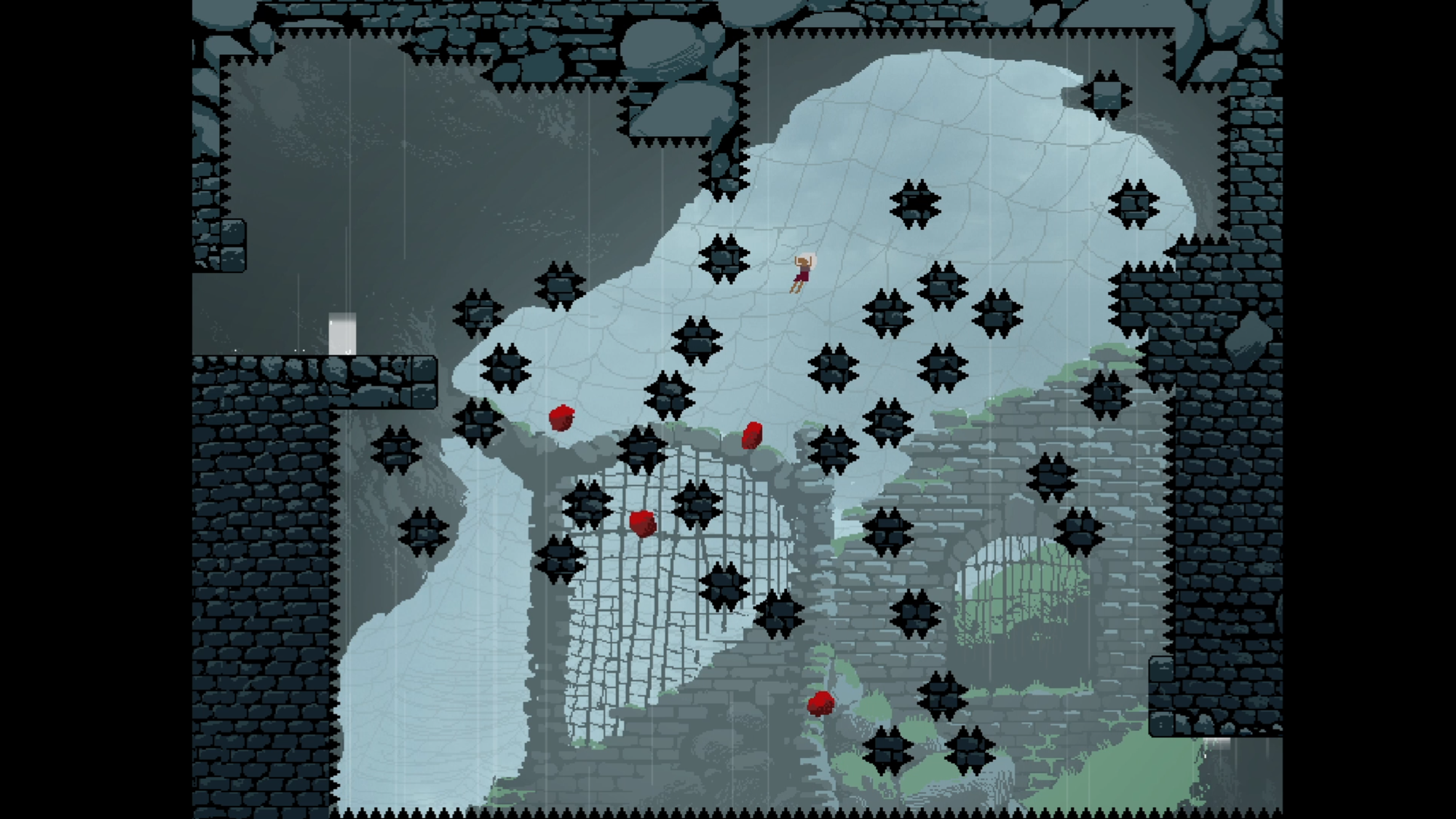
It’s hard to pin down exactly what Love Eternal is about. You’re a high school girl, and for no discernible reason, your family is visited by a force beyond comprehension. Demon? God? Both? You’re cast into a castle-looking realm of spikes and labyrinths, and while there is no guarantee of escape, staying still is its own death. You have one special ability to help navigate this hellish maze: you can snap gravity on and off, theoretically letting your thread your way through meticulously engineered killzones.
In practice, you're going to die a lot, and at first glance this places Love Eternal in the same punishing, pleasantly tortuous genre as VVVVV and the rich, modern history of "precision platformers." Except Love Eternal isn't trying to be abstract, it's trying to be mysterious and as you drag yourself through its traps and tricks, it's pulling you deeper into an ambitious horror narrative. You just have to be good enough, or determined enough, to let the game tell it to you.
It's a conceit that occurred to designer Toby Alden from watching players navigate their earlier (also challenging) games.
art19:b4dcfd80-be82-4122-90a0-03f021558106
“When I would watch people play the platforming sections of my games, I could tell that they really entered this trance-like state of focus, where they're really dialed in,” said Alden in a recent interview. “A lot of what makes horror effective is pacing and lulling people into a false sense of security. It’s not dissimilar to how comedy operates, where you set up a premise and subvert it. You’re doing this platform challenge, you're really locked in, everything else slipping away, maybe you forget that there was a story—and then suddenly it rears its head again.”
Love Eternal is, in the words of its designer, a “psychological horror platformer.” If that sounds a bit like Mad Libs, a collection of descriptive words that seem hard to imagine as an actual video game, you’re not alone, but it does make plenty of sense when you actually play Love Eternal, a game that wears its inspirations from Silent Hill and David Lynch on its sleeve from the jump.
“That's the buzzword salad I've been tossing around to describe it,” said Alden. “What I'm trying to get at is [that] horror is a broad genre and encompasses a lot of flavors. The thing I was trying to distinguish Love Eternal from is there isn't a lot of gore. There aren't a lot of jump scares. You're not collecting pages.”
What you are doing in Love Eternal is playing one of the most difficult platformers in recent memory, with a striking and compelling horror narrative to go along with it. It’s a game that is perfectly fine to punish your fingers, knowing full well it means you won’t see the end of the story. There are no options to make things easier. There is only failure, or trying again, while trying to make sense of the twisted forces lurking in the dark, dooming the game’s characters.
Love Eternal is not easy to recommend. It’s easier to know who it’s not for. Alden gets this.
“There is this trade-off with difficult games where the more difficult your game is, the more people you'll alienate, the more people won't be able to finish it,” said Alden. “The flip side of that is the people who do finish it will be much more strongly invested. An uncharitable way of describing it would be like Stockholm Syndrome [laughs].”
Make no mistake, Love Eternal is hard hard. A game that prompts guttural screams from the player in equal parts joy and suffering. It’s extremely satisfying when you make it to the end of a room, but there are no shortcuts. Attempting a shortcut is merely you rushing a jump due to impatience, because you’re tired of trying it for the 20th time—and the result is another death.
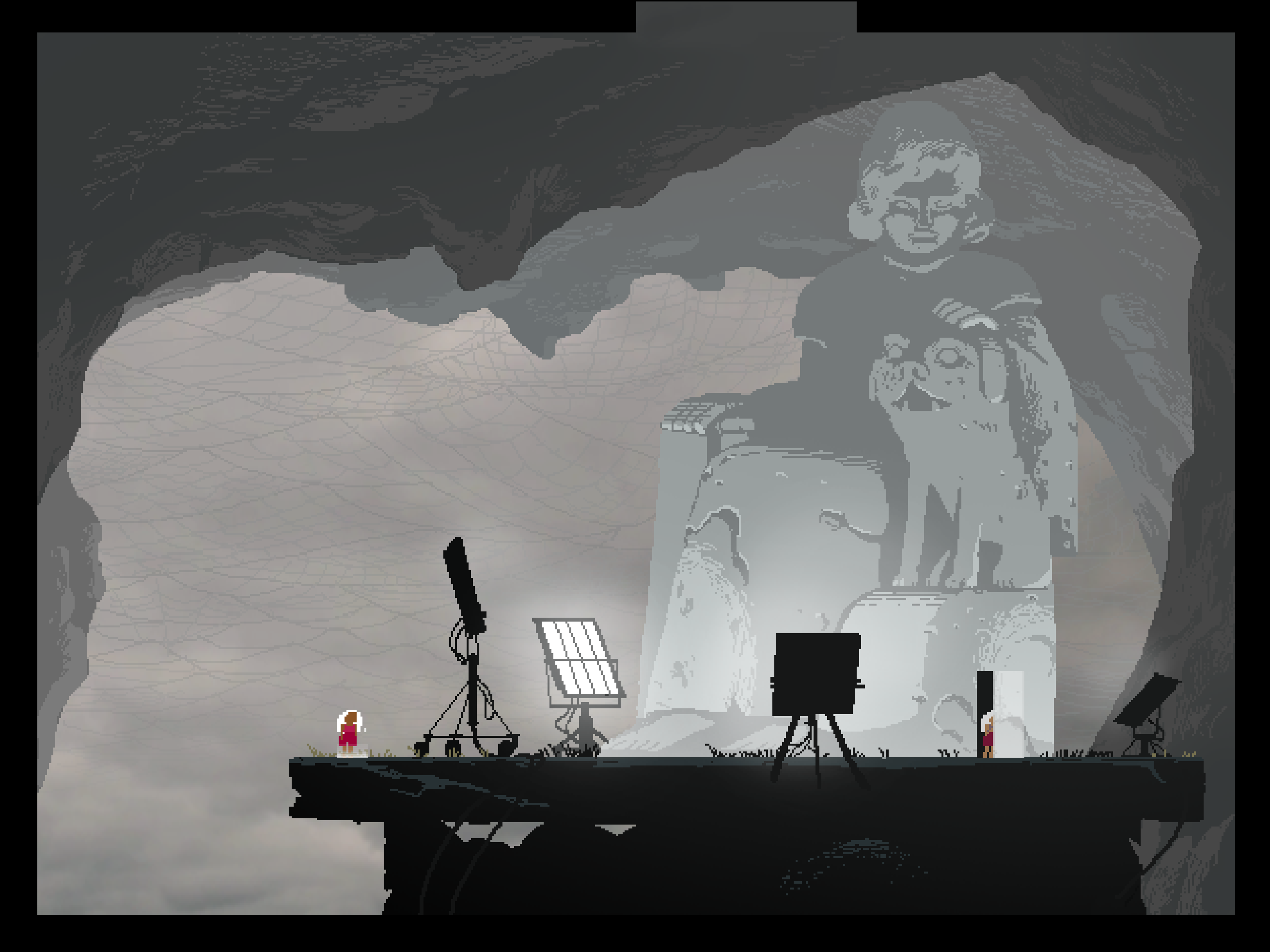
It’s part of the reason it’s surprising Love Eternal pitches itself as a game with a story. Stories yearn to be told in video games. And sure, Love Eternal has a “story” that’s part of the player’s experience, but also has a story story, one that’s told in beautifully drawn and creepy cutscenes.
It’s also a game that, later, features one of the most shockingly subversive sequences I’ve played in a game like this—or any game—in years. Spoiling the wow moment would do its surprise a disservice, but know that bypassing Love Eternal means missing a highlight moment.
(I'll have a piece about this you’ll-know-it-when-you-see-it bit later.)
Love Eternal is, in some ways, a spiritual and literal sequel to one of Alden’s previous games, Love, a platformer so demanding and exacting that no one beat it for seven years. A game without a plot. A game where players are tossed into the endgame deep end from the start.
“There was no difficulty curve,” said Alden. “It was just a linear line up, and it just didn't stop.”
If you put Love and Love Eternal side-by-side, you’ll notice similarities. In some cases, there are levels that look practically identical, only with new art. That’s because Alden opened Love and started to “sand down the rough edges and make it approachable.” Love Eternal ends up being a game made with years of hindsight about making Love, a game people largely couldn’t finish.
"The interesting thing about trying to learn something challenging is it’s this act of faith in yourself that if you put the time in, you will be able to do it. The type of challenges in platformers are really conducive to that experience, because you can really see yourself getting closer. You can see yourself making progress. There's this amazing sense of gratification when you actually get it.”
“Approachable” is probably not the right word for Love Eternal, however. But one person’s hard is another person’s cozy. You spend enough time in difficult games and start to lose perspective.
“The interesting thing about trying to learn something challenging is it’s this act of faith in yourself that if you put the time in, you will be able to do it,” said Alden. “The type of challenges in platformers are really conducive to that experience, because you can really see yourself getting closer. You can see yourself making progress. There's this amazing sense of gratification when you actually get it.”
I feel this. Confidence is not a trait I’d often use to describe myself, gaming or otherwise, but platformers are a genre where I have faith in my fingers, knowing that if I put in the time and effort, I will find a path. You feel this with Alden, too, as if the games they’re designing begin from the premise of crafting a puzzle that’s at the ends of their own skills. Then, they work backwards to where another player might finish it. Another player, though. Not all players.
“I’ve always liked hard games,” said Alden. “It’s something you can only do in games. When we talk about a movie or a book being difficult, it can be maybe challenging to parse, but it's not like you're actively being prevented from completing turning the pages.”
Perhaps books should invest in the idea of heavier pages to convey depth and nuance?
It’s not entirely clear what happens in Love Eternal. It’s more of a vibe, perhaps a reflection of the game’s own creative process, in which Alden and their primary creative partner, their brother, made up the story as they went along. The ending happened when, well, it happened. It’s the kind of game where you’re inclined to message a friend after, or go searching on reddit.
“There's nothing in the game that's this one-to-one analogy to an experience I had, or this is actually all a metaphor for X, if you decode the secret messages I’ve left in this game, this is what it's really about,” said Alden. “One of my pet peeves is when you Google any work that has any kind of subtext now, the third Google autogenerated answer is ‘What was the point of [INSERT NAME]?” [laughs] Oh my god, can we engage with the thing as it is?”
Okay, fine, I feel called out.
What’s fascinating about Love Eternal, though, is the story landing (or not) is icing on an excellent platforming cake. Love Eternal does not need a story to justify being worth one’s time, nor does it really crack structural issues preventing the genre from being useful for stories, but it’s a damn good, damn hard experience that ranks among one of the best platformers in years, and you’ll also be rewarded with delightfully weird and unnerving storytelling along the way.
“My intention for Love Eternal was like, it's not an easy game, but anyone who approaches it with a really sincere desire to finish it and is willing to put in the time will be able to,” said Alden. “Even if you don't play platformers normally, if you stick with it, you will be able to beat it.”’
That’s probably not true, but Alden believes it. And frankly, that belief, however naive, is part of what makes Love Eternal special.