This article involves heavy spoilers for the A Plague Tale video games.
A Plague Tale: Requiem is mostly known, understandably so, for its piles of endless rats. It is less known for having one of the most memorable—and upsetting—endings in a video game.
Trapped at the conclusion to a despair-filled adventure, one largely devoid of hope and mostly known for the suffering of its sibling protagonists trying to survive, is a scream-worthy finish, one that shatters a storytelling taboo that even most explicitly horror stories are unwilling to broach.
In Requiem, a child dies. More than that, you—the player—kill the child yourself. Worse, this child is your brother, and you kill him by tossing a rock at his face, as he begs you to end his life, knowing there is no salvation on the horizon. Death is an escape for him and everyone else.
As the rock lands, the screen uncomfortably snaps to black. It’s shattering. There are no words to describe how you’re supposed to feel—but the black screen suffices. There’s every reason to believe strangers on the internet leaving comments on videos of the ending where they say “I don’t usually cry but hugo getting killed broke me took 2 days off couldn’t focus on work.”
David Dedeine was co-creative director on the original game, before stepping back into an oversight role for the sequel. He returned to the creative director chair, however, for this year’s unsurprisingly excellent (and also very sad!) prequel game, Resonance: A Plague Tale Legacy.
“We're talking about the death of a child,” said Dedeine, who’s also the co-founder of A Plague Tale developer Asobo Studio, in a recent interview. “It’s a terrible thing, and we had to ask ourselves whether we were really prepared to portray something so difficult in a video game.”
Requiem itself is a sequel to A Plague Tale: Innocence, and both, over the course of a few dozen stealthy hours, tell the largely tragic story of sister and brother Amicia and Hugo. Set in an alternative Middle Ages, a monstrous plague is being spread by rats. Hugo has a blood connection to the rats by way of an old, ancient, and mysterious force called the Prima Macula, and much of their journey is a fruitless pursuit of a solution (or mitigation) to the Macula. It seems unlikely Hugo can be cured, but given the alternative, why wouldn’t you keep trying?
So they try. And try. And try.
It works, until the final sequence of Requiem. Hugo keeps the Macula at bay, from fully consuming him, because of Amicia. When Hugo wants to give up, Amicia carries him forward. But in Requiem, there’s a moment where Hugo is convinced Amicia is dead. His lifeline gone, Hugo’s will to live is sapped, and he becomes one with the Macula, its power fully unleashed.
Even in that daze, clouded by the Macula and becoming death (and rat?) incarnate, Hugo finds some resolve when Amicia shows up, anxious and desperate to find a path back towards Hugo.
“I’m sorry. But you’re ready now. To save everything,” says Hugo, after using his powers to have one last stroll with his sister, hand-in-hand, before asking her to do something unimaginable.
“Ready?!” shrieks Amicia, unwilling to process Hugo’s request. “How can I be ready for this?”
“I know,” he says. “But I can’t stop myself now. Only you can stop me. I love you. I’ve been happy with you. Goodbye, Amicia.”
“We're talking about the death of a child. It’s a terrible thing, and we had to ask ourselves whether we were really prepared to portray something so difficult in a video game.”
What happens next is a monumental ask of the player. They must move Amicia forward, watch as a parade of rats move aside, and engage, one last time, in an action they’ve done hundreds of times over the course of both games. Hold one button to pull back your sling. Then, release.
Pop.
“We hesitated a lot and, to be honest, we kept postponing the writing and implementation of the ending until very late in production,” said Dedeine. “We knew some players might hate us for making them experience that moment.”
In a sense, the game does provide players with an alternative. There’s no way to save Hugo, but if you can’t kill him yourself, another character bravely steps forward. (It feels less impactful.)
Dedeine said Hugo’s death wasn’t inevitable, but even in the earliest days of breaking the story for Requiem, it was “on the table.” And as morbid as Hugo’s ending is, as much as it asks the player to be the one to pull the metaphorical trigger, it brings the series’ unique mixture of hope and sacrifice full circle. The reason you’re playing Requiem is because the struggle is the point.
“It was difficult for us to imagine a truly happy ending for Hugo,” said Dedeine. “In our minds, his death felt consistent with the universe we had created and with the journey of the characters. Any other conclusion might have felt forced.”
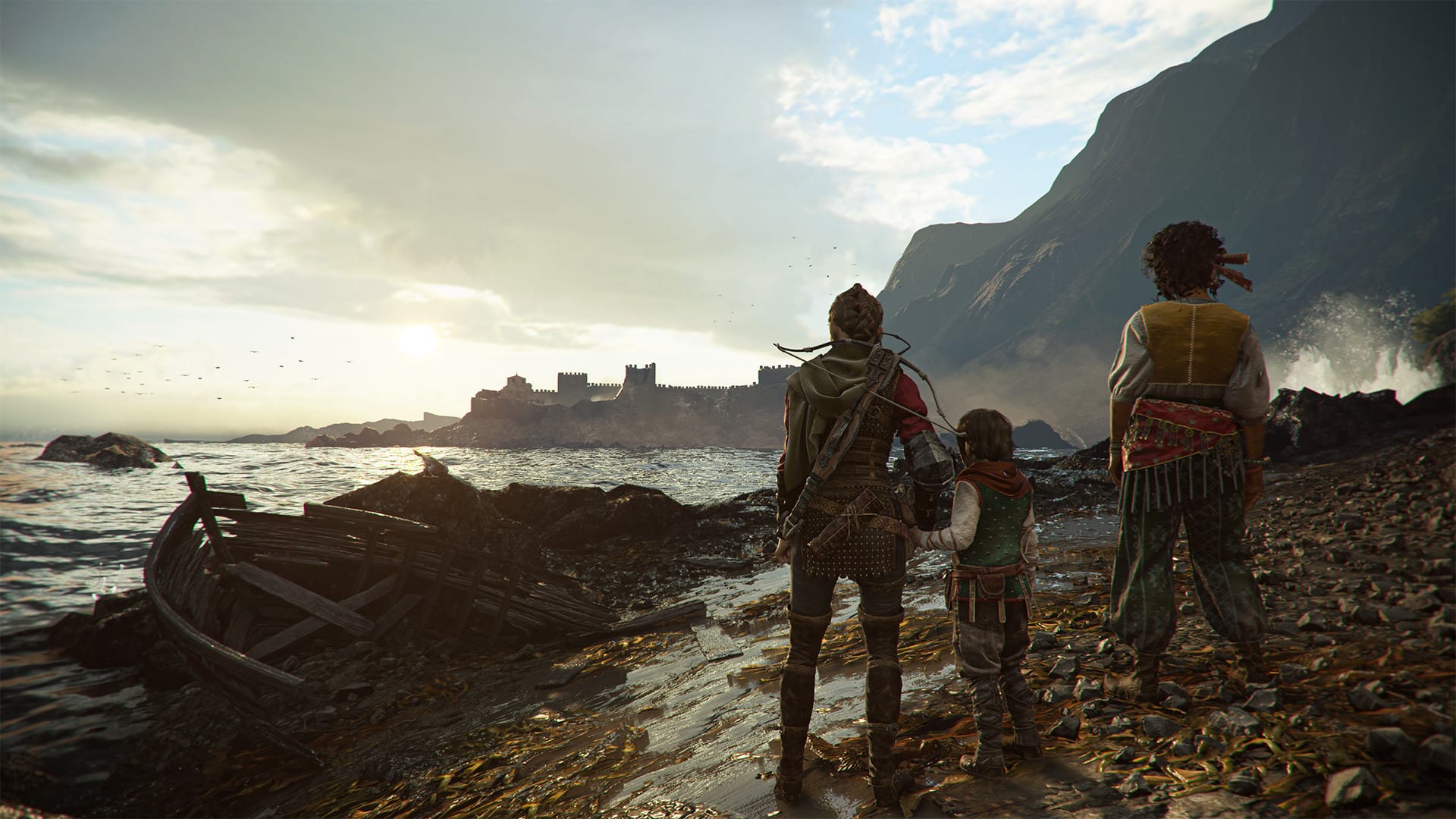
The question for the developers at Asobo, then, became not if, but how Hugo would die.
“We didn't invent the idea of a character becoming so powerful, or so dangerous, that someone has to stop them,” said Dedeine. “But having Amicia be the one to make that choice, even if players can refuse to act and let someone else do it, makes the cost of that decision much more personal and tangible. It also says a lot about Amicia herself. Throughout the series, she is willing to do absolutely anything to save her brother. In the end, that love leads her to the ultimate sacrifice: accepting that saving him means letting him go. For us, it was another way of staying true to the character.”
Equally in line with the series' themes, the death of Hugo does not mean the world is saved. It’s a patch, a balm. The Macula dealt with but not defeated. Hugo, at least, can rest. Amicia can try to piece together another life. Whether or not it involves the Macula is, in this case, her decision.
Hugo’s death, however it happens, is not a decision or the player. It’s required. It’s also why Requiem’s ending endures—lingers, even—years later, because of its unconventional weight.
“I think the reason the ending stays with people is that we remained honest with our characters and with the story we wanted to tell,” said Dedeine, “even when it was painful for us too.”