
Swim in the Wreckage: Subnautica 2 Early Access

Featured Review
Bruno Dias

Not far from the start of Subnautica 2, you'll encounter a shallow patch of seafloor covered in a homogeneous forest of huge, spiraling pink coral. When you see it for the first time, the PDA—the game's ubiquitous computer voice—will chime in to remind you: "Simple ecosystems are often a sign of ecological distress."

The waterlogged moon the game is set in, Proteus, is dying. But it's also trying to kill you, from the very moment you land. While the original Subnautica had the protagonist infected with the Kharaa bacterium—a nod to the Natural Selection series that made Unknown Worlds' name as a studio—on Proteus, the world itself is poison; the ocean water is full of heavy metals. I mean, there is also a virus that drives you to madness. But the suffering starts with lead and cadmium.

Subnautica was never really a horror game to me; I do not have a deep fear of the ocean and my reaction to having my submersible grabbed by a Reaper Leviathan was always "oh, this asshole again." I loved that game, and the somewhat-maligned sequel Subnautica: Below Zero, but never for the sheer terror that others seem to experience.

But Subnautica 2 does feel more like a horror game to me, not because of its blunt-headed sharks or aggressive giant squid, but because the storytelling has embraced existential and ecological horror in a way I really never expected it to.
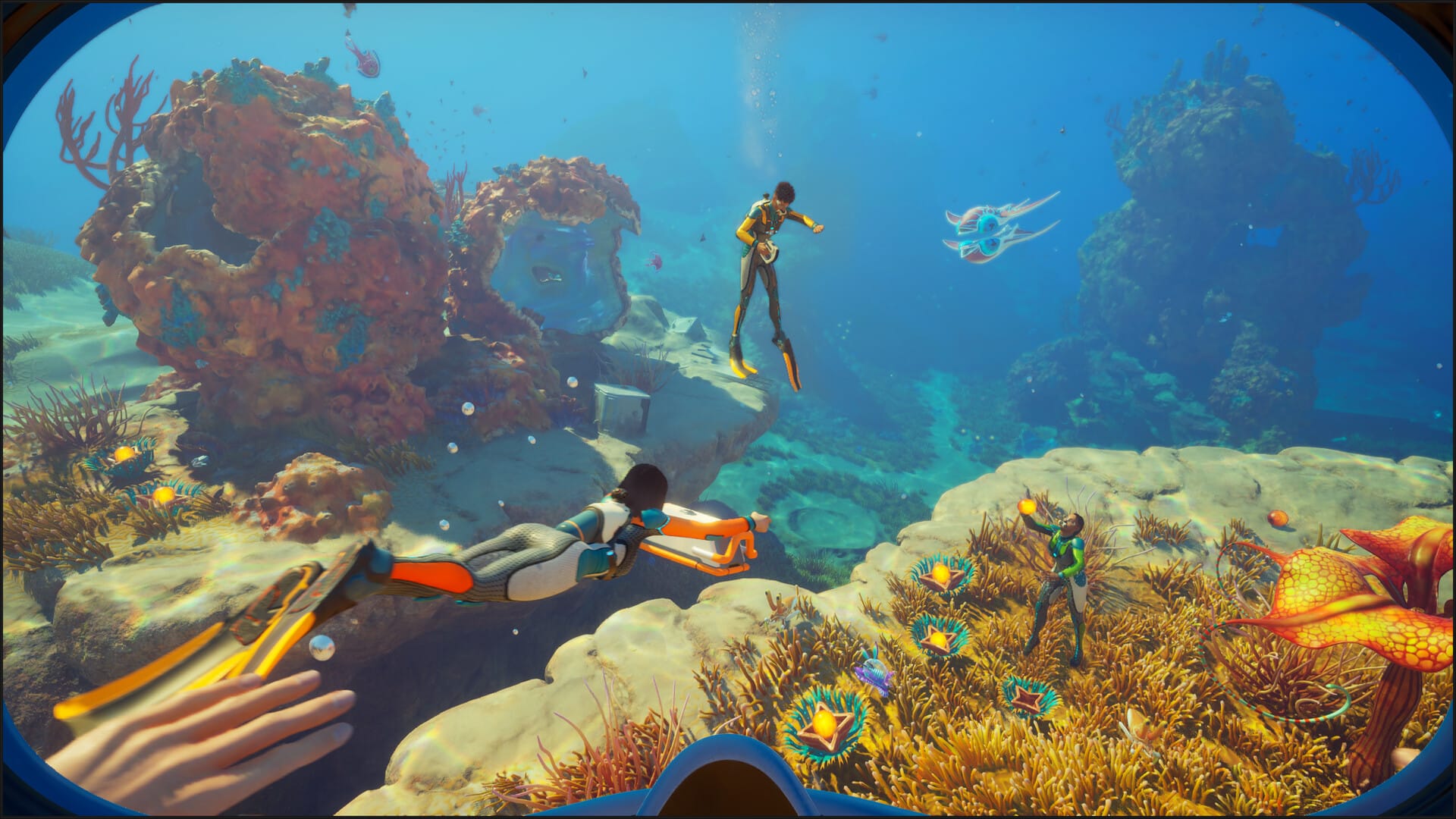
Through a scuba mask a group of swimmers cavort around a reef.

In a way, it's a deliberate pushing back on what this game could be, in less thoughtful hands: an exercise in adventure tourism, one that treats its world as a cool-looking place to explore and nothing more. Colorful underwater vistas, imaginative speculative biology, and a dash of deep-ocean terror—that's the formula, and they added a co-op mode. That would have been an easy sell, and in fact if you watch the original teaser trailer, that's what's being sold: "You like Subnautica? Here's more of it."

I'm perfectly happy to trot up to the trough for that. The game certainly is that; there's a whole new world to explore, but the ways and means are very familiar. You break distinctive mineral deposits to collect resources to build bases, submarines, and tools. Those enable you to go further and deeper in search of more crafting recipes and more exotic resources to build them with. Along the way, you encounter a story told through audio logs, environmental storytelling, and the semi-helpful commentary of the PDA.

But Subnautica 2 is more narratively ambitious than that. The original Subnautica was, tonally, a gentle bit of sci-fi. The Kharaa bacterium that infects the planet's ecosystem is doing real damage, but the game is set in a lush pocket of life surrounded by a vast ecological dead zone. The disease looks exactly like you imagine a sci-fi space disease would look like: glowing green boils that grow out of the skin of sea life and, eventually, the player character. The Alterra corporation that operated the crashed spaceship is comically evil, but the emphasis is on comically evil; when you first pick up a diamond in that game, your PDA reminds you that all the resources you've gathered so far are corporate property, and you owe them around a trillion credits.

In the sequel, however, the "proteavirus" wrecking the moon's ecosystem doesn't look like a goofy space disease that makes you turn green. It looks like coral bleaching. The forest of pink jellies is explicitly compared to an algae bloom. The lush life you see around you is an illusion: this ocean's trophic chain has collapsed, its original energy source seems to have disappeared. What remains is sustained only by eating the dead, an ecological pyramid scheme.

Bioluminescent sci-fi critters hanging out on rocks near at the bottom of the ocean.

The doomed colonists of the Cicada, the ship diverted from its original destination to crash land on Proteus, are very literally out of their depth; they thought they were going to a desert planet. They're bound in eternal servitude to Alterra: When they die, they are "reprinted." Being reset to a known good state is sometimes their only way of dealing with the inevitable starvation and heavy metal poisoning.

Subnautica 2 is far from the first video game to treat its respawning mechanic as a diegetic story element—System Shock did it 30 years ago—and it's not the first game to play this idea for existential horror. But here it treats it as a social horror too; the eternal cycle of digital reincarnation is an instrument of control over the colonists. The patronizing AI that runs the show chooses who to reprint, and whether to roll them back to a more compliant version of themselves.

Said AI explicitly positions the player as the one responsible for fixing things, rescuing the colonists—who, though not physically present, might still be restored from digital backups—and guaranteeing that a "human future" exists on Proteus. But of course, what that future looks like is questionable at best; unceasing digital servitude on a relentlessly hostile world at the behest of a corporation. One of the factions among the colonists is downright hostile to the idea of humanity, which to them means only rapacity and eternal grinding misery under techno-capitalism. I can't say I really blame them.

The world of Subnautica 2 feels messier. The colorful coral reef of the early shallows is very quickly dotted both with signs of ecological distress and the broken ruins of the failed colony. It's a more serious game; there's still humor, but it's laced with disquiet. It's reflective of greater ambition—this is a follow up to a hugely popular game, and it feels natural that it's a bit self-serious.

A sleek underwater base surrounded by marine life and lit by exterior floods.

But it also tracks with the times. When the original Subnautica came out in 2014, the idea of corporations putting people into debt bondage was a sci-fi trope. Nowadays not only does it seem like tech industry executives want to be able to buy you as a slave, they also fully believe they'll be able to keep your consciousness backed up in the cloud working for all eternity.

If the new game treated ecology and economics the way the first one did, it would risk seeming toothless and soft—god forbid, cozy. This new level of narrative ambition is at once surprising but also entirely necessary.

The writing here is very attuned to these ideas, and there is quite a lot of story material. As in previous games in the series, you only encounter its characters through the messages they leave behind; many of them are "black boxes", automated recordings of their last moments before death. But there's an unusually large cast with an intricate web of relationships and subplots, and the game world is more densely packed with this material than even the fairly story-heavy Below Zero. What's currently available in Early Access took me just shy of fifteen hours to complete, and it felt like only the first act of a story, but it still had almost as much story material as the entirety of Below Zero.

The open question, at this point, is how all of this story is going to hang together and pay off while the game still sticks to the structures of its predecessor. Like in the original Subnautica, you are tasked with solving Proteus' ecological collapse—a goal that is both normal to want and reasonable to achieve. This is done by clambering your way up the game's tech tree, which opens up both access to more parts of the game world and the tools needed to unlock its secrets.

This could, again, easily feel too facile; all it takes is someone with the right space doohickey to come make it all better. But Subnautica 2 has a specific twist on this formula: A lot of what you collect in this game are not blueprints for new gadgets, but alterations to your own biology that let you survive and explore Proteus.

By leaning into this idea of change and adaptation, the game seems to be threading the needle of keeping the systems and structures that the audience expects—exploring to advance through the tech tree—while giving it a new thematic heft that fits with the changes in tone and storytelling.

This is still, essentially, collecting upgrades and climbing a tech tree; the structure hasn't been meaningfully escaped. But I don't know that it needs to be. The game seems to be pointing towards the idea that a "human future" on this world doesn't necessarily involve a very recognizable humanity.

A Remap evaluation card indicating Subnautica 2 has both art and graphics, audio rather than sound, is fun more than cool, has a raison d'etre, and possesses that je ne sais quoi.

State of the Build, 26 May 2026:

It's a good sign how self-assured the story direction is here. Subnautica: Below Zero had its story more or less completely rewritten in early access, which I can't imagine is going to be the case for this sequel unless something goes very wrong. At the same time, what is here at present feels very much like a curated and guided experience meant to drive home these thematic ideas as much as anything.

There's no sidetracking in the release early access build of Subnautica 2; the world is a pretty linear sequence of locations that you will visit more or less in order, and all of them are involved in progressing to the current end of the available narrative. So the experience of picking a direction and seeing what's there, or finding yourself in a biome you're not really prepared to encounter, aren't available yet. And while the narrative feels self-assured, it certainly still has gaps; the world is punctuated with what look very much like future locations for more exploration that are presently sealed off.

Mechanically, too, this is typical early access in that things are present but not necessarily tuned. Damage numbers are all over the place—some predators do so little as to be functionally nonthreatening, but their aggression is through the roof regardless. I did, of course, encounter bugs, but nothing showstopping; a particularly funny one is that sometimes upon returning to base, my submersible would suddenly teleport to its dock from 100 meters away.

Ultimately, as you might expect, this is far from finished and is more like a preview of things to come. But it's a very well-constructed and encouraging one, and if nothing else I am now looking forward to a very different Subnautica 2 than the one I had in my head before playing this early access release.

Share
Success! Your email is updated.
Your link has expired
Success! Check your email for magic link to sign-in.