Ukrainian studio Frogwares were originally known for their long-running series of Sherlock Holmes games; when the original The Sinking City was announced in 2016 it seemed a perfect fit for them. A framework of mystery or investigation is really the natural fit for game adaptations of HP Lovecraft’s stories; the classic tabletop RPG Call of Cthulhu calls its player characters “investigators” for a reason.
While Lovecraft gets lumped in with the horror genre he helped codify, in truth his work owes as much to turn-of-the-century fantasy writers like Algernon Blackwood and Lord Dunsany—and to the mystery genre. As critic Mark Fisher points out in The Weird and the Eerie, Lovecraft’s protagonists are often terrified, but the reader seldom is. Where the reader and the protagonist align is in the fascination that the weird and otherworldly exerts on them. Lovecraft’s central theme, the weird—the alterity of the unknown found outside everyday experience—both repels and compels our attention; his protagonists are undone by their fascinations, driven to madness by their obsessions.
In the original Sinking City, this manifests as a detective game in which the player’s curiosity is double-edged; poking and prodding at the game’s nooks and crannies is the point, but it also gradually unravels the protagonist’s fraying sanity.
The Sinking City 2 is an ambitious departure from the first game, and not a direct sequel at all. Rather than a detective game with action elements, it entirely embraces survival horror specifically in the Resident Evil mode. There are doors locked with themed keys; there’s combat that emphasizes resource conservation; there are large levels full of looping paths to backtrack through—while the first game was an open world, Sinking City 2 is split into a handful of fairly large chapters that feel very much like the sections in something like Resident Evil Village. There’s a map with rooms that turn blue when you’ve found everything they contain. There’s lugging around a pair of bolt cutters that take up too much space in your inventory, so you can cut padlocks off doors.
On its Steam page, The Sinking City 2 explicitly bills itself as "a survival horror steeped in Lovecraftian dread." And that’s where its problems begin. “Lovecraftian dread” is very hard to define, mostly because—again—there really isn’t much of it. Lovecraft traffics in obsession, in horrifying fascination, in revulsion, sometimes in white-knuckle terror—but he really doesn’t do dread; the man couldn’t sustain tension to save his life. But a survival horror game lives and dies by its sense of tension; those are games where safety—here, yes, present in the form of “safe rooms” with a teleporting inventory stash and a save point—is rare, where you’re meant to never feel like you have enough ammo. They’re games about feeling stalked and accosted, about being in unstable spaces.
The Sinking City 2 delivers a too-faithful rendition of this kind of play. This game is not shy about its zombies, whose nature and visuals are very much in line with things we've seen in Dead Space and Resident Evil. Corpses that litter the game's levels come to life at opportune moments, or simply come crawling in through holes in the walls. The game loves the level design device where making progress—finding a key item, solving a puzzle—is immediately rewarded with a small gaggle of zombies spawning in behind you. It is also very much a game in which combat revolves around the ammo economy. On the normal difficulty setting, it expects you to really get the most value out of every precious bullet, using guns to stagger enemies as much as kill them, finishing them off with melee attacks and a dedicated curbstomp button.
Survival horror games often have an element of treating the space as a strategic problem to solve; how to get from point A to point B while minimizing risk and cost. The Sinking City 2's levels feel much more like linear sections have been carefully assembled into a single space, using one-way passages, keys, and locks to constrain the player into long loops that function as sub-levels. There's significant backtracking, but rarely is there interesting choice in how to reach a destination.
Those loops often lead back to exactly where you need to go next, especially in the game's two largest levels—one set in a decaying hospital, another in a ruined fish market. It sometimes seems too perfect, too clever by half; functional, but lacking in surprises or wrinkles. The effect of much of what this game is doing feels a bit like a very technically competent cover band.
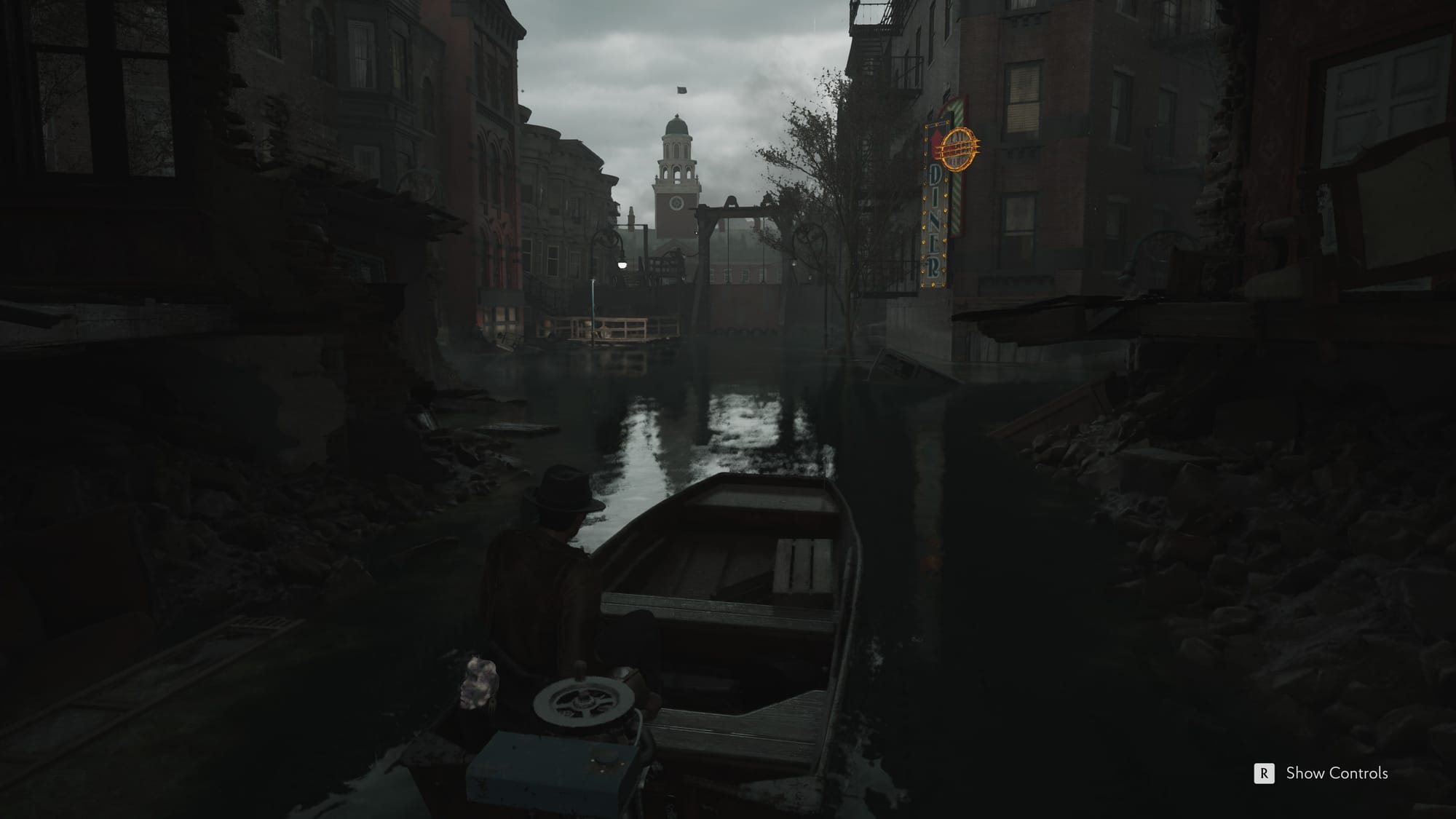
While the approach to survival horror feels a little unimaginative, the approach to Lovecraft feels like the product of a very deliberate conceptual push. It’s a beautiful game—one of the best looking AA games I’ve seen in a while. Its vision of a weird, eldritch Jazz-age New England is very heightened, the kind of game space where you’ll find posters advertising elements of the plot. The game’s idea of a save point is a fanciful gramophone with a giant conch shell for a horn. There’s an effort here to create a sense of the weird; Arkham is portrayed as a sort of Miévillean place where all of the weirdness from all of Lovecraft’s stories collides, a city whose strangeness is its identity. It is also, of course, a flooded ruin crawling with wet zombies.
Signing up is free!
By signing up—again, it costs nothing!—you can read the rest of "Survival Horror and Lovecraft Clash in The Sinking City 2," and receive free newsletters and emailed articles from Remap!
Sign up now Already have an account? Sign in