
Seeing this in motion is as gorgeous as you might desperately hope.

Every Good Story Needs a Banging Soundtrack

Featured
Patrick Klepek

Johnny Galvatron, lead singer of the long running Australian rock band The Galvatrons and creative director of a new and beautiful coming of age story Mixtape, once also gave a girl a carefully crafted mixtape in high school. It was a collection of mixtapes, actually, and part of a misguided gesture in a courting process with the girl who would become his wife and mother to their child. 

“The first mixtape I gave her was a very, very sad excuse of me trying to make a mixtape of the music she would like,” admits Galvatron, whose actual name is Jonathan Mole. “Has nu metal started? I might [have been] listening to Limp Bizkit.”

He had no idea what girls were listening to, let alone his wife. But it proved memorable, and crucially, it’s a story she hasn’t forgotten. They’d talked about it the night before our interview. 

Moments like that—making emotional mountains out of molehills—are what Mixtape is about.

Mixtape is a new game from Beethoven & Dinosaur, the studio behind 2021’s whimsical musical adventure The Artful Escape. Now, tell me if you’ve heard a version of this story before: three outcast high school students—one boy, two girls—are best friends preparing for a party on the eve of the rest of their lives. Stacey, who lives with headphones on, has splintered the group r because, in the morning, she leaves for New York on a quest to become—gasp—a music supervisor. For years, she’s talked about going on a road trip with Slater and Cassandra. Instead, she’s going out of town. 
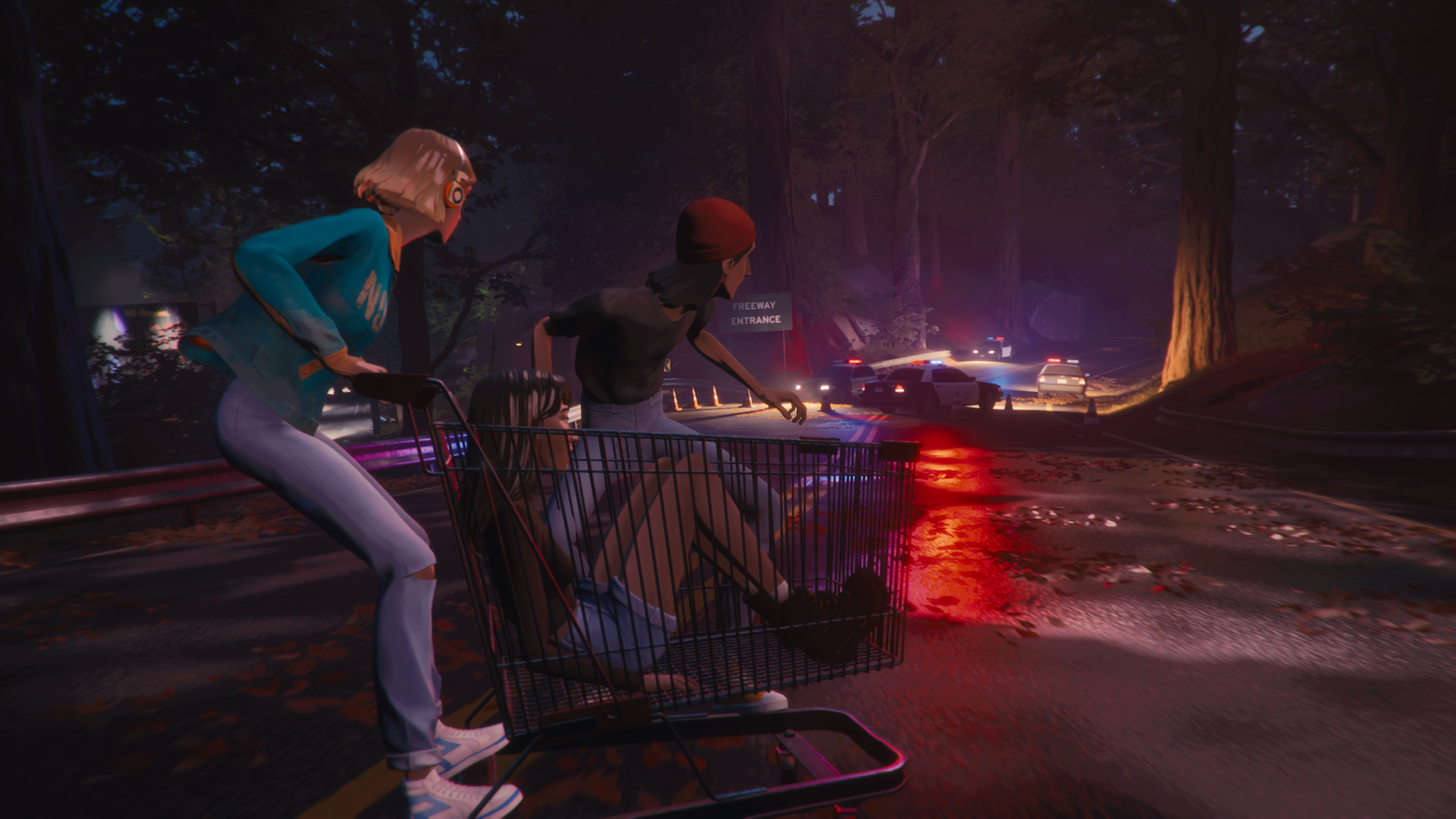
A screen shot from the video game Mixtape
In an era of Jackass, who among us has not thought about inner Johnny Knoxville?

For now, there’s a party—and you can’t have a party without booze. It’s Life Is Strange (absent the supernatural) by way of John Hughes. 

“Every day is the biggest day,” said Galvatron. “The highs are the highest and the lows are the lowest—because you're a teen. You don't know anything else. You're not paying bills. You don't need to rest for the weekend. You can just live your life. […] There's something so pure and wonderful about kids who define themselves by the art that they like and just like…”

“Just being into something,” chimed in the game’s producer, Woody Woodward.

“Being into shit is cool,” said Galvatron.

art19:a740e52f-7710-41c0-a3a5-688ee1f6aa08

Mixtape is not a game with a game over screen, and it’s primarily a story about Stacey, Cassandra, and Slater grappling with a friendship that’s on the verge of changing forever. But for now, in this one moment, it can be exactly how it always was, which is spending most days thinking about music, listening to music, and, when possible, partying. 

“The thing that's interesting and heartfelt and persuasive about coming of age stories is that things are universal,” said Galvatron. “These feelings of inadequacy or feeling left out or looking to find your place—or being obsessed with music. These things are what makes being a teen interesting and those coming-of-age stories interesting. Universality. […] Not really the setting or the time. It's showing that people's experiences are the same, no matter the era.”

You experience most of Mixtape through a series of vignettes that fill in the history of the group and their dynamics. What things were like when it was just Stacey and Slater. Why Stacey’s sister is so important. The irresponsible antics all of them could—and did—get up to. What happens when, in the immortal words of The Real World, friends “stop being polite and start getting real.” They yell. They scream. They say deeply hurtful words they don’t even mean.

Early on, for example, is Stacey’s first kiss, at which point Mixtape has you controlling two unsettlingly realistic tongues with analog sticks. It’s gross, and naturally, someone has braces.

“The braces were a later addition,” noted Galvatron. 

“Every day is the biggest day. The highs are the highest and the lows are the lowest—because you're a teen. You don't know anything else. You're not paying bills. You don't need to rest for the weekend. You can just live your life. […] There's something so pure and wonderful about kids who define themselves by the art that they like

Most people experience Stacey’s own revulsion in the moment and exit the interaction quickly. (Calling it a mini-game isn’t accurate; it’s a way to express the awkwardness in the language of games.) But there’s an achievement for sticking around longer, and Galvatron said Double Fine founder Tim Schafer played with the tongues for 15 minutes to see how the sequence worked. 

The scenes are often surreal (flying about on the way to a cool hangout spot on the other side of a windy field on a sunny day) and filled with half truths—not lies, exactly, but the way you mostly remember the emotional beats of a story, rather than all the fine details. Mixtape taps into those emotional beats and tries to give you a reason to be experiencing them through a video game.

One notable moment has the group rocking out in the car, and the player’s interactions blend seamlessly between turning the lights on and off, tapping the side of the car, or head banging. 

It’s simple, effective, and effectively captures an irresistible evening of youthful nothingness. 

Another has players using a shopping cart to sneak a friend who’s had too much to drink out of a party in the process of being busted by the cops, only for the shopping cart to go barreling downhill and result in a high-speed chase. The chase? Probably didn’t happen. The shopping cart, though, was directly pulled from an experience Woodward had as a kid, wherein he’d spend weekends on a friend’s farm “getting towed around in the shopping cart behind their dirt bike” before getting grossed off and falling into exactly what you’d imagine on a farm: cow shit.

(They do not fall into cow shit in Mixtape. They do fall into something else, though.)

“There's obviously brilliant games out there that are you know about overcoming hardship and overcoming obstacles and perseverance through difficulty,” said Galvatron, “but in some of the stuff that we like to try and do is like—what is it like to be betrayed by your friend how do you express that mechanically? How do you express teenage freedom mechanically?”

One way the game tries: inputting a Konami code-esque bit for a secret handshake. It rules.

It’s also drop dead gorgeous, pulling on the iconic “2.5D” and “on twos” animation style of the excellent Spider-Verse animated films, and has an abso-fuckin’-lutely banging soundtrack.

Mixtape is as defined by its soundtrack, and the respect it has for the idea of loving music, as anything else. It cares as deeply about its songscape as any music rhythm game. (There's not even a "streamer mode" to hide the licensed music, because "music is the soul of Mixtape.") The game announces a new licensed track, as though you’re tuning into an episode of MTV’s TRL to hear from Carson Daly about how Jamiroquai’s “Deeper Underground” is debuting on the Godzilla soundtrack and about to be the soundtrack to your whole summer, you just don’t know it yet.

"When we were starting Mixtape, I saw this photo of this girl dancing,” said Galvatron. “She had her eyes closed—just listening to the music. I remembered when I was a scene kid. I would hang by the stage door at the Metro in Melbourne to meet bands, or I would sell the t-shirts there for bands, or I would make posters for when they were coming through town. I loved being a scene kid.”

It’s not just a soundtrack, either. It’s not just chasing a vibe. The music informs the gameplay, weaving between the familiar beats and guitar solos. The sequences would be entirely different with another song; it would be communicating something else. Which is why Galvatron was so excited when Devo, his all-time favorite band, agreed to be part of the Mixtape soundtrack. 

A photo from the movie The Breakfast Club
The Breakfast Club was set in the 80s, released in the 80s, and parts have aged exactly as poorly as you might imagine from that description, but at its core is a timeless story.

“That’s Good,” which Galvatron called a “religious object,” lovingly opens the game, as the trio recklessly skates downhill. It feels like a piece of clothing for Cassandra, Stacey, and Slater. 

“Devo skateboarding down a hill into town and clapping along to Devo works beautifully,” said Galvatron, “But that's not going to work to Roxy Music, it's not going to work to Silverchair. You have to have these different elements, and that's when the gameplay became a mixtape just as much as the music.”

To that end, early in the development process, Woodward said the game ditched the idea of a “vertical slice,” a highly polished section of a game meant to represent what the whole game might eventually look like, in favor of a “horizontal slice,” a rough version of every musical beat.

“That helped us get the tracks in the right order for the right memories and stuff, because the pacing is such an important thing,” said Woodward. “Then, we went through and started standing up the gameplay and the visuals in each section. Does this song still fit? Is it still giving us the emotions and the vibe we want? Most of the time the answer was yes. And then we just made a great video game.”

“You just hit the game part—the tools—and then it's just a video game,” said Galvatron.

Much like becoming an adult, you just blink—and then it all happens.

And what happened, ultimately, was Beethoven & Dinosaur delivering one of the best, most bangin', and most vulnerable videos games of the year.

Patrick Klepek (he/him) is an editor at Remap. In another life, he worked on horror movie sets, but instead, he also runs Crossplay, a newsletter about parenting and video games. You can follow him on TwitterThreadsMastodon, and Bluesky.

Share
Success! Your email is updated.
Your link has expired
Success! Check your email for magic link to sign-in.